

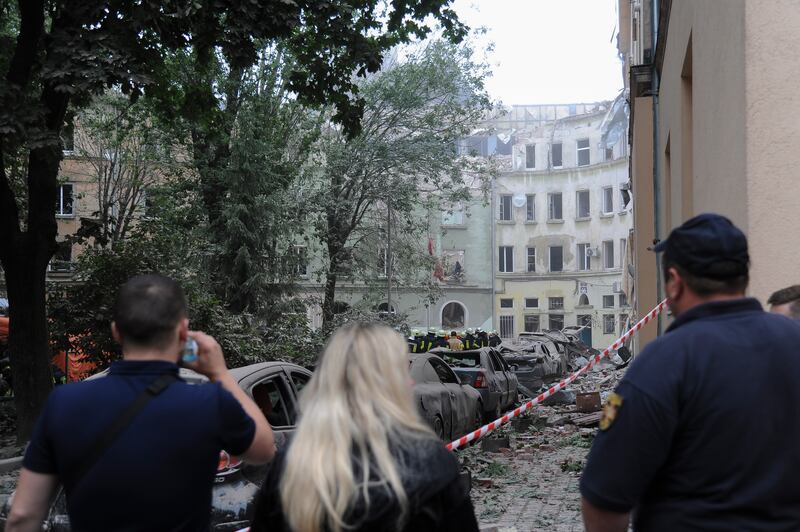

A Russian missile strike attacked Lviv, Ukraine, early Thursday, hitting a residential apartment building, killing at least four people and wounding more than 30 others.
“This is the largest attack on Lviv’s civilian infrastructure since the beginning of the full-scale invasion,” Andriy Sadovyi, Lviv’s mayor, said in a video on Twitter, per The New York Times.
What happened with the Russian missile strike on Lviv?
Sadovyi said nearly 60 apartments and 50 cars were damaged in the attack. Ukraine’s military said Russia fired 10 Kalibr cruise missiles from the Black Sea toward Lviv, and Ukraine was able to intercept seven of the 10, according to The Guardian.
Ukrainian President Volodymyr Zelenskyy responded to the attack, writing on Telegram, “Unfortunately there are wounded and dead. My condolences to the relatives! There will definitely be a response to the enemy. A tangible one,” per Twitter.
Rescue crews are still searching for survivors in the rubble, and “emergency services said they had managed to rescue seven people from the rubble and evacuated 64 others,” per Reuters.
Where is Lviv, and why did Russia attack Lviv?
Lviv is located in the western region of Ukraine. At the beginning of Russia’s invasion, it “was considered relatively safe given its proximity to the border with Poland, a NATO member,” per the Times.
Vira Luben, a Lviv resident in her 70s, told Reuters that Russia will “say that they are bombing military objects but they hit a peaceful house.
“People were sleeping,” Luben told Reuters. “How could they do it?”
In the early days of the war, Lviv was considered a critical transit city for refugees hoping to flee Ukraine to Poland.
The city is more than 300 miles away “from the frontlines of the war in eastern and southern Ukraine, where Kyiv’s counteroffensive to dislodge Russian forces is in its early stages,” The Guardian reported.