

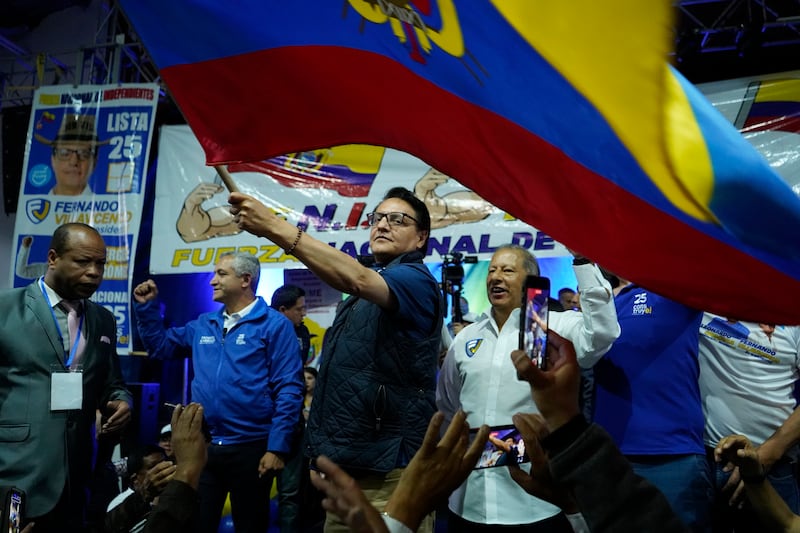

Presidential candidate Fernando Villavicencio was shot and killed Wednesday while leaving a campaign rally. Villavicencio spoke out about corruption and was a leader that alleged there were connections between organized crime and government officials.
The criminal gang Los Lobos, or “The Wolves,” claimed responsibility for the shooting, according to BBC.
Villavicencio was speaking to young supporters and “was gunned down” after leaving a high school in Quito, The New York Times reported. One suspect was killed after the shooting, and reports say nine other people were shot in the incident.
According to Reuters, 30 shots were fired, and “video footage posted on social media showed Villavicencio getting into a car after the event, before the sound of apparent gunfire and screaming.”
“When he stepped outside the door, he was met with gunfire,” Carlos Figueroa, who worked for Villavicencio’s campaign and witnessed the shooting, told The New York Times. “There was nothing to be done, because they were shots to the head.”
It’s the first time a presidential candidate has been assassinated in Ecuador, and it took place less than one month after the mayor of port city Manta was also fatally shot during a public appearance, per the Times.
Three of the other presidential candidates, Jan Topic, Yaku Pérez and Bolívar Armijos, announced they would be suspending their campaigns shortly after the assassination of Villavicencio, The Washington Post reported.
Within 48 hours last week, Villavicencio reported his campaign received two death threats, “including a message from someone claiming to have ties to a leader of one of the most powerful drug trafficking groups in Ecuador, Los Choneros,” per the Post.
Who was Fernando Villavicencio?
The presidential hopeful formerly worked as a journalist, covering investigative work. He also previously worked as an adviser to National Assembly member Cléver Jiménez, and “became a fierce critic of then-president Rafael Correa,” accusing the president “of ordering an armed incursion at the hospital” in 2011. After the accusations, Correa sued Villavicencio and Jiménez for libel, and both of them received 18-month prison sentences, with Villavicencio “hiding out in the country’s Amazon region until the end of his sentence,” the Post reported.
“Ecuador has become a failed state,” Correa stated Wednesday night, per the Post. “Our homeland hurts. My solidarity with his family and with all the families of the victims of violence.”
Villavicencio was 59 years old before being killed and was polling in the middle of the pack in the eight-person presidential race. The presidential hopeful advocated for fighting against corruption and argued that drug trafficking was a key catalyst to violence and other crime in the country, telling CNN in May that the country had become a “narco state.”
What is going on in Ecuador with narco-trafficking?
Ecuador is saddled between “the two largest narcotics productions hotspots in the world: Peru and Colombia,” and while the country hasn’t historically produced cocaine, it “has become an integral part in the lucrative trafficking routes from South America to North America and Europe,” CNN reported.
It was previously considered “a relatively safe nation,” but in the last five years, it “has been consumed by violence related to narco-trafficking,” according to the Times.
What happens next after Ecuador’s Fernando Villavicencio was killed?
Ecuador’s current president, Guillermo Lasso, declared three days of mourning and a national state of emergency, a move that he says will mobilize the military and guarantee security, per Reuters.
“This is a political crime, which has the character of terrorism, and we do not doubt that this murder is an attempt to sabotage the electoral process,” Lasso said in a video statement late Wednesday night, per Reuters.
The first round of the presidential election takes place Aug. 20 and will continue as scheduled, according to Electoral Council President Diana Atamaint, CNN reported.