

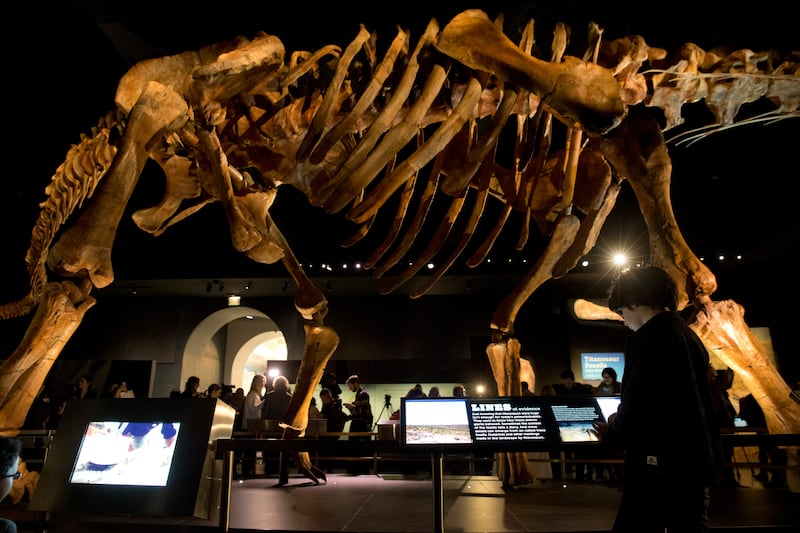
A man in France can now share with the world that he found a semi-complete dinosaur skeleton while walking his dog, according to The Washington Post.
Back in 2022, Damien Boschetto decided to go on a walk in Montouliers, France, with his dog, Muffin, when he saw a giant bone sticking out of a cliffside.
What dinosaur did they find?
According to Business Insider, Boschetto and a paleontology team found a 30-foot-long titanosaur, a type of sauropod. The titanosaur lived during the Cretaceous Period and is one of the largest species of dinosaurs ever discovered, according to the American Museum of Natural History.
Paleontologists know of more than 30 types of titanosaurs, with the largest measuring up to 85 feet long, per The Washington Post. To avoid having looters at the site, Boschetto and the paleontologists kept their discovery a secret until they were able to excavate the whole skeleton, per Business Insider.
What will they do with the fossil?
What makes this discovery astounding is that finding titanosaur bones in Europe is rare, and as Boschetto excavated the bones with a team from the Cruzy Museum, it became an even rarer find when they found most of the skeleton intact, per The Washington Post.
“The skeleton was buried in a sediment layer of hard-packed sandstone, requiring a slow and deliberate process to extract it. According to Boschetto, it is missing the skull and a femur, which the team hopes to locate in future excavations,” according to The Washington Post.
Business Insider reports that this skeleton will be put on display at the Cruzy Museum once paleontologists finish studying it.
Scientists have found other fossils from titanosaurs. According to the Natural History Museum in London, it has fossilized eggs of a titanosaur that were found in India a couple of centuries ago.
For Boschetto, this find has changed his life. The Washington Post reports, “In September, Boschetto left his job in the energy sector. With paleontology as his passion, he applied to a college in Paris that has a campus in Cruzy in order to turn his avocation into his vocation. ‘I would like to join the Ecole Pratique des Hautes Etudes to obtain a master’s degree in paleontology to promote my work,’ he wrote. ‘This discovery strengthened my involvement in scientific research and in my resumption of studies in paleontology.’”