

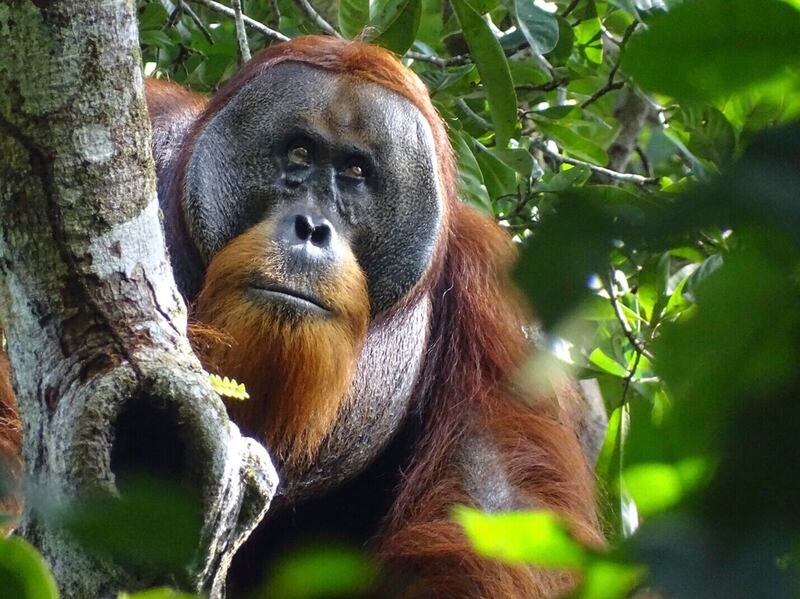
Researchers have seen what may have been the first documented event of an orangutan treating a wound using a known medicinal plant, according to a new report published in the journal Scientific Reports.
The orangutan, located in Sumatra and nicknamed Rakus, had a large open wound under his right eye, which researchers said is often the result of male orangutans fighting.
After noticing the wound, researchers watched Rakus use the plant called yellow root, a climbing plant that is found all over Southeast Asia and used in traditional medicines. According to the report, Rakus would chew up the yellow root until it became a paste and smear it on his wound.
This pattern continued for a couple days and researchers noticed that “five days later the facial wound was closed, while within a few weeks it had healed,” per The Guardian.
Why an orangutan using a medicinal plant is historic
Rakus is probably the only known orangutan to seek out a specific plant with medicinal properties to heal an injury, per BBC Wildlife. Previously, researchers knew that primates would eat plants and rub it on their fur “to medicate against parasites or perhaps alleviate muscle pains.”
Caroline Schuppli, one of the lead researchers in the report, said that they weren’t sure how Rakus knew that the yellow root plant had medicinal properties, but it appears that Rakus used the plant intentionally to treat his wound, per The Guardian. There was no evidence that any other orangutan in the area did this.
Anne Pusey from Duke University told National Geographic why Rakus’ behavior is important. “The leaves used have well-known medicinal properties, the application process was long and deliberate, and the wound was seen to heal quite quickly. The fact that this has only been observed once in the study population leaves many questions unanswered about the origin of the behavior, but it adds to the idea that self-medication may have very deep evolutionary roots in our lineage.”
Michael Huffman, who is studying “animal self-medication” at Nagasaki University, told Nature that self-medication is seen in many species, such as Canadian snow geese swallowing whole leaves to expel tapeworms.
But Rakus is the first subject of a “study to scientifically demonstrate that an animal is using a plant with medicinal properties applicable to wounds, and putting those on the wounds and consistently treating over a period of time,” Huffman told Nature.
How smart are orangutans?
According to the Borneo Nature Foundation, orangutans are known to have a high level of intelligence among the primate species. They use tools to forage and hunt for food, they use a form of sign language to communicate with others, and they use leaves to raise the volume of their voice.
In 2018, researchers found out that orangutans can talk about their past, particularly if a predator has been seen, according to Science. Orangutans will release a kiss-like noise to warn others that a predator is nearby, but some had been recorded repeating that noise after the predator is gone, evidence to scientists that “primates other than humans can ‘talk’ about the past.”