

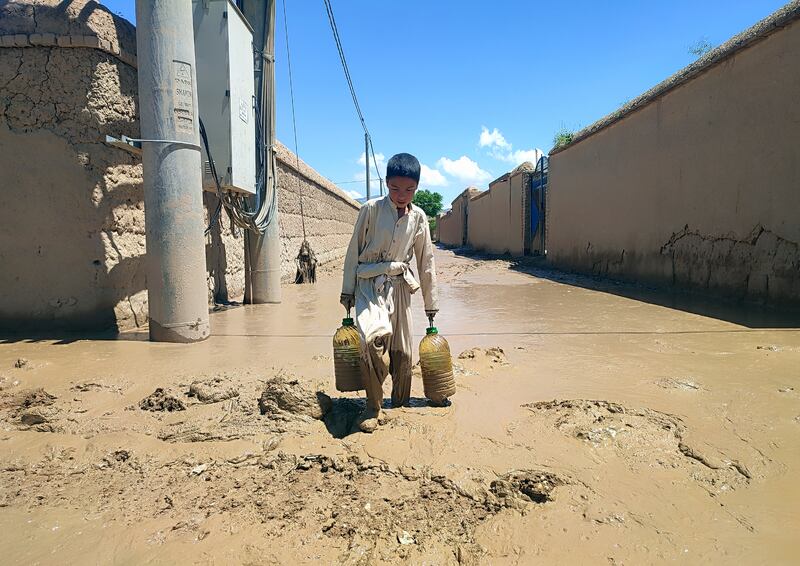

Some of the worst flash flooding in recent memory swept through parts of Afghanistan over the weekend, leaving more than 300 people dead, 1,600 people injured, with hundreds missing, and more than 1,000 homes destroyed, according to Reuters.
The most severe destruction is in Baghlan province, in Afghanistan’s north, where “unprecedented rainfall” has damaged or destroyed thousands of homes since Friday and made most of the area inaccessible to vehicles. World Food Programme posted a photo on X of donkeys carrying food relief on their backs, with the caption “WFP had to resort to every alternative to get food to the survivors who lost everything.”
“Videos posted on social media showed dozens of people gathered Saturday behind the hospital in Baghlan looking for their loved ones,” according to The Associated Press. “An official tells them that they should start digging graves while their staff are busy preparing bodies for burial.”
Zabihullah Mujahid, the chief spokesman for the Taliban government, posted on X that “hundreds ... have succumbed to these calamitous floods, while a substantial number have sustained injuries.”
Mujahid said the provinces of Badakhshan, Baghlan, Ghor and Herat fared the worst, perThe Associated Press. Mujahid added that “the extensive devastation” has resulted in “significant financial losses.”
According to Reuters, in the Nahrin district of Baghlan province, people carried their shrouded dead to a gravesite.
“We have no food, no drinking water, no shelter, no blankets, nothing at all, floods have destroyed everything,” said Muhammad Yahqoob, who has lost 13 members of his family, children among them. “Out of 42 houses, only two or three remain,” he said. “It has destroyed the entire valley.”
“Lives and livelihoods have been washed away,” said Arshad Malik, the Afghanistan director for Save the Children. “The flash floods tore through villages, sweeping away homes and killing livestock.”
He estimated that 310,000 children lived in the worst-hit districts, adding, “Children have lost everything.”
Salma Ben Aissa, the Afghanistan Director for the International Rescue Committee, said:
“These latest floods have caused a major humanitarian emergency in Afghanistan, which is still reeling from a string of earthquakes at the beginning of this year, as well as severe flooding in March. Communities have lost entire families, while livelihoods have been decimated as a result.
One woman told The Washington Post that the water rose so quickly that she had no time to put on her shoes. “We just grabbed our children and we ran,” she said. She also said it was “the end of the world” for her family, as the family’s home, their belongings and their livestock were all swept away. “We have nothing left,” she said.
Already underfunded, Afghanistan’s health system is ill equipped to respond to the crisis, aid workers warned Sunday, according to The Washington Post. In an initial assessment, the U.N. said that “the country lacks the necessary resources to manage a disaster of this magnitude.”
Qatar’s Foreign Ministry said in a statement that it was ready “to cooperate” with the Afghan authorities and Karen Decker, the head of the U.S. diplomatic mission to Afghanistan, posted on X that she was: “Heartbroken by loss of life in Baghlan and elsewhere in Afghanistan after heavy rains and flash floods. The United States joins others in mobilizing emergency relief, food, and medical supplies through partners to support recovery efforts.”
The Herat region was also hit last October by devastating earthquakes that killed thousands. Another earthquake the year before killed over 1,000.