

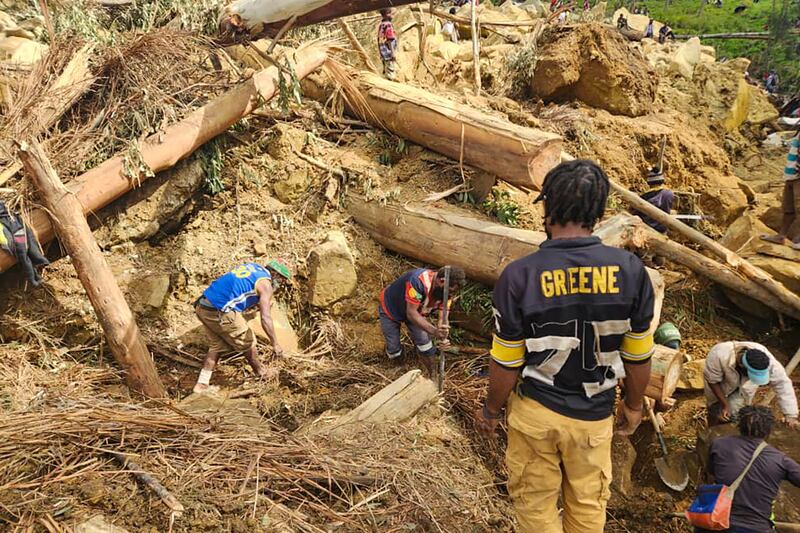

The Papua New Guinea government said more than 2,000 people are believed to have been buried alive in a landslide in the South Pacific island nation after the side of a mountain came down in the early hours of Friday morning, reports the Associated Press. That is approximately triple the initial U.N. estimates of 670.
Estimates of the casualties have varied widely since the disaster occurred, and it was not immediately clear how officials arrived at the number of people affected. The variance in the total number of possible deaths reflects the difficulty in getting an accurate population estimate. The mountainous nation’s last credible census was in 2000.
The International Organization for Migration, which is working closely with the government and taking a leading role in the international response, has not changed its estimated death toll of 670 released on Sunday.
“We are not able to dispute what the government suggests but we are not able to comment on it,” said Serhan Aktoprak, chief of the U.N. migrant agency’s mission in Papua New Guinea. “As time goes in such a massive undertaking, the number will remain fluid,” Aktoprak added.
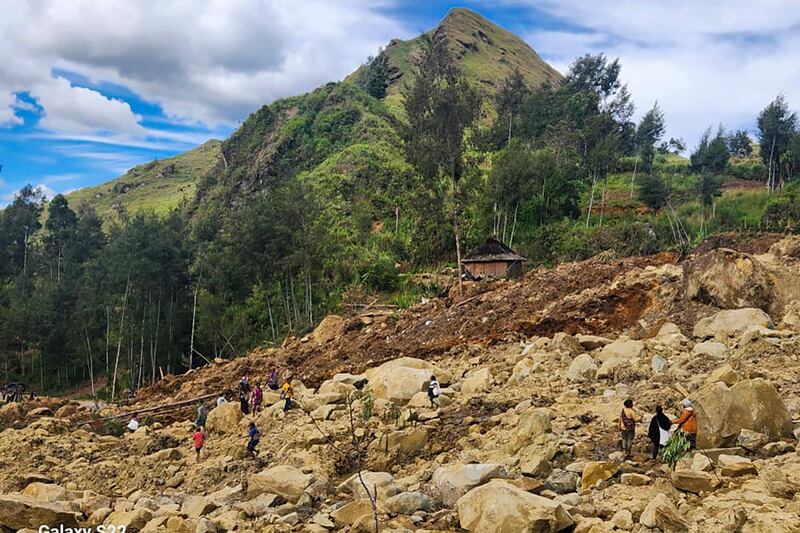
Aktoprak said in a media interview that the community in Yambali village, which is situated at the foot of a mountain in the remote Enga Province, is buried under between 6 to 8 meters of soil, or 20 to 26 feet. Some of the boulders that buried houses and cut off a major highway were larger than shipping containers, reports The New York Times. One hundred and fifty houses are believed to be buried. Rescuers heard screams from beneath the earth but have only been able to locate six survivors, reports the BBC. To date, five bodies have been recovered.
Defense Minister Billy Joseph said at least 4,000 people had been living in the six remote villages in the Maip-Mulitaka area in Enga province, where the landslide occurred in the early hours of Friday while most were asleep, although the number could be substantially higher.
The deep mud and debris covered an area the size of three or four football fields and was being cleared exclusively by hand with shovels and picks for more than two days, until an excavator donated by a local builder arrived on Sunday, reports the AP. Survivors have been hesitant to allow heavy machinery to be used, however, because they do not want the bodies of their relatives harmed, said Aktoprak.
“I have 18 of my family members being buried under the debris and soil that I am standing on, and a lot more family members in the village I cannot count,” resident Evit Kambu told Reuters. “But I cannot retrieve the bodies so I am standing here helplessly.”
In a statement released on Saturday, the United Nations Office in Papua New Guinea said that communications infrastructure and access roads to the affected site have been damaged.
An Emergency Response Coordination Team has been set up to coordinate and lead relief efforts, comprising the Enga Provincial Disaster Coordination Office, the Department of Health, Department of Provincial Works, police, Defense Force and the United Nations.
Thousands of residents were ordered to evacuate from the path of the still-active landslide by the government on Tuesday after parts of a mountain collapsed. “The landslide area is very unstable. When we’re up there, we’re regularly hearing big explosions where the mountain is, there is still rocks and debris coming down,” Enga province disaster committee chairperson Sandis Tsaka told Reuters.
“The landslide is still active, as people are digging through the rocks, more is still coming down.”
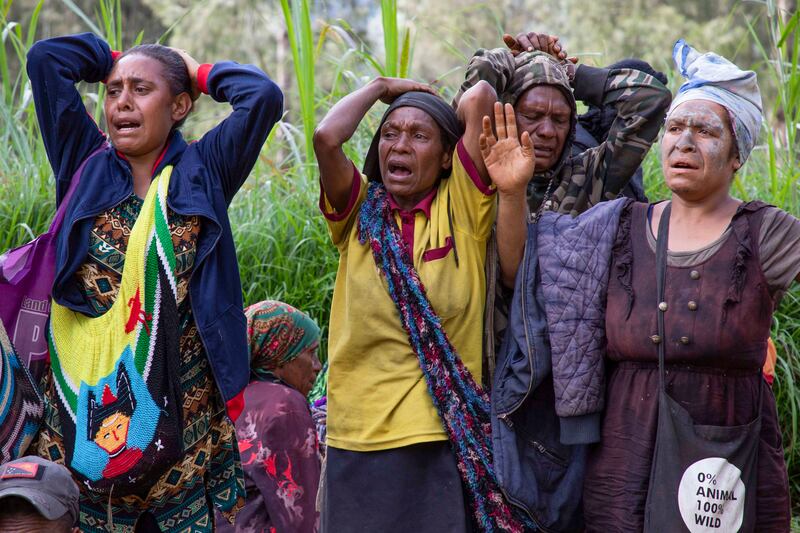
Officials also fear a disease outbreak is looming at the scene of Papua New Guinea’s mass-casualty disaster because of water streams and the bodies that are trapped beneath the tons of debris that swept over a village.
Papua New Guinea makes up the eastern half of the island of New Guinea, with the western half belonging to Indonesia. It sits in the Pacific Ocean’s so-called “Ring of Fire,” a belt of active volcanoes and frequent earthquakes. It is a diverse, developing nation with 800 languages and at least 10 million people, who are mostly subsistence farmers.
Torrential rains and strong winds during March and April triggered flooding and landslides throughout the nation. On March 24, a 6.9 magnitude earthquake struck near the northern town of Ambunti, shaking villages along the Sepik River and in surrounding areas already inundated by the flooding.