

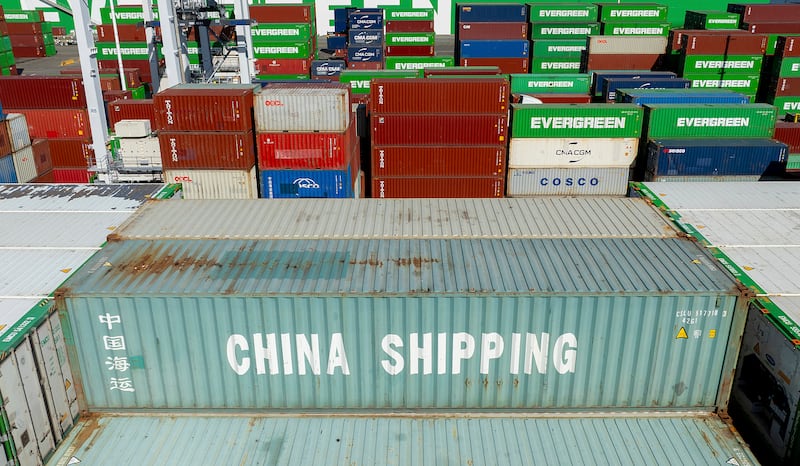

- China to apply 34% tariffs on all U.S. goods starting next Thursday.
- Stock markets around the world continued to drop after China's retaliation.
- The March jobs report shows a significant increase in the number of jobs in the U.S.
After China announced retaliatory tariffs on all imported goods from the U.S., stock markets around the world, including the U.S., continued to see drops on Friday.
Amongst the uncertainty caused by the recent tariffs, the March jobs report was released on Friday, showing a significant increase in the number of jobs in the U.S. It also showed an uptick in the unemployment rate.
On Wednesday, Trump announced tariffs on almost all goods imported to the U.S., with especially high tariffs on products from China. In retaliation to this announcement, China will be applying a 34% levy on all U.S. imported goods starting next Thursday, per The Wall Street Journal.
Trump doesn’t seem to be discouraged by the retaliation or dropping stocks. On Friday morning he posted on Truth Social saying that right now is a “great time to get rich,” and later added that “China played it wrong, they panicked.”
China’s response to Trump’s tariffs extended beyond the levies, with Beijing adding several companies to its unreliable entities list, “which asserts that the firms have broken market rules or contractual commitments,” per CNBC. China also launched an antitrust investigation into DuPont on Friday, which caused shares to drop by 12%.
U.S. Secretary of State Marco Rubio acknowledged the market crashes around the world but said that economies weren’t crashing and global business would adjust, per The Wall Street Journal.
The status of stock markets after China’s retaliation
After significant stock market drops around the world on Thursday, China’s retaliatory levies have caused shares to dip even more.
The Nasdaq Composite is down 7.8% this week, with the S&P 500 and the Dow Industrials down 6.4% and 5.3%. This week is the worst week since 2020 for both the Nasdaq and the S&P 500, per CNBC.
Stocks for technology companies continued to fall on Friday, with Apple down an additional 3%, making a 10% loss for the week. Nvidia is down 5% and Tesla has fallen 6%. These three companies are some of the hardest hit by Beijing’s retaliatory measures, as they have large exposure to China.
On Friday, the 10-year treasury yield fell below 4%, this is due to investors going into bonds for safety, pushing prices higher and rates lower.
On Thursday, analysts from JPMorgan raised the odds of a global recession this year from 40% to 60%, per CNBC.
The drops in shares were seen around the world, with European stocks among some of the hardest hit on Friday. Germany’s DAX dropped 4.3%, France’s CAC 40 is down 3.7% and Japan’s Nikkei 225 fell 2.8%, according to The Associated Press.
What the March jobs report looks like
Economists expected job growth to slow in March, and predicted that 130,000 would be added. But the recent jobs report showed that numbers highly exceeded expectations, with 228,000 jobs added throughout the month, per CNN.
“There was also a sharp increase in transportation, construction, and warehousing employment. The President’s push to onshore jobs here in the United States is working. The Golden Age of America is on its way!” read a statement from the Trump administration.
While there were more jobs than expected added in March, the unemployment rate during the month rose from 4.1% to 4.2%, partially due to new entrants to the labor market.
“The robust gains notched in March were likely a rebound after wildfires and bad weather depressed job growth in January and February (which were revised down by a combined 48,000 jobs),” per CNN.
While jobs increased in March, it is unclear what the tariffs will mean for the labor market going forward.
“Today’s better than expected jobs report will help ease fears of an immediate softening in the US labor market,” said Lindsay Rosner, of Goldman Sachs Asset Management, according to CNBC. “However, this number has become a side dish with the market just focusing on the entrée: tariffs.”