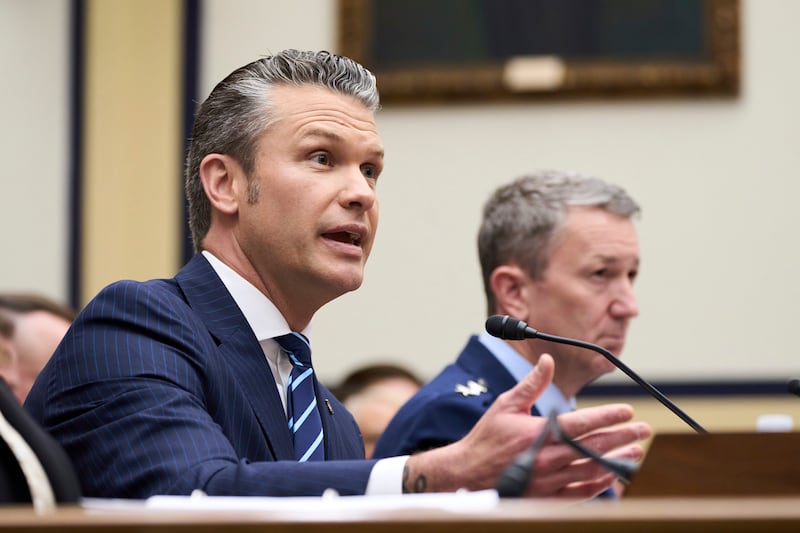

- During congressional testimony, Defense Secretary Pete Hegseth responded to questions about the military's plans for Greenland.
- President Donald Trump has spoken of the need to have a U.S. presence in Greenland to ensure international security.
- A majority of Utahns oppose Greenland being annexed into the U.S., a recent poll showed.
The Trump Administration continues to monitor Greenland over its potential role in maintaining security for North America, according to testimony given by Defense Secretary Pete Hegseth.
During his appearance last week before Congress’ House Armed Services Committee, Hegseth was asked whether the Pentagon has developed plans to take Greenland — or Panama — by force, if necessary, The Associated Press reported.
“Our job at the Defense Department is to have plans for any contingency,” Hegseth repeated.
While it isn’t unusual for the Pentagon to develop “what-if plans” for conflicts that may never materialize, Hegseth’s reported handling of the questions regarding the Greenland issue prompted a direct inquiry from a Republican lawmaker.
“It is not your testimony today that there are plans at the Pentagon for taking by force or invading Greenland, correct?” said Rep. Mike Turner, R-Ohio.
As Hegseth started to repeat his answer about contingency plans, Turner added emphatically, “I sure as hell hope that is not your testimony.”
“We look forward to working with Greenland to ensure that it is secured from any potential threats,” Hegseth responded.
Added Rep. Adam Smith, D-Wash., “Speaking on behalf of the American people, I don’t think the American people voted for President Trump because they were hoping we would invade Greenland.”
Increasing interest in Greenland from China, Russia
One thing that’s not unclear: President Donald Trump’s interest in Greenland.
“We need Greenland for national security and international security,” Trump said from the Oval Office in March.
“So we’ll, I think, we’ll go as far as we have to go,” he continued. “We need Greenland. And the world needs us to have Greenland, including Denmark. Denmark has to have us have Greenland. And, you know, we’ll see what happens. But if we don’t have Greenland, we can’t have great international security.”
Trump’s focus on the massive, mineral-rich Arctic landmass — which is in an autonomous territory of Denmark — predates his return this year to the White House.
The administration is reportedly concerned about growing Chinese and Russian military and commercial activities in the Arctic.
“Greenland is growing in importance as we find ourselves in a global competition with China and in a new technological revolution with regards to warfare,” Rebecca Pincus, director of the Wilson Center’s Polar Institute and a former adviser to the U.S. Defense Department on Arctic strategy, told RadioFreeEurope/RadioLiberty earlier this year.
“So, Greenland is important from a missile-defense perspective, from a space perspective, and from a global competition perspective, in which shipping and maritime sea lanes are increasingly important,” she said.
As a territory of Denmark, it is part of NATO, but Greenland is pursuing independence from Copenhagen and some experts fear that could open a door for Russia and China to gain a foothold in the country, RFE/RL reported.
Last week, Denmark’s Parliament approved legislation to allow new U.S. military bases on Danish soil, broadening an existing previous military agreement between the countries.
Danish Foreign Minister Lars Løkke Rasmussen, in a response to lawmakers’ questions, wrote that Denmark would be able to terminate the agreement if the U.S. tries to annex all or part of Greenland, The Associated Press reported.
Meanwhile, Greenland Prime Minister Jens-Frederik Nielsen has called U.S. statements about the Arctic island “disrespectful” — adding that Greenland “will never, ever be a piece of property that can be bought by just anyone.”
Political parties in Greenland, which has been leaning toward eventual independence from Denmark for years, recently agreed to form a broad-based new coalition government in the face of Trump’s designs on the territory, reported The Associated Press.
The Pentagon, meanwhile, is likely to shift Greenland from U.S. European Command to U.S. Northern Command, the military body responsible for defense of the American homeland, Mexico and Canada, according to Navy Times.
The change itself only involves redrawing the maps of U.S. combatant commands and handing over responsibility for the military forces in Greenland, but it has caused angst among some in Denmark who think the administration is trying to draw the territory closer to America.
A majority of Utahns oppose Greenland becoming part of U.S.
An April poll conducted by the Deseret News/Hinckley Institute of Politics revealed about three-fifths — or 58% — of Utah voters somewhat or strongly oppose the idea of Greenland becoming a U.S. territory.
Meanwhile, 42% said they somewhat or strongly support Greenland being annexed into the United States.
Utah Republicans indicated slightly more support for Greenland becoming a territory of the U.S., with around 62% saying they somewhat or strongly support the idea, — compared to 13% of Democrats and 23% of independents.
Utah voters were also asked what kind of pressure they would be comfortable applying on Greenland in pursuit of it becoming a U.S. territory.
Overall, roughly 8 in 10 voters — or 78% — said they don’t want the U.S. to apply any pressure on Greenland.
At least 16% said they supported economic and political interventions, while 6% said they backed military pressure.