


President Donald Trump is looking to finalize an agreement with universities after sparring with them for months over research funding and antisemitism on campuses, but his plan includes major changes to the way higher education operates leading to pushback.
Trump put forward a plan called “Compact for Academic Excellence in High Education,” outlining 10 requirements universities must reach to receive federal funding. If they develop other “models and values” than those listed in the plan, “the institution elects to forego federal benefits,”
The compact was sent to nine top universities as a kind of trial run. These universities have until Oct. 20 to give “limited, targeted feedback,” and they have until Nov. 21 for execution of the terms.
Massachusetts Institute of Technology was the first university to reject the plan.
The university’s president, Sally Kornbluth, wrote in a letter published Friday morning, “Fundamentally, the premise of the document is inconsistent with our core belief that scientific funding should be based on scientific merit alone.”
She added that MIT already accomplishes merit-based admissions and minimizes student debt, which are two of the requirements the Trump administration has posed.
The compact’s requirements are the following:
- Equality in admissions — Universities are not allowed to consider sex, race, ethnicity, nationality, political views, sexual orientation, gender identity, or religious associations (with exceptions for single-sex or primarily religious institutions).
- Marketplace of ideas and civil discourse — Universities must commit to fostering a vibrant marketplace of ideas with no single dominant ideology.
- Nondiscrimination in faculty and administrative hiring — Maintain meritocratic selection based on objective and measurable criteria.
- Institutional neutrality — University employees, when acting on behalf of their institutions, must abstain from actions or speech relating to societal and political events, unless they directly impact the university.
- Student learning (grade integrity) — Grades must not be inflated or deflated for any non-academic reason.
- Student equality — Women’s equality requires single-sex spaces and fair competition in sports. Institutions must commit to interpreting gender as biological sex.
- Financial responsibility — Universities should eliminate staff and programs that fail to serve students and reduce tuition burdens.
- Foreign entanglements — Universities must comply with federal anti-money laundering. No more than 15% of a university’s undergraduate student population shall participate in the Student Visa Exchange Program (applies to incoming classes). No more than 5% of an undergraduate class shall be from any one country.
- Exceptions — Religious institutions and single-sex institutions may maintain preferences for religious affiliation and sex.
- Enforcement — University presidents and heads of admissions must annually certify the university’s adherence to these principles and conduct an annual anonymous poll to evaluate performance of the compact.
The compact has sparked both outrage and celebration
In The New York Times, Marc Rowan, CEO of Apollo Global Management, who played a role in creating the compact, said this kind of proposal “is not unusual,” but it is garnering criticism because it is counter to current academic culture.
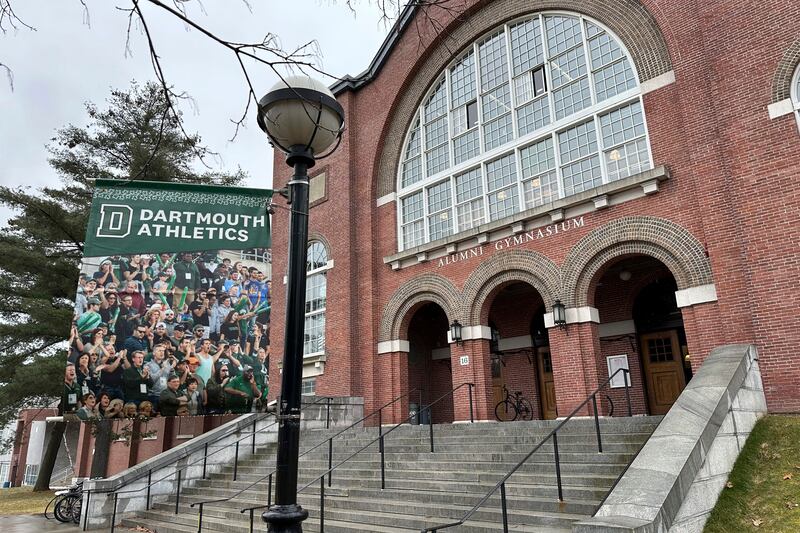
More than 500 current and former faculty at Dartmouth signed a petition urging their president not to sign the compact. It is a “direct threat to the beating heart of the university: free inquiry and the pursuit of knowledge,” the petition states.
But Rowan said he believes, “It places no constraints on individual speech, nor does it intrude on academic freedom.”
“The compact does require schools not to punish, intimidate or incite violence against conservative ideas. Those are not speech restrictions. They are restrictions on the suppression of speech,” he said.
At the University of Southern California, faculty and staff said Trump’s compact is “probably unconstitutional,” “antithetical to principles of academic freedom,” “a Trojan horse” and “egregiously invalid,” per the Los Angeles Times.
But Rowan said he believes the compact is warranted “given the enormous investment of taxpayer money” that is funneled into universities.
Taxpayer money should “prop up a system that purports to educate American students and serve the public good,” but it is “all too often doing nothing of the sort,” he said.
