


- Farmers' Almanac to cease publication due to financial difficulties and changing media landscape.
- The publication started in 1818 and was known for its unique weather prediction methods.
- The older publication, The Old Farmer’s Almanac, will continue publishing.
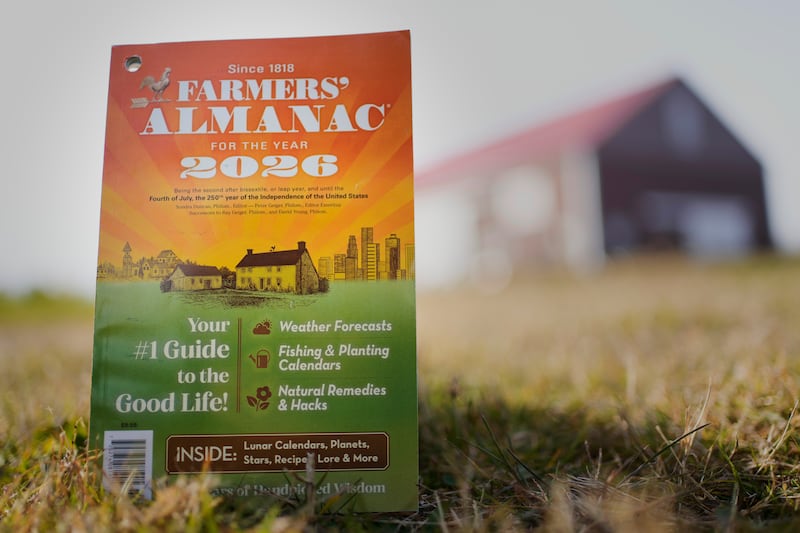
The Farmers’ Almanac — not to be confused with The Old Farmer’s Almanac — announced last week that its 2026 edition will be its last.
First printed in 1818 and based in Maine, the publication has used a secret formula based on sunspots, planetary positions and lunar cycles to generate long-range weather forecasts.
The almanac also features gardening tips, trivia, jokes and natural remedies such as elderberry syrup as an immune booster and catnip as a pain reliever.
In a statement, Editor Sandi Duncan and Editor Emeritus Peter Geiger wrote, “It is with a great appreciation and heartfelt emotions that we write to share some sad news. After more than 200 years of sharing a unique blend of weather, wit and wisdom, we’ve made the very difficult decision to write the final chapter of this historical publication.”
“We are incredibly proud of the legacy we leave behind and are filled with gratitude,” the statement continued. “We appreciate and thank our loyal readers, contributors, and partners who have supported us through the years. Though the Almanac will no longer be available in print or online, it lives on within you.”
The Farmers’ Almanac is closing due to financial challenges connected with producing and distributing the almanac in today’s media environment.
Access to existing digital content on its website will be discontinued in December, per Today.
The difference between the Old Farmer’s Almanac and The Farmers’ Almanac
After The Farmers’ Almanac made its announcement, The Old Farmer’s Almanac, a New Hampshire-based publication, posted on Instagram to clarify that it would still be continuing for the years to come.
“Over the years, there has been some confusion between our two almanacs, so to be clear: The OLD Farmer’s Almanac isn’t going anywhere. As we have since 1792, we will continue to publish our annual edition, while educating and entertaining readers online at Almanac.com,” the post said.
“Rest assured, as sure as the Sun will rise, The Old Farmer’s Almanac — with our familiar yellow cover and 80% accurate weather forecasts — will be around for generations to come,” the post continued.
The New Hampshire-based publication is older than The Farmers’ Almanac and first started in 1792. The Old Farmer’s Almanac is believed to be the oldest continually published periodical in North America, according to The Associated Press.
Both publications follow the late medieval traditions of almanacs, which are annual calendars that chart the phases of the moon and the daily timings of sunrise. The first printed almanac was in Europe in 1457, per The New York Times.
The 2026 edition of The Old Farmer’s Almanac will feature new gardening books, digital tools, calculators and seasonal weather forecasts. Its book also contains gardening knowledge, astronomy and folklore material.
Throughout the 20th century, both almanacs thrived, giving farmers and gardeners information they couldn’t get anywhere else, per Today. But in the modern digital age, that same information is easily accessible from a number of sources.
Over 200 years of The Farmers’ Almanac
In an individual statement, Duncan wrote, “It is with a heavy heart that we share the end of what has not only been an annual tradition in millions of homes and hearths for hundreds of years, but also a way of life, an inspiration for many who realize the wisdom of generations past is the key to the generations of the future,” according to CBS News.
The Farmer’s Almanac was initially published in New Jersey and later moved to Maine. For decades, the books were made with holes in them so they could be hung in convenient places, per The New York Times.
When it was started, the National Weather Service did not yet exist and the precise forecasts of the modern era could barely be imagined. This made the rainfall predictions provided by almanacs invaluable to farmers.
In the 1930s, more Americans were moving off their farms and into cities and suburbs. In 1932, the almanac first mentioned the word “lawn.”
As it moved into the digital age, the publication did all it could to stay relevant. It created a website in 1997 and starting in 2006, the staff ran a syndicated show on public TV stations for two years, per The New York Times. The company also worked to establish a social media presence with accounts on X, Facebook, Instagram, Pinterest and YouTube.
In 2017, the Farmers’ Almanac reported a circulation of 2.1 million in North America. It said it was gaining new readers among people who were growing fresh produce at home and who were interested in where their food came from.
In the company’s most recent pitch to advertisers, it said it distributed 510,000 copies but did not clarify how many copies were actually sold. These distribution numbers were far behind The Old Farmer’s Almanac, which has a circulation of 2.5 million.
Duncan, the first woman to serve as editor, said that the “trajectory” of newsstand sales combined with the ways people can now easily gain information led to the decision to end the publication.
“As everybody in media knows, it’s kind of tough out there,” she said, per The New York Times. “You share stuff online, but if people are not subscribing or they are not buying, how do you make your money?”
For over 200 years the publication has stuck to the same formula used at its founding, a mathematical and astronomical formula that looks at sunspot activity, the tides and the position of the planets. The formula was slightly tweaked over the years, but it was never modernized.
“We’ve never used satellite systems or computers,” Duncan said about the almanac’s predictions, per The New York Times.