

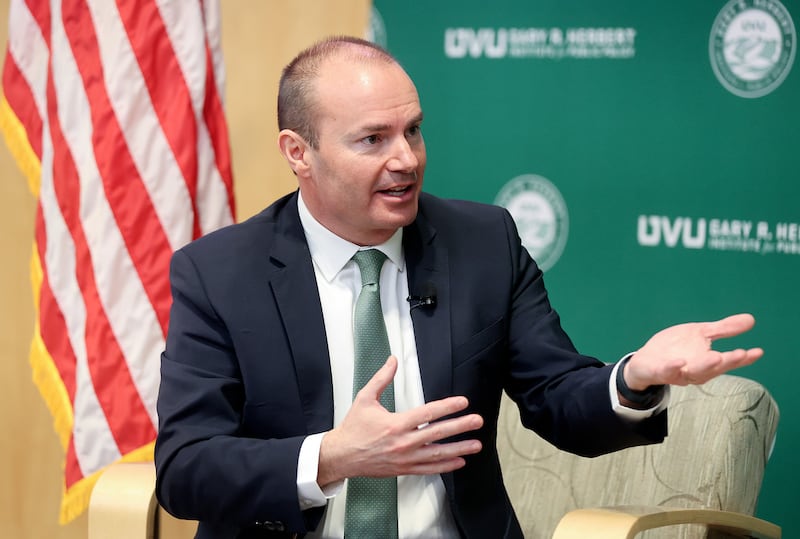
Private citizens could be granted authority to seize property from drug cartels under a constitutional provision not used in more than 200 years, thanks to a new bill introduced Thursday by Utah Sen. Mike Lee.
The bill would authorize the president to commission privateers to seize the property of cartels or other groups responsible for an act of aggression against the United States. Though not issued by the U.S. government since the War of 1812, letters of marque allow private individuals or companies to “outfit private warships for the purposes of sinking or capturing vessels belonging to enemy nations,” according to Cornell University’s Legal Information Institute.
“The Constitution provides for letters of marque and reprisal as a tool against the enemies of the United States,” Lee said Thursday. “Cartels have replaced corsairs in the modern era, but we can still give private American citizens and their businesses a stake in the fight against these murderous foreign criminals. The Cartel Marque and Reprisal Reauthorization Act will revive this historic practice to defend our shores and seize cartel assets."
Lee’s bill would allow American privateers to seize the property of cartels or cartel-linked groups “on land or sea,” according to his office. The bill authorizes privateers “to employ all means reasonably necessary” to seize property of cartels outside of U.S. territory.
Letters of marque could be issued against “any individual who the president determines is a member of a cartel, a member of a cartel-linked organization, or a conspirator associated with a cartel or a cartel-linked organization, who is responsible for an act of aggression against the United States.”
Letters of marque were not uncommon in the early days of the republic, and President James Madison issued more than 500 such authorizations to private citizens during the War of 1812, allowing them to target British merchant vessels. The Confederate States of America issued letters of marque to privateers during the Civil War, but President Abraham Lincoln did not exercise the power.
In the heyday of privateering, many privateers also engaged in piracy, according to the Legal Information Institute, particularly during periods of peace when they were expected to resume normal commercial activity. The Paris Declaration respecting Maritime Law of 1856 formally banned privateering, though the U.S. did not sign on to the treaty.
Recent proposals have included allowing digital letters of marque to authorize online privateers to seize digital assets used in cybercrime, according to the Register.
A House version of Lee’s bill was also introduced by GOP Rep. Tim Burchett of Tennessee, who said cartels “push millions of dollars in fentanyl into our country with no regard for American lives.”
“It’s time to get creative about how we face these threats,” he added. “These cartels present a serious risk to our national security and this bill would authorize President (Donald) Trump to commission Americans to help defend our homeland.”
The bill comes as the Trump administration continues to face scrutiny for a series of strikes against suspected drug trafficking boats in the Caribbean in recent months.