

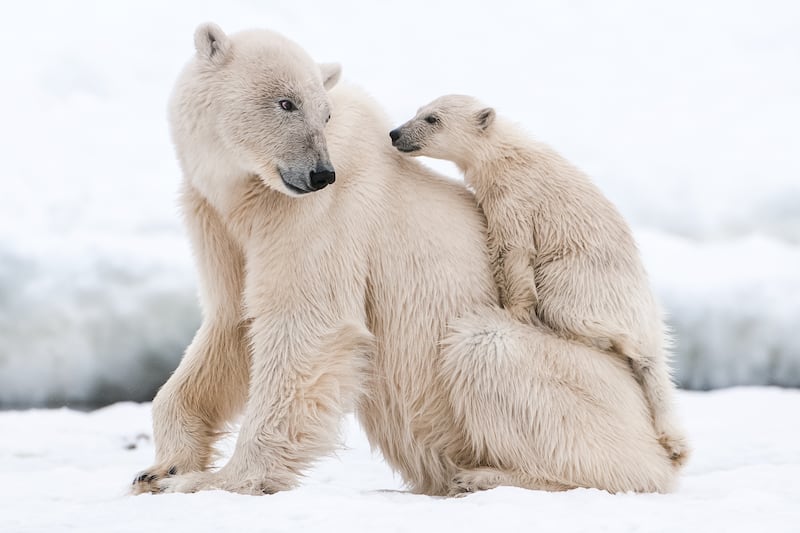

- Adoption occurs in only 1% of polar bear litters.
- Adopted cub’s chances of survival improve significantly under maternal care.
- Adult female polar bears are tagged with GPS collars to help scientists better understand the animals.
Scientists in Canada researching polar bears came upon an unusual discovery this fall when they found a mother bear who had adopted a cub.
The mother was first spotted with one cub in the spring, and in November she was seen again, but this time with two cubs. They were able to verify the cub was not her own, marking the 13th such case of cub adoption within the Western Hudson Bay subpopulation, according to CBC.
“When we got confirmation that this was an adoption, I had a lot of mixed feelings, but mostly good,” Alysa McCall, director of conservation outreach and a staff scientist with Polar Bears International, said, according to CBC.
“It’s just another reason why this species is so incredible, why they’re so fascinating and interesting, and it gives you a lot of hope when you realize that polar bears may be looking out for each other out there,” she added.
When were the polar bears spotted?
It was in March that Evan Richardson, a polar bear research scientist with Environment and Climate Change Canada, first spotted the mother with one cub while out in the field, per CBC.
In November, Richardson was taken aback when he saw the mother again, but this time with two cubs. Two of the bears had been previously tagged with GPS tracking collars. The newly adopted cub did not have one.
The bears were seen during the annual polar bear migration along the Western Hudson Bay in Churchill, Manitoba, which is known as the polar bear capital of the world, per CBS News.
All three polar bears were captured on camera last month. In the video, they are seen exploring the snow-covered terrain. At one point, one cub hurries toward the mother while the other cub appeared to be waiting for it.
According to The Washington Post, the International Union for Conservation of Nature has classified polar bears as vulnerable.
How rare is adoption among polar bears?
Richardson said adoption occurs in just 1% of polar bear litters, according to The Washington Post.
“It’s not that frequent though because in our long-term study we have over 4,600 individual bears that we’ve known over the last 45 years, and literally hundreds and hundreds of litters (of cubs),” Richardson said, per CBC.
Researchers estimate the mother is 5 years old, while the cubs are both about 10 to 11 months.
They don’t know for certain why the mother adopted a lone roaming cub, but Richardson has a hypothesis.
“We really think it’s just because polar bears are so maternally charged and such good mothers, and they just can’t leave a cub crying on the tundra. So they pick them up and take them along with them,” he said, according to CBC.
Typically, polar bear cubs stay with their mothers for two to 2½ years.
“It’s not a lot of time to learn how to be a polar bear, but they do soak up a lot of lessons during that time. The survival rate for cubs to make it to adulthood is around 50% … but if we learn a cub has no mom, it has almost no chance,” McCall said, per CBC.
Now that it has been adopted and has a mother to teach it the ropes, it has a good chance of reaching adulthood.
Researchers do not know what happened to the biological mother of the adopted cub, but they have collected a genetic data sample that they hope will provide some insight.
The mother is known as X33991 and is being tracked through a research program by Environment and Climate Change Canada and the University of Alberta, per The Washington Post. The program places GPS collars on adult females to track their movements to help understand and protect the animals.