

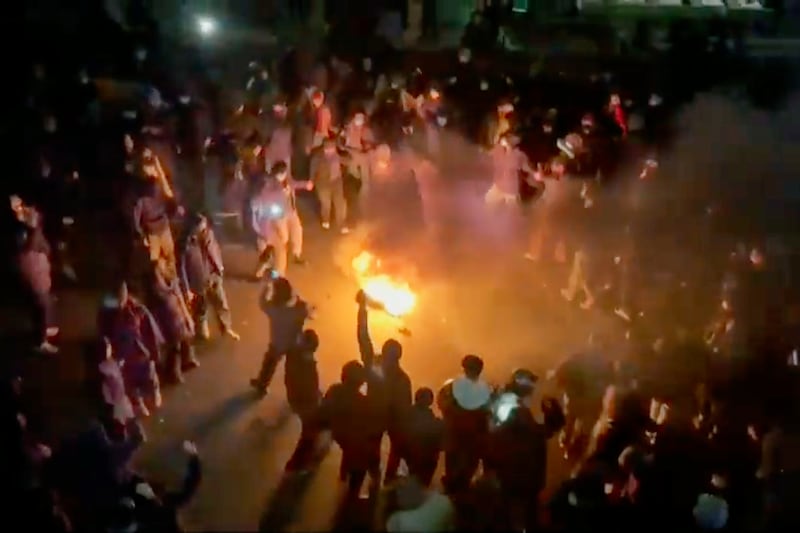

- Nationwide protests that began Dec. 28 over Iran’s government and economy have spread to all 31 provinces, with an estimated death toll exceeding 500 and more than 10,600 arrests.
- Iran has imposed a near-total internet and communications blackout, which witnesses say coincided with intensified violence, while the government frames outside media or political support as foreign interference.
- As Iran signals it is "prepared for war" but open to negotiations, U.S. officials say Iran is nearing a red line.
President Donald Trump has been briefed about possible ways the U.S. might intervene in Iran, as the government there reportedly has become increasingly violent toward protesters.
On Monday, Trump also announced new tariffs in response to the escalating violence.
At the Kahrizak Forensic Medical Center, just south of Tehran, videos released online showed Iranian families searching through hundreds of black bags for the bodies of their loved ones over the weekend. From video taken at several locations, some of the deceased appear to be young men and women.
Protests began in Iran on Dec. 28 against the country’s government and failing economy, and have since spread to 180 cities and towns across all 31 provinces, according to accounts.
Most of these accounts have not been independently verified because of the difficulty in gathering information in the country.
Though several reports conflict, the death toll has been estimated to be more than 500, with thousands more reportedly arrested.
The country’s internet was blocked starting on Jan. 8, presumably by the government. Iran is now in its fourth day of the blackout, per the cybersecurity watchdog NetBlocks.
The blackout has shut down the country’s SMS system, and phone calls are shut off at night. Messaging on the Islamic Republic’s app is unavailable, but mobile banking apps have started back up, a resident of central Iran told Los Angeles-based tech entrepreneur Mehdi Yahyanejad.
A 20-year-old civil engineering student, Novian, told IranWire that “everything changed” once Iran “cut the internet.”
“Shootings increased, and gunfire came from all directions. It wasn’t even possible to distinguish who was shooting at whom. It was like an apocalypse movie,” he said.
Iran says it’s ‘prepared for war’
In a news conference Monday, Iran’s foreign minister Abbas Araghchi told a group of ambassadors, “We are not warmongers, but we are prepared for war. … We are also prepared for negotiations, but fair negotiations, with equal rights and mutual respect."
Iran’s foreign ministry spokesman Esmaeil Baghaei added that the communication line between Araghchi and U.S. special envoy to the Middle East Steve Witkoff is “open and messages are exchanged whenever necessary.”
The Islamic State-run newspaper Tasnim reported that any media or political support for the country’s protests is “an unacceptable intervention in the internal security of the country.”
Meanwhile, President Trump announced that any country doing business with the Islamic Republic of Iran “will pay a tariff of 25%,” from the U.S., effective immediately. He also confirmed that Iran had contacted the U.S. about potential talks. But “we may have to act before a meeting,” he said, per The Washington Post.
Trump says it’s looks like ‘they’re starting to’ cross a line
Aboard Air Force One on Sunday, when asked if Iran had crossed a “red line yet to trigger a response,” Trump said, “They’re starting to.”
“We’re looking at it very seriously. The military’s looking at it. And we’re looking at some very strong options. We’ll make a determination,” Trump said. He added that he is getting hourly reports and will make a determination soon.
During his conversation with the press, Trump said that he was going to call Elon Musk about helping reconnect the country to the internet.
“We may get the internet going, if that’s possible,” Trump said. “We may speak to Elon, as you know he’s very good at that kind of thing. He’s got a very good company.”
Starlink blocked
Though owning a Starlink receiver is illegal in Iran and can result in two years in prison, Yahyanejad estimated that there are tens of thousands of the devices currently in the country.
But the receivers that exist in country have been having abnormal issues connecting users to the internet.
Internet researcher Amir Rashidi told IranWire that “military-grade jamming signals were detected targeting Starlink satellites,” after the protests began. By 10 p.m. local time, more than 80% of packets sent by Starlink devices is lost, he said.
Rashidi said he’d never seen interference of this kind before. “The technology involved is highly sophisticated and military-grade,” IranWire reported.
The U.S. State Department has financially supported several organizations that provide Iranians with free virtual private network technology for more than 15 years, as an effort to get around Iranian censorship.