

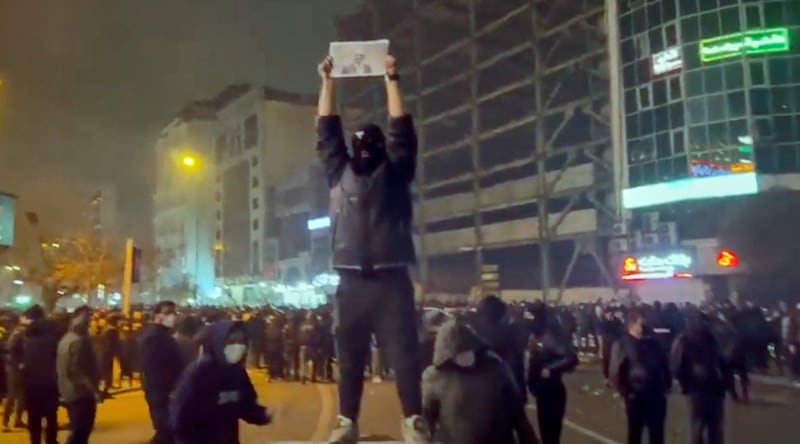

- President Trump said he had been told Iran had halted killings and scrapped execution plans, even as reports suggested the U.S. was preparing for possible military intervention within 24 hours.
- Protests that began over Iran’s economy have spread to 190 cities, with human rights groups estimating more than 2,500 deaths and 18,000 detentions amid an internet blackout and violent crackdowns.
- Iran’s judiciary publicly threatened rapid trials and executions for protesters, prompting Trump to warn of “very strong action” and announce new economic penalties on countries doing business with Iran.
After talks of military intervention ramped up on Wednesday, President Donald Trump said he’d been told the killing in Iran had stopped, and the country’s execution plans had been scrapped.
His off-handed comment in the Oval Office came after reports that the U.S. had begun evacuating some personnel from the Al-Udeid Air Base in Qatar ahead of potential military intervention in Iran. Other reports said U.S. military intervention could be launched in the next 24 hours.
Protests erupted on Dec. 28 over the country’s failing economy but have since snowballed into widespread anger with the ruling Islamic theocracy. In the past 2½ weeks, the protests have spread to 190 cities and the Islamic Republic’s response has been deadly.
The country’s internet blackout has made it difficult to determine the protests’ death toll, but human rights groups estimate it exceeds 2,500 and more than 18,000 people have been detained.
Iranians who have fled the country say the government’s response became significantly more violent after it cut internet access.
“They’re drowning people in blood. They’re shooting directly at chests, killing mercilessly,” one man who had crossed the border into Turkey said in a video. Other footage shows law enforcement breaking into a hospital with guns and shooting at protesters as they ran.
Iran said in TV broadcast to expect rapid trials and executions
In a broadcast aired by the state, the head of Iran’s judiciary said they will move forward with rapid trials and executions for protesters.
“If we want to do a job, we should do it now. If we want to do something, we have to do it quickly,” he said, per The Associated Press. “If it becomes late, two months, three months later, it doesn’t have the same effect. If we want to do something, we have to do that fast.”
Iran’s statement follows Trump’s appearance on CBS Tuesday evening, in which he said the U.S. “will take very strong action” if executions begin.
“We don’t want to see what’s happening in Iran happen,” Trump said. “And you know, if they want to have protests, that’s one thing, when they start killing thousands of people, and now you’re telling me about hanging — we’ll see how that works out for them. It’s not going to work out good.”
Trump says executions will not be happening in Iran
During a bill-signing ceremony focused on ending a policy barring public schools from offering students whole and 2% milk, President Trump told reporters, “We’ve been told that the killing in Iran is stopping, and it’s stopped and stopping, and there’s no plan for executions or an execution,”
“I’ve been told that on good authority,” he said. The president added that he was informed by “very important sources on the other side, and they’ve said the killing is stopped. And the executions won’t take place.”
Earlier on Wednesday, European and Israeli officials told The Guardian that Trump had decided to intervene in the conflict, and the former reported that U.S. military intervention could likely take place in the next day.
Those reports were backed by dozens of commercial ships dropped anchor outside Iran’s port limits as a precaution ahead of a potential strike, Reuters reported.
On Tuesday, Trump canceled all meetings with Iranian officials, and he has received briefings on possible responses, The Wall Street Journal reported. Nonviolent responses could include cyberattacks, sanctions and anti-Islamic regime campaigns online.
The president has already announced economic consequences for any country doing business with the Islamic Republic of Iran — requiring them to pay a 25% tariff from the U.S., effective immediately.
As for a force of arms response in Iran, only six U.S. Navy warships are currently deployed in the Middle East, and there is no aircraft carrier strike group nearby, the Journal reported.
“The Pentagon could still order Tomahawk missile strikes from destroyers in the Middle East, as well as send bombers and jet fighters stationed in the region equipped with long-range weapons,” The Wall Street Journal said. But the U.S. military presence in the area is far lower than it was when the U.S. waged ballistic missile strikes on the country last June.