

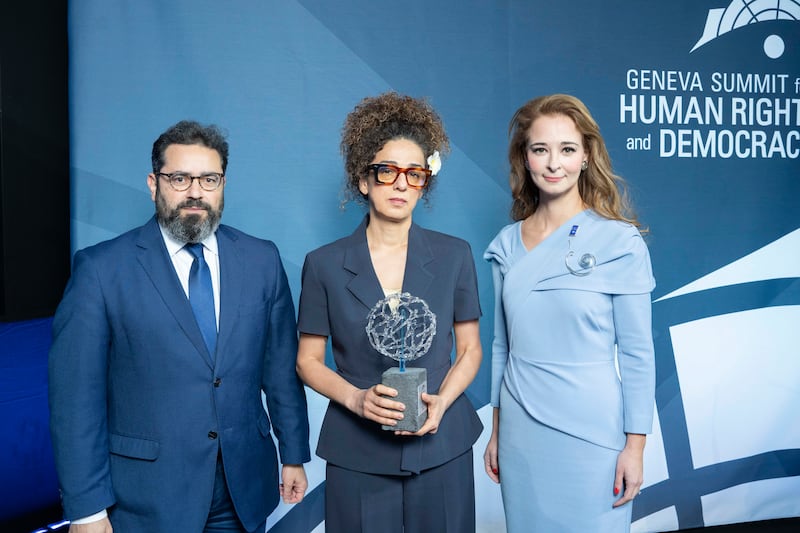

Masih Alinejad didn’t want to be in Geneva this week accepting an award. After the brutal crackdown on protesters taking place in Iran over the last month, the journalist struggled to feel right about attending.
“The entire nation is being traumatized,” she explains, referring to tens of thousands of Iranians widely believed to have been killed over the last month.
“We need action not an award,” says the dissident journalist, who has survived multiple assassination attempts, including by a Russian agent presumably hired by Iran who was recently sentenced in a New York court to 15 years.
Yet Alinejad traveled to Geneva on Wednesday to receive the award on behalf of “the Iranian people” from the Geneva Summit for Human Rights and Democracy. She did so because of U.N. Watch’s track record of amplifying the voices of dissident activists and leaders, who she called “the true representatives of Iranians.”
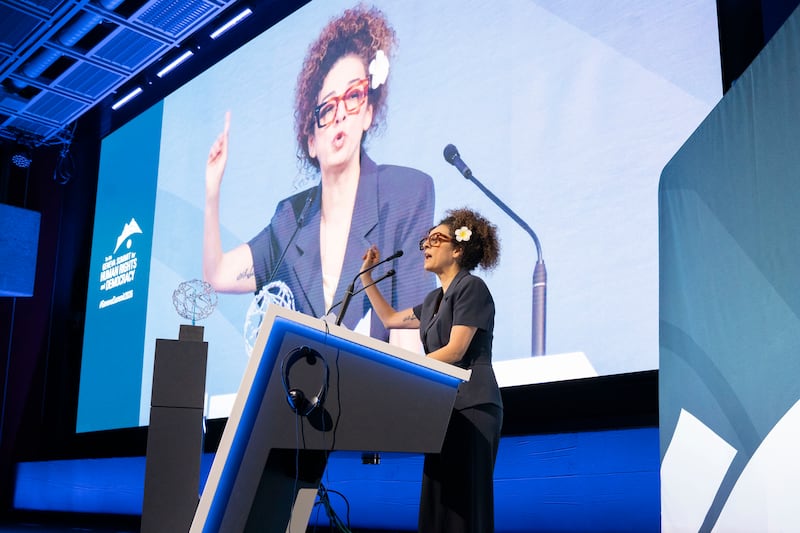
In her acceptance speech, she called on the Western world to hold the Iranian regime accountable instead of just negotiating more. Over recent weeks, U.S. and Iranian representatives have continued to negotiate a potential nuclear deal, with threats of U.S. military intervention still on the table.
“If this award means that … we’re going to stand united to expel the officials of the Islamic Republic from this country, I accept this award.”
Broken and blinded, but not giving up
Midway through her speech, Alinejad asked two Iranian women in the audience to stand — one of whom had been blinded in recent protests, with the other severely injured.
After being invited to the stage, the blind woman said in Persian, “My people with empty hands are fighting with the government. They have guns and bullets and weapons and everything.”
As of Sunday, the U.S.-based Human Rights ActivistsNews Agency reported the following confirmed casualties:
- 7,015 verified fatalities (6,508 protesters, 226 individuals under the age of 18, 214 members of military/government forces and 67 others) — with another 11,744 cases under review.
- 25,845 civilian injuries.
- 53,552 arrests, including 144 students.
These verified cases are widely understood to be a subset of the true toll. In an exploration of the “truth of Iran’s death toll,” Guardian journalists recently reported “testimony from medics, morgue and graveyard staff reveals huge state effort to conceal systematic killing of protesters.”
Citing communications with a “network of more than 80 medical professionals across 12 of Iran’s 31 provinces,” alongside reports from morgues and graveyards across the country, the Guardian reports Iranian contacts agreeing that “all publicly cited death tolls represent a severe underestimation.”
These contacts estimate that “officially registered deaths related to the crackdown likely represent less than 10% of the real number of fatalities” — suggesting the true toll could exceed 30,000.
‘Raising children without terror’
Shima Baughman is a nationally-recognized expert on criminal justice and the Woodruff J. Deem professor of law at Brigham Young University. As a 7-year-old child, she also came to the United States as a refugee from Iran. Baughman tells the Deseret News that she is watching the unfolding events in Iran with both hope and “a deep, guarded ache.”
“I know personally the cost paid by ordinary people when power tightens its grip,” she says — recounting sleeping with her sister on a narrow twin bed next to her mother in an Iranian prison, after her mother was detained. “I learned very early how fragile freedom is, and how easily faith and family can be treated as threats by the state.”
“What the world must understand,” Baughman said, is the Iranian people are “asking for something universal. The freedom to live, worship, speak, and raise their children without fear.”
“Religious freedom is not a Western luxury. It is a human need. When a government polices belief, prohibits scripture, and imprisons mothers, sometimes with their children beside them, it hollows out the moral core of a nation.”
The ultimate barometer of success in her former country, Baughman says, is “whether Iranian women can raise their daughters without terror, whether faith can be practiced without surveillance, and whether families like mine no longer have to choose between silence and survival.”
“The world has an obligation,” she said, “to stand unmistakably on the side of human dignity,” adding: “I believe Iranians are ready for that future. The question is whether the world is ready to help them reach it.”