
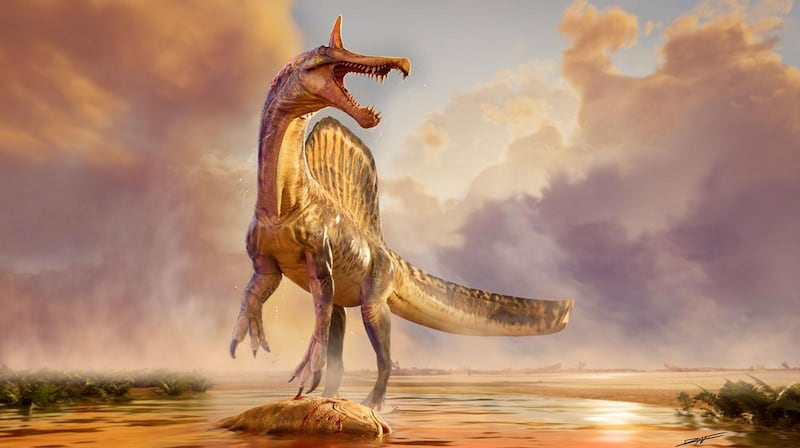

Paleontologists in the Sahara Desert have unearthed fossils of a new Spinosaurus species, one of the largest meat-eating dinosaurs discovered. Known for its large blade-shaped crest and teeth specialized for snaring fish, the newly discovered predator hunted in inland forests and rivers, like a modern-day wading bird, earning the nickname “hell heron.”
The researchers estimate the dinosaur was about 40 feet long and weighed between 5 to 7 tons.
Officially named Spinosaurus mirabilis, Latin for “astonishing Spinosaurus,” it is said to have lived in what is now Niger over 95 million years ago.
Its discovery far from the coast challenges previous assumptions, as similar fish-hunting dinosaurs have typically been found in coastal areas.
The findings were published Thursday in the journal Science.
The discovery
Though the site was originally discovered in 2019, researchers did not recognize the new species until they returned in 2022 to find more remains, according to BBC Science Focus magazine. During that 2022 expedition to West Africa, the team collected 55 tons of specimens, according to ABC News.
“This find was so sudden and amazing, it was really emotional for our team,” said Paul Sereno, a professor of organismal biology and anatomy at the University of Chicago and lead researcher.
“I’ll forever cherish the moment in camp when we crowded around a laptop to look at the new species for the first time,” Sereno said. “One member of our team generated 3D digital models of the bones we found to assemble the skull. ... That’s when the significance of the discovery really registered.”
The researchers argue this group of dinosaurs went through three phases of evolution with added “aquatic adaptations and existence in habitats around the Tethys Sea.”
The Spinosaurus species
This is only the second known Spinosaurus species. The first, Spinosaurus aegyptiacus, was named in 1915 from fossils in Egypt, according to NBC News.
While both species share long dorsal spines and skulls adapted for fishing, Spinosaurus mirabilis features a significantly larger, scimitar-shaped crest, a longer snout, more widely spread teeth and longer hind limbs.
Researchers believe the fragile crest was likely used for display rather than as a weapon. It may have been brightly colored to help in sexual or territorial competition or recognition.
“It’s about love and life — attracting a mate, defending your hot feeding shallows,” said Sereno. “What else could be more important?”
Sereno called the trip the “expedition of a century.”
Daniel Vidal, a postdoctoral researcher and collaborator at the University Chicago, noted the discovery helps bridge the gap between Spinosaurus populations previously only found in North Africa and their known presence in Brazil.
“This discovery really helps to see that their distribution might have been unbroken,” said Vidal, adding it “probably tells a lot of how these animals migrated from one area to the other.”