

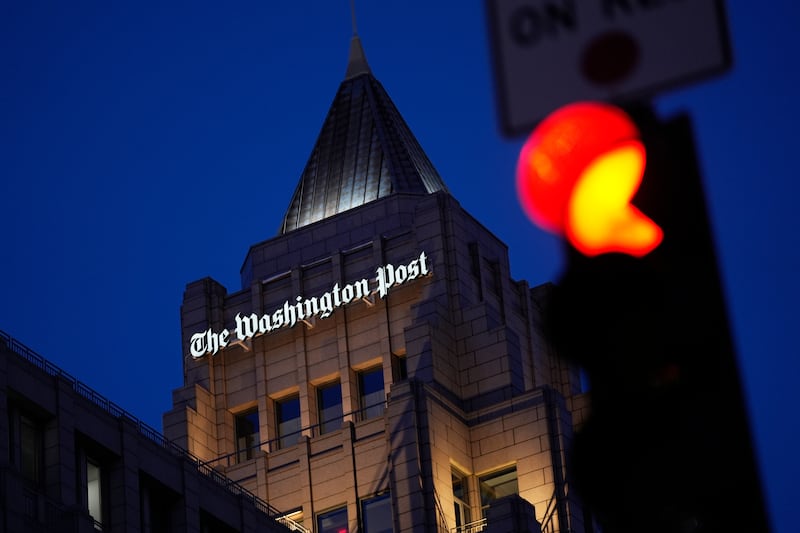

In the past three years, The Washington Post has lost more than employees and subscribers: It lost $277 million, according to a report from The Wall Street Journal.
That makes the Post’s cumulative losses more than what Jeff Bezos paid for the newspaper when he bought it in 2013.
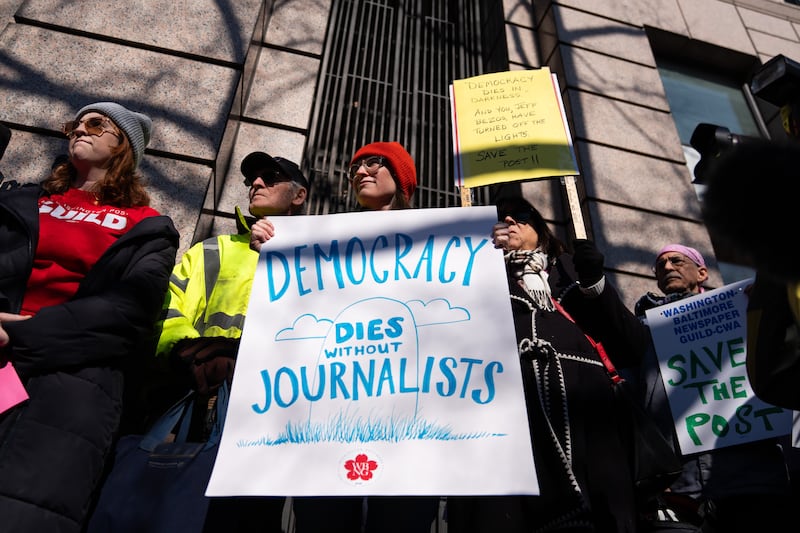
The Journal’s reporting, attributed to anonymous “people familiar with the matter,” provides context to recent layoffs that shrunk the editorial staff by more than 30% and cuts in its coverage, including that of books and sports.
The layoffs were widely decried by other media outlets and analysts; The New Yorker, for example, published an article, written by former Post editor Ruth Marcus, called “How Jeff Bezos Brought Down The Washington Post.” Similarly, The Atlantic published “How Jeff Bezos Broke The Washington Post.”

Last weekend, hundreds of people gathered at a Washington, D.C., bookstore for what The New York Times called “A Wake for The Washington Post’s Books Section.”
Per The New York Times, at that event, former Book World editor Marie Arana said that the Post, “once one of the most respected journalistic institutions in America, is enduring a mass demolition like no other.”
Reporting of the newspaper’s losses are unlikely to change that narrative, especially given the vast resources of its owner. (Fortune reported last month that he is worth $266 billion.) But the numbers do raise a legitimate question: How much should even the third richest man in the world be expected to lose in support of a newspaper that he bought intending to make it profitable?

According to Alexandra Bruell’s report in The Wall Street Journal, the Post lost $100 million in 2025, $100 million in 2024 and $77 million in 2023.
ProPublica editor Jesse Eisinger, on the day of the layoffs, wrote on social media that losses don’t matter to billionaires like Bezos.
But Bezos, per Business Insider, said in a statement that the changes were driven by data that shows what Post readers want.
“The Post has an essential journalistic mission and an extraordinary opportunity. Each and every day our readers give us a roadmap to success. The data tells us what is valuable and where to focus,” Bezos wrote.
And Gerard Baker, writing for The Wall Street Journal earlier this month, pointed out that newspapers have to change to adapt to a changing media environment, and that some journalists have played a role in losing the public’s trust.
“The list of recent media distortions — from the Russia-collusion hoax to Covid and Black Lives Matter — is long. But the most important form of bias, more insidious because it is necessarily hard to measure, isn’t what the news reports. It is what it chooses not to report,” Baker wrote in a column titled “The biggest threat to journalism? Journalists.”
At a newsroom meeting this week, Bruell wrote, acting CEO and Publisher Jeff D’Onofrio and Executive Editor Matt Murray “described years of overspending and declining productivity” even as the company continued to hire.
Per the Journal, “The number of news stories published by the Post has fallen by 42% since 2020, while newsroom costs were 16% higher in 2025 compared with 2020,” according to D’Onofrio.
The loss numbers that the Journal reported were not given at the staff meeting, but obtained independently by Bruell.
She reported that Murray, the executive editor, talked about the Post’s mission at the staff meeting Wednesday, saying, “We don’t want or need to do every story or jump on everything that happens. We’re not a paper of record; there’s no such thing anymore in today’s world.”
The “paper of record” remark was quickly highlighted on social media, held up as evidence of The Washington Post’s purported decline. (The New York Times declared itself “the complete newspaper of record” as early as 1937, and the term generally describes a publication of national import that serves as a historical record of events. Local newspapers can also be papers of record for the communities they serve, which is why the closure of nearly 3,500 newspapers since 2005 is so concerning.)
Regarding the Post’s losses, there was crowing from conservative critics of the mainstream media, with one column on Breitbart recasting the Journal’s headline as “Far-left Washington Post losses topped $100 million last year.”
Drew Holden, managing editor at the think tank American Compass, had a more nuanced take earlier this month, writing that the Post clearly had to make cuts, while still questioning some of the changes.
As for Bezos, he said when he bought the Post that change was coming and that it would be challenging.
In a missive to the newspaper staff in 2013, he wrote, “There will, of course, be change at The Post over the coming years. That’s essential and would have happened with or without new ownership. The Internet is transforming almost every element of the news business: shortening news cycles, eroding long-reliable revenue sources, and enabling new kinds of competition, some of which bear little or no news-gathering costs. There is no map, and charting a path ahead will not be easy. We will need to invent, which means we will need to experiment.”
Laid-off staffers might point out that Bezos also said, in that same letter, “follow the story, no matter the cost.”
Some, however, have already found new jobs: The Athletic, owned by The New York Times Co., announced this week that it has hired seven former Post staffers and is expanding its coverage of sports in the D.C. area.