

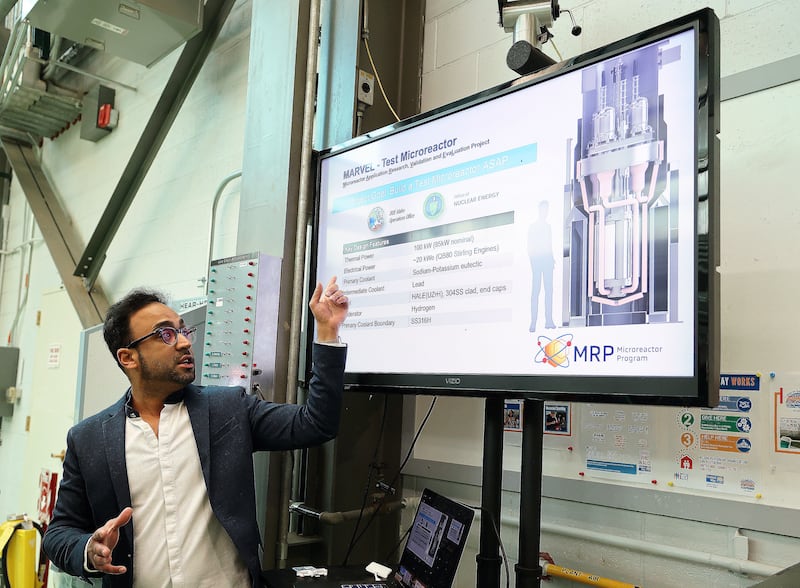

After three decades of stagnation, researchers in Idaho are making up for lost time in the nuclear innovation space.
The Microreactor Application Research Validation and Evaluation (MARVEL) project is developing a small, sodium-potassium-cooled nuclear reactor at Idaho National Laboratory.
Its goal is to help private companies build their own reactors “without having to reinvent the wheel,” the head of the project, Abdalla Abou-Jaoude, told the Deseret News.
His team just achieved two major milestones.
First, the Department of Energy approved their Preliminary Documented Safety Analysis report.
“That took I don’t know how many thousands of man hours to do the analysis, calculations, drawings — all these things to get reviewed by the department to make sure they’re OK with it," Abou-Jaoude said.
Second, the team finished MARVEL’s reactivity control system, which uses control drums instead of traditional vertical control rods.
This kind of tech hasn’t been used in four decades, Abou-Jaoude said. “We almost lost that knowledge, so we had to relearn all of it.”
Idaho National Laboratory researcher Anthony Crawford led the effort, and it’s now built and assembled.
“It’s pretty exciting,” Abou-Jaoude said. “The setup could be used by other companies. ... It’s like the people’s reactor. We’re not trying to make money off of it — it’s a taxpayer-funded project for private companies to learn from."
Trump’s nuclear energy executive order is speeding everything up
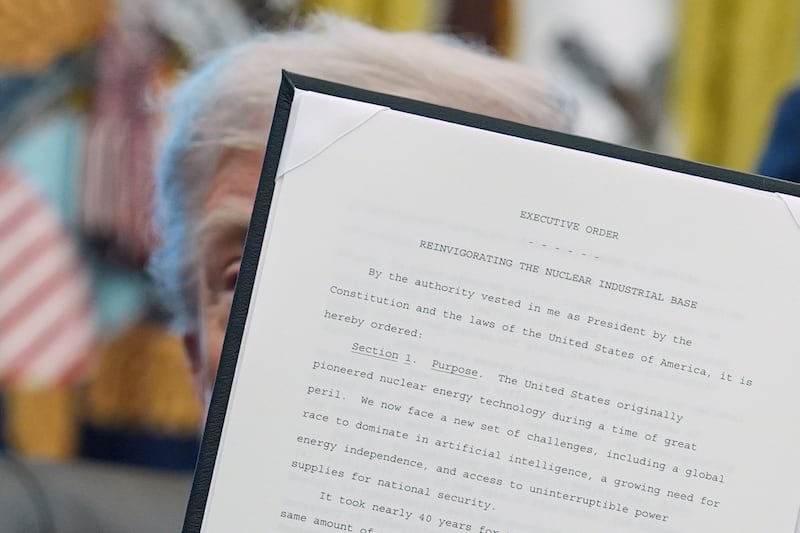
President Donald Trump signed a pro-nuclear power executive order last May, which has significantly sped up progress at INL.
“One of my colleagues, Brian Smith, likes to joke that, for a while these timelines were slipping to the right, and they’re finally now slipping to the left," Abou-Jaoude said.
The executive order has sped MARVEL’s progress up by at least a year. MARVEL was initially scheduled to “go critical” at the end of 2027, and now they’re targeting sometime between September and December of 2026.
“The executive order has really lined up everybody to push this all forward,” Abou-Jaoude said.
He added that a 2026 appropriations bill gave his team’s budget a significant boost. It appropriated about $1.8 billion for nuclear innovation and another $3.1 billion for small modular and advanced reactors.
What could MARVEL be used for?

INL has partnered with several private companies for potential microreactor applications.
In the artificial intelligence space, a microreactor like MARVEL could be coupled with a data center, which houses IT infrastructure like servers and storage drives.
“We’re working with some data center companies like Amazon Web Services,” Abou-Jaoude said. Regular transmission lines are so complex, data center companies “want to have their own islanded grid, with nuclear reactors providing their energy directly.”
The lab has also partnered with ConocoPhillips and NOV on nuclear-powered desalination, which could alleviate water challenges in oil and gas operations.
With these projects and others, MARVEL serves as a testbed, where private companies can “test novel applications of nuclear energy,” Abou-Jaoude said.