

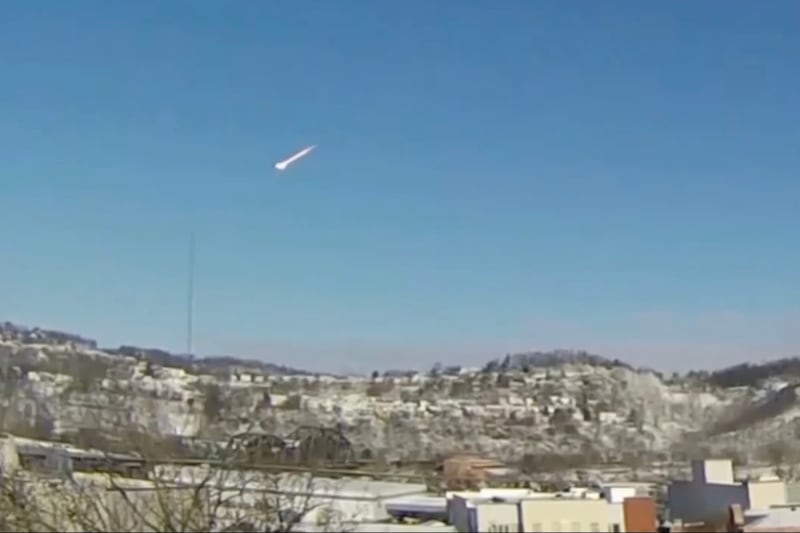

Is it a bird? Is it a plane? It’s a meteor.
Tuesday morning was anything but quite for residents in northeast Ohio and Pennsylvania when they heard unusual roaring in the sky.
The National Weather Service in Cleveland shared an update from Geostationary Lightning Mapper imagery that shared the likely culprit of the loud boom was a meteor.
Shortly after hearing the noise, residents took to social media to share what they heard and identify the source. One user on X shared, “Just heard a huge loud boom and our entire house shook.”
Another posted to Reddit, saying, “Sounded like a few sonic booms, and then rumbling. Not entirely consistent with aircraft, or thunder.”
The National Weather Service in Pittsburgh shared a video of a meteor rocketing through Earth’s atmosphere Tuesday morning.
“Now that’s something you don’t see (or hear) everyday. Just a casual meteor causing a sonic boom this morning in Northeast Ohio,” one X user said.
The American Meteor Society received over 100 pending reports from Illinois, Ohio, Pennsylvania, Kentucky, Virginia and Maryland, according to AccuWeather.
What is a sonic boom?
A sonic boom is a noise similar to thunder, caused by an object traveling faster than sound — about 750 miles per hour at sea level, the U.S. Air Force says.
“An aircraft traveling through the atmosphere continuously produces air-pressure waves similar to the water waves caused by a ship’s bow. When the aircraft exceeds the speed of sound, these pressure waves combine and form shock waves which travel forward from the generation or ‘release’ point,” according to the Air Force.
National Weather Service meteorologist Jim Sullivan said a helpful way to visualize the sound barrier is when you see a flash of lightning, then hear thunder, because light travels faster than sound, as reported by Cleveland.com.
What people hear on the ground is a “sudden onset and release of pressure after the buildup by the shock wave or ‘peak overpressure,’” the Air Force added.
Meteors, meteoroids and meteorites
NASA says rocky objects that travel through space are known as meteoroids. As soon as they enter Earth’s atmosphere, they become meteors as they create fireballs.
The fragments that reach Earth’s surface are called meteorites.
How often does this happen?
Scientists estimate about 48.6 tons of meteoritic material falls on Earth daily. Most come from comets and are not big enough to survive entrance into Earth’s atmosphere, NASA notes.
According to BBC’s Science Focus, meteors always create sound waves as they travel through Earth’s atmosphere, but they are not always loud enough to hear from the ground.