

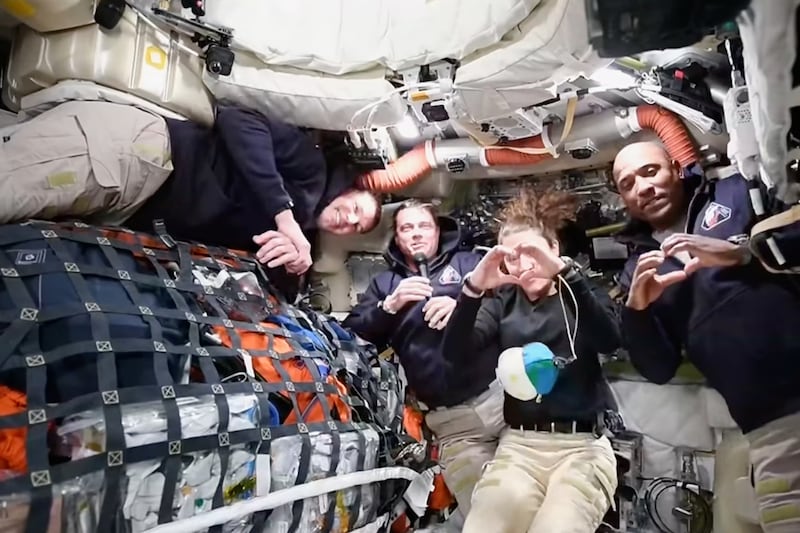

Ahead of Monday’s historic lunar flyby, the Artemis II crew took a moment Sunday to celebrate Easter while preparing to reach the farthest depths of space ever traveled by humans.
Before the crew carried out planned tests for Artemis pressure suits and flyby preparations, Commander Reid Wiseman, Victor Glover and Christina Koch presented “astronaut wings” to Canadian crewmate Jeremy Hansen, who is on his first spaceflight.
Earlier that day, Koch relayed Easter greetings to flight controllers and the rest of us here on Earth.
“This time of year is something that many religions and many cultures hold dear,” Koch said, according to CBS News. “It’s a time of emotions such as joy, as well as solemness, honoring what’s going on both in our world and in our religious beliefs.”
Koch also reflected on her family traditions. “If I was on the Earth right now, I would be with my family in Houston and we would be hiding confetti eggs in the backyard and watching two very sweet little girls go try to find them.”
The crew maintained the egg hunt tradition aboard the Orion spacecraft, hiding eggs around the cabin.
“They were dehydrated scrambled egg variety, but we’re all pretty happy with them,” Koch reported.

At the time of Koch’s Sunday message, the crew was 76,362 nautical miles from the moon and 168,000 miles from Earth, according to CBS News. The mission has already provided unexpected details of the lunar surface.
Glover shared his own Easter message alongside the rest of the Artemis II crew: “Whether you celebrate it or not, whether you believe in God or not — this is an opportunity for us to remember where we are, who we are and that we are the same thing and that we got to get through this together.”
The primary goals of Artemis II are to test the Orion moonship and refine procedures for future lunar landings. The mission also includes a full schedule of scientific observations.
Artemis II wake up calls with a twist

As the crew has gotten closer to reaching milestone moments on Monday, the crew has been woken up by a variety of songs from different artists, as is standard for the mission, but these wake up calls have started to include messages from previous astronauts.
Sunday, the crew awoke to CeeLo Green’s “Working Class Heroes” and a message from retired astronaut Charlie Duke.
“Hello Reid, Victor, Christina and Jeremy. This is Apollo 16 astronaut Charlie Duke,” he radioed. “John Young and I landed on the moon in 1972 in a lunar module we name Orion. I’m glad to see a different kind of Orion helping return humans to the moon.
On Monday, Day 6 of the mission, the crew was greeted by a message from Jim Lovell, the Apollo 8 pilot and Apollo 13 commander.
Lovell recorded the message before his death in August 2025 at the age of 97.
“Welcome to my old neighborhood,” Lovell said in the recording. “When Frank Borman, Bill Anders and I orbited the moon on Apollo 8, we got humanity’s first up-close look at the moon and got a view of the home planet that inspired and united people around the world. I’m proud to pass that torch on to you.”
A milestone day
At approximately 1:57 p.m. EDT Monday afternoon, the crew became the humans to travel the farthest from the Earth, passing the record set by the Apollo 13 crew in 1970.
After breaking the record, Hansen relayed a challenge back to the next generation of space explorers, via NASA’s livestream of the mission:
“We most importantly choose this moment to challenge this generation and the next to make sure this record is not long-lived.”
Hansen also proposed names for two newly discovered lunar features: “Integrity,” in honor of their spacecraft, and “Carroll,” in memory of Wiseman’s late wife.
The spacecraft is expected to reach a maximum distance of 252,760 miles from Earth at approximately 7:07 p.m. EDT before beginning its return home. At that point, the crew will be 4,070 miles above the lunar surface, its closest approach, according to NASA.
Communication will be lost for approximately 40 minutes starting at 6:44 p.m. EDT as the moon blocks radio signals while the ship passes behind the far side.

How to watch
NASA is providing 24-hour live coverage of the mission on YouTube, X, the agency’s website and smart TV applications.