

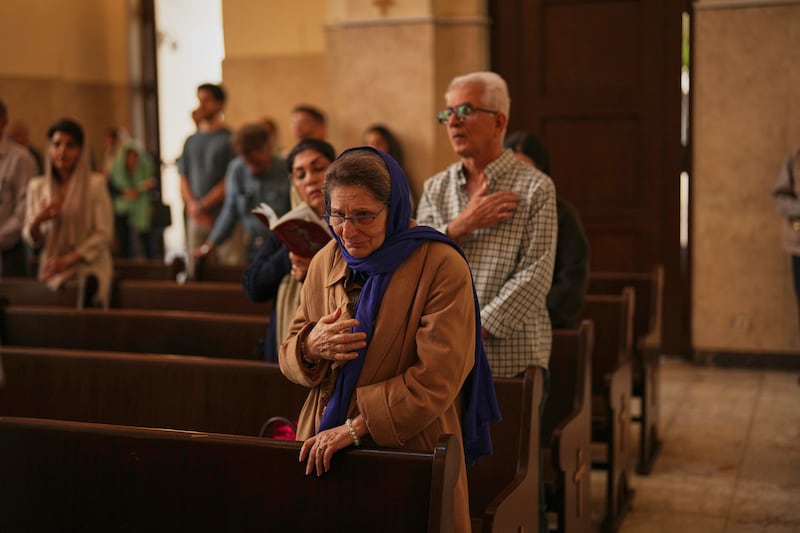

In the first 24 hours after the United States and Iran reached a ceasefire deal, several events have illustrated how “fragile” this truce is. There has been a reported “barrage” of Iranian attacks on Gulf nations, Israel has continued to attack Hezbollah (with Trump’s support), disagreement persists on negotiation starting points and, most critically, the Strait of Hormuz has closed again, according to Iranian state media.
Since the ceasefire depends on “the Strait of Hormuz remain(ing) open,” as White House press secretary Karoline Leavitt said, uncertainty continues. Leavitt herself, however, disputed reports that the strait was closed and reiterated this central demand from the president — namely, that the strait needed to be open with “no limitations,” including tolls.
Deseret News recaps four diverging takes on this critical moment in the war and what it may mean for what comes next.
Aaron MacLean, national security analyst at CBS News
“Trump’s threats seem to have gotten Iran to agree to open the strait,” CBS News national security analyst Aaron MacLean stated in a column for The Free Press. “But agreeing to do something and doing it are different things.
“It is possible that the ceasefire turns out to be merely nominal, and we will in a few short days be back in the same situation we were in on Tuesday, with Trump making dramatic threats nobody knows if he is bluffing about, and Iran using its ability to effectively close the Strait as its leverage.
“Should that happen,” MacLean continued, “and if Mr. Trump really can’t stomach the idea of extended convoy operations, then a campaign designed to produce state collapse — the very regime change about which the president was so ambivalent about a month ago — is the remaining option.
“For now, though, the sides have kicked the can with the ceasefire, despite its uncertain terms and uncertain enforcement of those terms,” he wrote. “If the ceasefire doesn’t lead down the path toward diplomacy, or surrender, or Trump simply losing heart and moving on, we will be back in the standoff that gripped the world on Tuesday. And if that happens, Trump will hold the same cards.”
MacLean noted that “the Islamic Republic faces massive risks of its own. It is already weakened and impoverished as a result of the war its proxies began in 2023. And for all its stubborn fervor, running a state takes cash, as does oppressing a population.”
Voice from central Iran speaking with reporter
Amy Kellogg, a former senior foreign affairs correspondent for Fox News, recounted her Tuesday night call with an Iranian man she called Reza (his name has been changed for his safety) who lives in Isfahan, several hours south of Tehran. The man reported that airstrike damage in his city in recent weeks had “been confined to strategic targets like the police headquarters, a Revolutionary Guards base, and a gas station on a property occupied by the Islamic Revolutionary Guards Corps.”
In the evening, Reza described residents going up on the rooftops to watch bombs landing on the city, confident they weren’t aimed at residences. “For us,” he said, “they are happy explosions.”
“Trump is really praised in Iran right now,” the Iranian told Kellogg. “I wasn’t a Trump supporter before,” he said, but admitted this past month’s attacks have made him a fan.
When learning of the ceasefire, Reza sighed and acknowledged feeling deflated, believing the regime had potentially secured “a lifeline.”
In a text message to the reporter, he said that regime supporters are “already out on the streets celebrating.”
Fareed Zakaria, CNN analyst
Fareed Zakaria said on CNN that the negotiations have been “almost a casebook in how not to negotiate.”
“It’s not surprising that the ceasefire is fragile,” he said. “You have no actual negotiation going on between the two parties. You have no real trust built up between them.”
“What this war has done is handed Iran a weapon that is far more usable than a nuclear weapon,” the foreign policy analyst said, “which is the Strait of Hormuz choking off global oil supplies, essentially disrupting the global economy.”
Zakaria called this the “single biggest strategic shift that’s taken place, and strategic loss for the United States and its allies.”
The Iranians have realized they “have this weapon, they can use it, they can turn it on and off at will.” That means, he argued, “the United States and its Gulf allies are, in a sense, hostage to Iranian good graces in order to get their product out.”
Zakaria then explained that the U.S. military has fought since 1799 against other countries and pirates to preserve “freedom of navigation.”
“That is what has been given up here,” he said, due to this emerging “idea that Iran can control one of the key choke points of the world economy.”
Emphasizing how open the strait has been across decades of tension, Zakaria said, “The United States and Israel have somehow handed Iran a weapon at the end of this that they never had. ... It’s a very strange outcome. So much for the art of the deal.”
Mark Dubowitz, Foundation for Defense of Democracies
“I think it’s very unlikely President Trump would ever agree to the demands that the Iranians have put forward,” Mark Dubowitz, the CEO of the Foundation for Defense of Democracies, said on Fox. He acknowledged that “there is certainly a planetary difference between the U.S. demands and Iranian demands.”
In anticipation of Iran’s diplomatic posture, he added, “I doubt that they will negotiate in good faith. I think they are committed to resistance at all costs.”
Yet, he said, “the regime is now facing the prospect of complete elimination ... they want to stay alive, and they have to understand that there has to be some kind of deal. And the real question is: What are they willing to concede on? They have got to concede on the nuclear program, on the ballistic missile program, on support for terrorism.”
Dubowitz predicted, “President Trump did not come into office — and will not leave office — with this regime in charge of the Strait of Hormuz and with deadly capabilities that can threaten the United States and our allies.”