

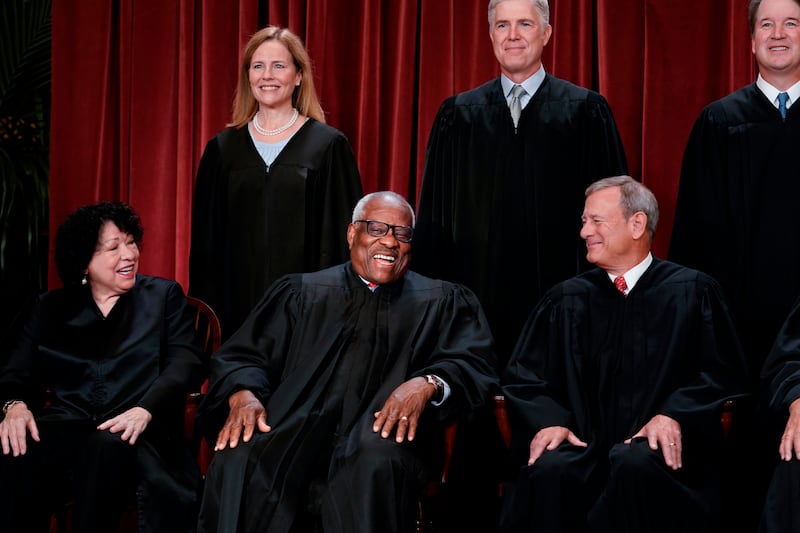

On May 7, Clarence Thomas became the Supreme Court’s second-longest serving justice.
Nominated by President George H.W. Bush, Thomas was sworn into the Supreme Court on Oct. 23, 1991, following a contentious Senate confirmation process, and has now served for 34 years and 200 days.
Thomas has been said to be the court’s primary originalist, someone who tries to interpret the U.S. Constitution according to the understanding of the Founding Fathers.
| Rank | Name | Length |
|---|---|---|
| 1 | William O. Douglas | 36 years, 209 days |
| 2 | Clarence Thomas | 34 years, 200 days |
| 3 | Stephen Johnson Field | 34 years, 195 days |
| 4 | John Paul Stevens | 34 years, 192 days |
| 5 | John Marshall | 34 years, 152 days |
Earlier this month, Thomas passed both Stephen Johnson Field and John Paul Stevens on the list. The two were appointed by Abraham Lincoln and Gerald Ford, respectively.
Sitting ahead of Thomas is William O. Douglas who served on the Supreme Court for 36 years and 209 days.
Thomas’ early journey took him from cynicism to idealism and faith
Growing up, Thomas hoped to become a Catholic priest. However, after joining a seminary, Thomas became disillusioned with perceived racism within the church.
“I got angry back in the 1960s” said Thomas, “I turned my back on what I had been taught and I fell away from my faith.”
Thomas subsequently joined the Black Panthers, a Black Power organization. One day, he found himself in what he described as a riot in Boston that sparked self-reflection.
“I realized that I was full of hate,” said Thomas. “I remember going in front of the chapel and saying, ‘Lord, if you take this anger out of my heart, I’ll never hate again.’”
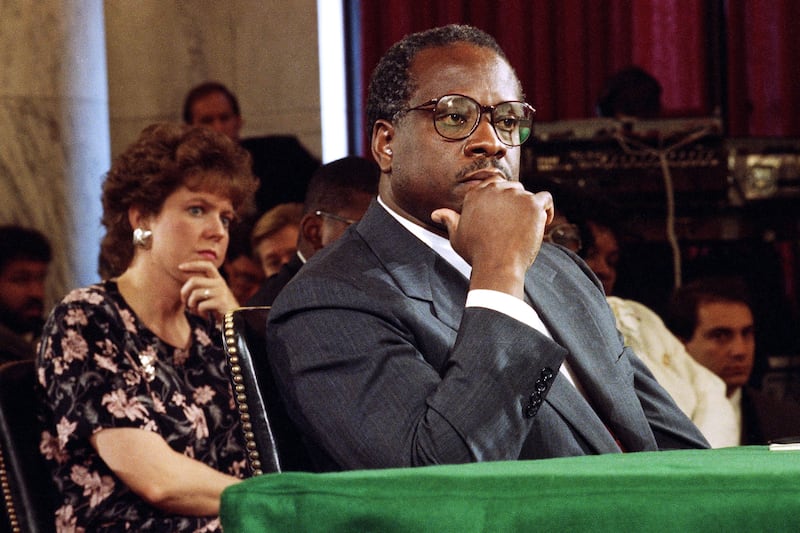
This was Thomas’ first prayer in years and said that it “was the beginning of my process back. I went from anger and hatred to cynicism, and then to trying to figure things out.”
“I’m more idealistic than I’ve ever been. ... I was something like the prodigal son, slowly making my way back to what I had abandoned,” said Thomas.
A history of solo dissents
In the history of the Supreme Court, Thomas ranks 10th for most solo dissents by a justice.
Amid his service, Thomas has often faced immense criticism for being a Black conservative.
When Thomas was nominated to the Supreme Court, he was opposed by the NAACP. He was also initially excluded from the National Museum of African American History and Culture.
In 1998, Thomas was met with backlash when he was named the keynote speaker at the National Bar Association, a largely Black lawyers’ association.
“I have come here today not ... to defend my views” Thomas said, “but rather to assert my right to think for myself. ... I’ve come to assert that I am a judge and I will not be consigned the unquestioned opinions of others.”
When asked once if he ever feels lonely in his decisions, Thomas replied with a story about Justice (John Marshall) Harlan. Harlan was the sole justice to dissent on Plessy v. Ferguson, the case that set forth the idea of “separate but equal.”
“Do you think he was popular?” asked Thomas. “Popularity isn’t of high value to me. I set out to do my best to be right.”
Thomas’ philosophy of interpretation and his most important cases
John Yoo, a law professor at University of California, Berkeley, said during an interview hosted by American Enterprise Institute that Thomas may be “the most committed to interpreting the Constitution based on the understanding of those who drafted and ratified it.”
Thomas has consistently argued that the Constitution does not have a basis for the right to abortion.
In 2022, the court struck down the constitutional right to an abortion in Dobbs v. Jackson Women’s Health Organization.
About abortion, Thomas said that the Supreme Court had previously “transformed judicially created rights like the right to abortion into preferred constitutional rights, while disfavoring many of the rights actually enumerated in the Constitution.”
In his rulings, Thomas has also staunchly opposed affirmative action. Affirmative action refers to policy designed to eliminate and prevent discrimination or to attempt to resolve the effects of past discrimination.
In 2023, the court effectively struck down affirmative action based on race in Fair Admissions, Inc. v. President and Fellows of Harvard College.
Thomas is also a proponent of federalism. When the Supreme Court held that states could not instate term limits for congressional candidates in U.S. Term Limits, Inc. v. Thornton, Thomas dissented.
Thomas said that the Constitution did not speak on this matter. He then said that the court had violated the Constitution’s “one overriding principle” that “All power stems from the consent of the people.”
Who was the longest-serving Supreme Court justice?
William O. Douglas was appointed to the Supreme Court by President Franklin Delano Roosevelt at the age of 40.
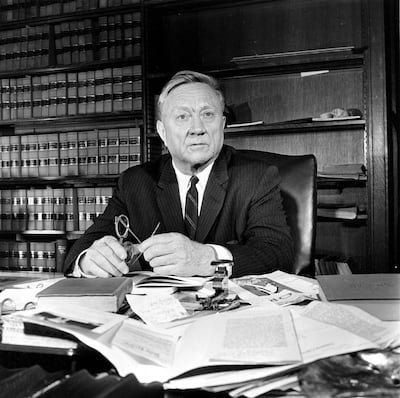
He is often cited as the most progressive Supreme Court Justice in U.S. History.
Similar to Thomas, Douglas faced controversy throughout his career.
Douglas was widely acclaimed as a genius and has set the record for many Supreme Court metrics.
Some, however, such as Richard Posner, a retired federal judge, were more critical. Posner said that Douglas was “foul-mouthed, self-absorbed, and devoured by ambition.”
Although Douglas was the longest serving, there were many who were much older than him when they left office.
Oliver Wendell Holmes Jr., appointed by President Theodore Roosevelt, was the oldest justice ever to serve. He retired from the court at the age of 90.
In order to pass Douglas, Thomas would need to serve well into 2028.
“I think Justice Thomas will retire no earlier than 8 years from now,” Yoo said on a podcast. “I think most of them would like to retire under a president and a senate likely to appoint someone who shares their approach to deciding cases.”
Term limits and the future of the Supreme Court
Renewed discussion of term limits has taken place in recent years.
The U.S. Constitution states that justices “shall hold their Offices during good Behaviour.”
This is broadly interpreted to mean that a justice may serve until death, resignation, or removal from office.
Multiple members of Congress have proposed bills in recent years to establish term limits for Supreme Court justices.
Such proposals would establish 18-year terms for justices while also creating regularly occurring appointments by presidents.
“There have been debates about term limits since the beginning of our republic,” said current Supreme Court Justice Ketanji Brown Jackson. “It’s a political process ... and in our democracy, people are engaging in that debate right now.”