

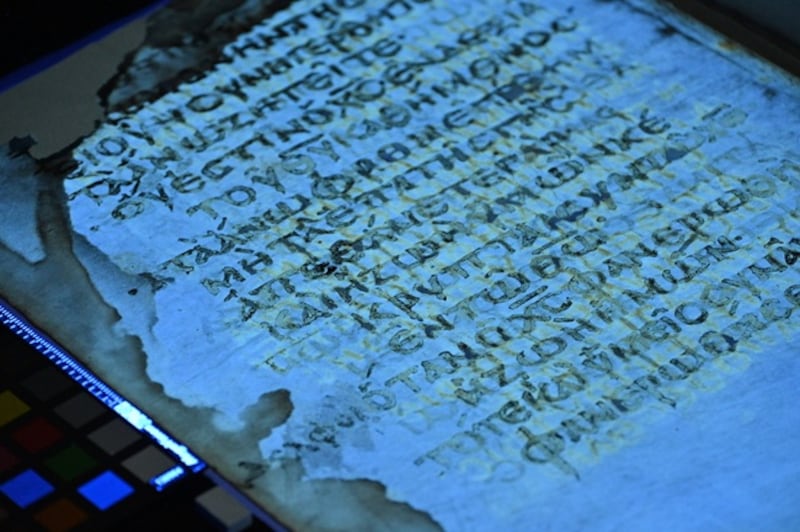

Researchers have recovered 42 lost pages of an early New Testament manuscript and used advanced imaging to read “ghost” text that has been invisible for centuries, according to the University of Glasgow.
The project, led by professor Garrick Allen of the University of Glasgow and Kimberley Fowler of the University of Groningen, successfully recovered portions of what researchers call Codex H. The sixth-century manuscript contains letters written by the Apostle Paul that were taken apart in the 13th century in Greece, per the University of Glasgow.
During the Middle Ages, the manuscript was essentially recycled. Its pages were re-inked and used as binding material and end papers for other documents. Today, fragments of the Codex H were found in libraries in Italy, Greece, Russia, Ukraine and France, according to the researchers.
While the discovery doesn’t add new verses to the Bible, it is broadening modern understanding of how the text was handled and read by people centuries ago.
“The breakthrough came from an important starting point: we knew that at one point, the manuscript was re-inked,” Allen said. “The chemicals in the new ink caused ‘offset’ damage to facing pages, essentially creating a mirror image of the text on the opposite leaf — sometimes leaving traces several pages deep, barely visible to the naked eye but very clear with latest imaging techniques.”
The “ghost” imprints were often several pages deep. While invisible to the naked eye, they became visible through multispectral imaging, a process that layers different light wavelengths to reveal hidden data, Allen continued to note.
The ability to see the history of the pages and what was written allowed researchers to uncover several pages of information from just one physical page.
To ensure historical accuracy, the team worked with Paris-based experts to radiocarbon date the pages, confirming their sixth-century origins, according to the University of Glasgow.
What was hidden in the ‘ghost’ text?
The recovered pages contain the oldest known “table of contents” for the Letters of Paul, revealing that ancient readers organized their scriptures in a significantly different way than we do today.
The find also offers insight into Euthalian tradition — “a series of lists, prefaces and cross-references” that were attached to Acts, Paul’s Letters and the Catholic Epistles in hundreds of Greek New Testament manuscripts and their origins and function in society, according to the researchers.
“Given that Codex H is such an important witness to our understanding of Christian scripture, to have discovered any new evidence — let alone this quantity — of what it originally looked like is nothing short of monumental," Allen said.
Key findings from the manuscript include:
- Ancient chapter lists: The pages contain the earliest known examples of chapter lists for Paul’s Letters, which are significantly different from how we divide them today.
- Scribal insights: The documents show how sixth-century scribes annotated and interacted with sacred texts, offering a window into their theology.
- Historical recycling: The physical state of the pages demonstrates how sacred manuscripts were reused and repurposed once they were worn.
The project was funded by the Templeton Religion Trust and the Arts and Humanities Research Council, with the cooperation of the Great Lavra Monastery.
While a printed edition of Codex H is on its way, a digital version is already available to the public.