



Venezuelan father Harold Fuentes said he has hope for the future of his home country, as he reflected on where things stand in the country now, months after the arrest and capture of former president Nicolás Maduro by U.S. Special Forces.
However, corruption embedded in Venezuela’s regime has prevented meaningful change to their struggling economy in Maduro’s absence, he said, and will continue to do so absent a free and respected election.
“I know that my family is very grateful for Donald Trump and this situation post-Maduro. But it will take the economy a long time to stabilize,” Fuentes told the Deseret News.
Maduro was captured on Jan. 3, and transported to the United States. He is currently being held in the Metropolitan Detention Center, a jail in Brooklyn, New York.
When Maduro entered office in 2013, Venezuela’s poverty rate was around 27%. In 2024, two years before his arrest, it had increased to 82%. With Maduro’s absence, Venezuela’s extreme poverty rate has continued to climb. In 2026, a majority (56%) of Venezuela’s population has difficulty accessing basic human necessities, according to the European Commission.
Fuentes watched Venezuela’s economy deteriorate
Fuentes was born and raised in Venezuela. He was 37 years old when Hugo Chávez assumed power. During Chávez’s first term, the country did pretty well economically.
“The oil price was very high,” Fuentes said. But throughout the socialist leader’s second term, “the oil price went down, down down, then the economy started going bad.”
Chávez was elected president in 1998. During his 15-year presidency, he consolidated power and became seen as a dictator. Maduro was Chávez’s hand-picked successor, and he took over rule of the country after Chávez’s death in 2013.

Due to several government-sanctioned threats to his life, Fuentes and his family left Venezuela in 2017. After living in Equador and Peru, the Fuentes family immigrated to Florida and later settled in Salt Lake City, Utah.
Fuentes’ 23-year-old son Jared remembered the noticeable decline of Venezuela’s economy throughout his childhood.
“I remember as a kid, with 10 bolívares I was able to buy a bunch of food and drinks, but eventually that changed,” Jared told the Deseret News.
Before 2012, Jared recalled leaving the supermarket with a cart filled with food, but gradually they would leave the store with less.
“When I was in my teenage years, from 11 to 14ish, I didn’t go to the supermarket because there was nothing there. It was really empty,” he said.
Eventually, members of the Fuentes family would wait in lines outside grocery stores from midnight until noon, “just for a simple piece of chicken and bread,” Jared said.
In 2016 and 2017, Jared recalled watching his 13-year-old peers eat out of the trash, since they had nothing at home.
“If you see people, they were so skinny, not because they worked out, but because they didn’t have any food and were looking for food in the trash,” he said.
Inflation continues to grow after Maduro’s arrest
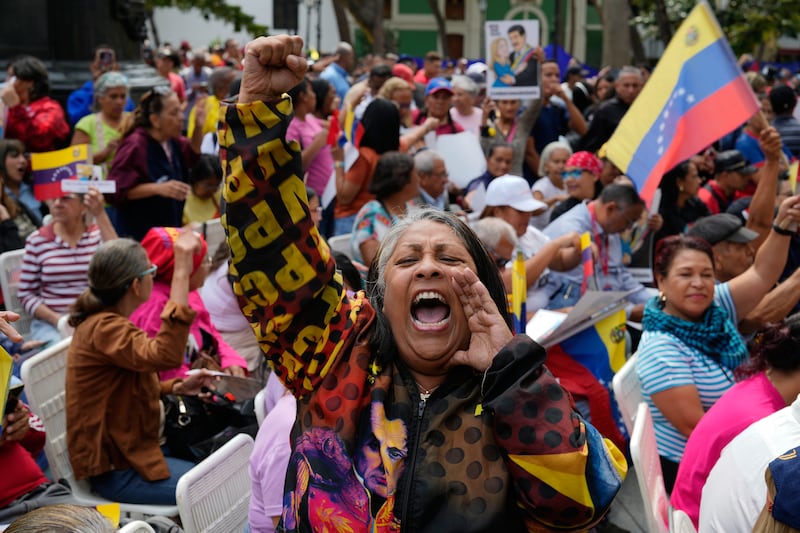
Life for the average Venezuelan has not materially changed with Maduro’s absence, according to economic indicators. And outside the dictator’s removal, Venezuela’s core authoritarian leadership remains intact. Acting President Delcy Rodríguez served as Maduro’s vice president for more than seven years.
During Maduro’s final month in office, Venezuela’s inflation rate was 475%, according to the trade publication Trading Economics. Three months into his absence, it had risen to 650%, with an exchange rate gap hovering around 50%. Since January, the value of Venezuela’s currency, the bolívar, fell at least 36%. The country’s monthly minimum wage sits at 27 cents.
As a consequence, the fiscal crisis has rendered many Venezuelans destitute.
In 2024, 82% of the population lived in poverty, with about half (54%) living in extreme poverty. In 2026, the extreme poverty rate has grown to 56%, according to the European Commission.
Within the last year, a majority (54%) of the wealthiest 20% had difficulty affording food.
In search of financial and political stability, nearly 25% of Venezuela’s population (7.9 million citizens) left the country between the time Maduro took office in 2013 and when the U.S. arrested him for narco-terrorism and cocaine trafficking in 2026.
International investors appear cautiously interested

But amid Venezuela’s struggles, there’s a reported buzz of optimism about possible economic growth.
American oil operators are looking at re-launching production in Venezuela, after being looted and forced out of the country nearly two decades ago.
American investors, engineers and lawyers were spotted meeting with acting President Rodríguez throughout March and April, according to media reports, pitching plans to revive under-utilized oil fields. Wary oil giants Exxon Mobil and ConocoPhillips were also reportedly in the country following Maduro’s ouster, giving potential investments a second look.
Jon Hughes, the CEO of a Texas-based investment bank, was in Caracas at the end of April. He told The Wall Street Journal, “It was unmistakable, the sense of impending opportunity.”
“There were so many Americans meeting with so many Venezuelans. Both sides are engaged in a constructive way, with a shared vision of making things function better and getting production up,” Hughes said.
Simultaneously, the first commercial flight between the U.S. and Venezuela took off from Miami at the end of April, marking the first time in seven years.
Diplomats and businessmen celebrated the milestone, according to The Wall Street Journal. John Barrett, the U.S. chargé d’affaires at the American embassy in Caracas, heralded the flight as an omen to Venezuela’s “economic engine ramping up.”
“We’re just getting started,” he said.
Fuentes: Venezuelans ‘have hope’ after Maduro
“Jan. 3, 2026 — that day will be in Venezuela’s history forever," the elder Fuentes said. “After Maduro, many people, my family, my friends, my colleagues in Venezuela have hope. They are optimistic about the situation because everybody knows we need a new election.”
Fuentes and his wife have 13 siblings who still live in Venezuela.
“The situation post-Maduro is very complex, because it’s only been a very short time,” Fuentes explained. “The government model is still in the country.”
He continued, “The most important thing is political change. We need political change. We need an election.”
Daniel Di Martino — a Venezuelan immigrant and Manhattan Institute fellow, pursuing a doctoral degree in economics at Columbia University — echoed Fuentes’ sentiment in an interview with the Deseret News.
“As long as the current regime is in power, Venezuela cannot become a rich country,” Di Martino said.
He referenced the recent buzz among American investors, seemingly encouraged by Venezuela’s acting president.
“They’re being deceived,” he said. “It’s the pro-regime cronies who are taking them on trips that these people pay thousands of dollars to go on.”
If Venezuela were a safe place to do long-term business, which oil drilling requires, “you would have seen all the oil companies investing billions and billions, opening new drills and things improving quickly,” Di Martino said.
Instead, oil expansion has proceeded slowly. In April, Venezuela’s oil exports rose 14% from March levels, to 1.23 million barrels a day, according to trade sites.
Through the remaining 2½ years of President Donald Trump’s term, Di Martino predicted that Venezuela’s leadership will comply with the U.S., and “as soon as he’s out of office, they’re going to go back to what they were doing two years ago.”
“What Venezuela needs is not short-term investments. What Venezuela needs is restarting the electric grid, the water pipes, increased oil drills, all of that,” he said.
Is political change in Venezuela possible?
In 2023, Venezuelan politician María Corina Machado won the opposition’s presidential primary with more than 90% of the vote. Though Venezuela’s Supreme Court barred her from running in an election for 15 years — forcing her to withdraw from that general election — Machado has become a trusted voice in Venezuela for democracy.
In 2025, she won the Nobel Peace Prize “for her tireless work promoting democratic rights for the people of Venezuela and for her struggle to achieve a just and peaceful transition from dictatorship to democracy.”
After hiding from the regime for more than a year, Machado told NPR she hopes to return to Venezuela by the end of 2026.
Di Martino predicted that once Machado goes back to Venezuela, “we’re going to see the most massive protests we’ve ever seen.”
“Then the Venezuelan regime is not going to be able to kill them because Trump is going to threaten them. That can actually trigger change,” he said.