

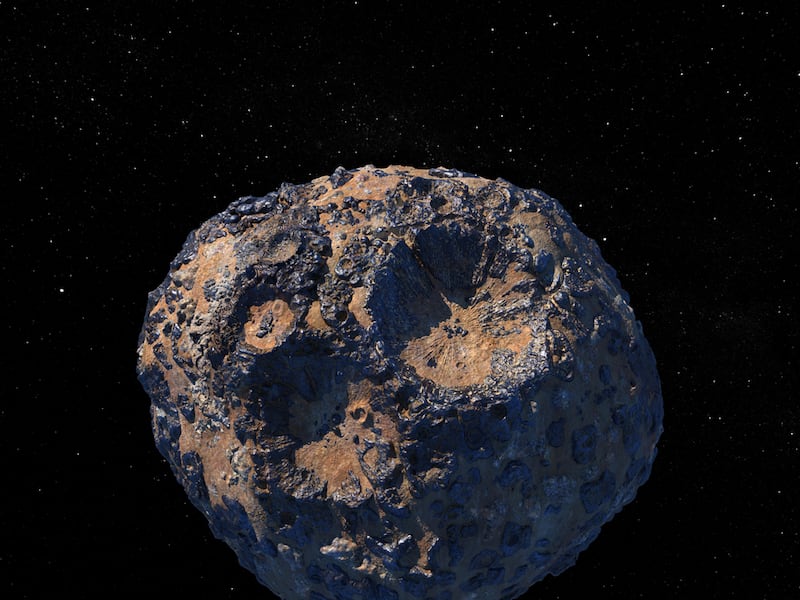

- Mount Lemmon Survey astronomers spotted an asteroid headed for the vicinity of Earth on May 10.
- The bus-sized rock, designated 2026 JH2, will pass by Earth at about 24% of the distance to the moon.
- Scientists say there's no cause for concern but are preparing for a future potential Earth-killer asteroid.
A distance of 56,000 miles may sound like a lot but it’s just a whisker on the scale of space encounters and it’s how close a newly-discovered asteroid will come to Earth when it passes by Monday.
Astronomers with the Mount Lemmon Survey in Arizona identified the asteroid on May 10 and follow-up observations by the European Space Agency estimate the near-Earth object is 52 to 114 feet based on its brightness, according to a report from Space.com.
Designated 2026 JH2, the asteroid will come closest to Earth, a distance of 56,913 miles, just before 4 p.m. MDT on Monday.
Although the flyby is considered a close call by scientists, the space rock poses no danger, according to Richard Binzel, a professor of planetary sciences at the Massachusetts Institute of Technology.
“2026 JH2 will pass safely by the Earth,” Binzel said in an email to CNN. “This is actually a rather normal occurrence, car-sized objects pass between the Earth and the moon every week. At the size of a school bus, these pass through our neighborhood several times per year.”
Binzel also noted that before asteroid tracking efforts like the Mount Lemmon Survey were active, objects like 2026JH2 would zoom by without notice.
“We are only recently developing surveys that are sensitive enough to see them,” Binzel said.
A livestream of the close encounter can be viewed on the free Virtual Telescope Project’s YouTube channel, with coverage beginning at 1:45 p.m. MDT.
“At the time of the observation, the object will be moving pretty fast against the stars, but our advanced telescopes will precisely track 2026 JH2 while it will be almost at its minimum distance from us, peaking in brightness, around magnitude 11.5, before it will set below our horizon," Virtual Telescope Project founder Gianluca Masi told Space.com in an email.
How to defend Earth against a future killer asteroid?
Back in 2022, NASA successfully crashed a spaceship into an asteroid in a test of its ability to divert a future space rock on a collision course with Terra Prime.
Sponsored by NASA’s Planetary Defense Coordination Office and led by the Johns Hopkins University Applied Physics Laboratory, the Double Asteroid Redirection Test, or DART, was a $325 million project designed to crash the 1,260-pound spacecraft traveling at 14,000 mph into Dimorphos, an asteroid that’s 525 feet in diameter and 7 million miles from Earth.
Dimorphos is a moonlet asteroid, orbiting a larger asteroid named Didymos, which is about a half-mile in diameter. Mission officials have stressed that the binary system “is not on a path to collide with Earth and therefore poses no actual threat to the planet” but is the “perfect testing ground” to see if an asteroid’s natural path can be altered via a high-velocity impact.
About a month after the collision, NASA confirmed that the impact had changed the time it takes Dimorphos to make one revolution around Didymos from 11 hours and 55 minutes to 11 hours and 23 minutes — a difference of 32 minutes.
Thanks to an onboard camera system that streamed at one-image-per-second back to Earth, mission engineers, along with the viewing public, had a real-time view, albeit one delayed by the 45 seconds or so that it takes for the video to process and stream back to Earth-based receivers, capturing DART’s approach and collision with Dimorphos.
According to a 2024 report from NASA’s Jet Propulsion Laboratory, out of more than 730,000 known asteroids, about 16,000 are near-Earth objects. Of those, 1,784 are potentially hazardous asteroids. But the report notes risks of a large asteroid impacting Earth are exceedingly rare.