
SALT LAKE CITY — Another nearly 2,000 people in Utah have tested positive with COVID-19, trending, again, in the wrong direction, state health officials said on Thursday.
Societal consequences, in the form of limited and rationed health care, are looming.
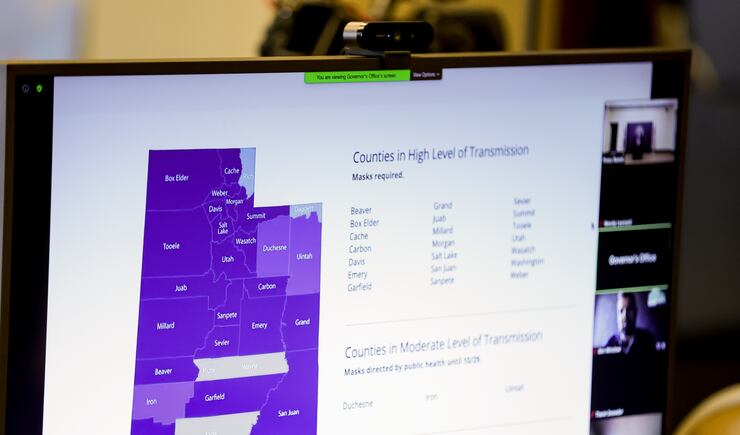
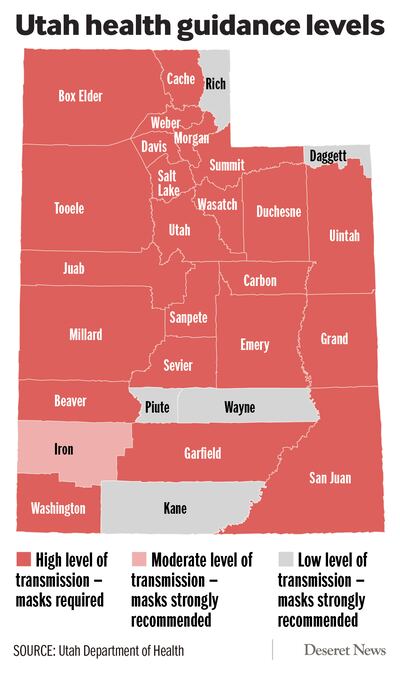
Two more counties — Uintah and Duchesne — have moved from moderate transmission status to high levels of transmission. Masks are required throughout the majority of the state, in 23 of 29 counties, according to the Utah COVID-19 Transmission Index, which was updated on Thursday.
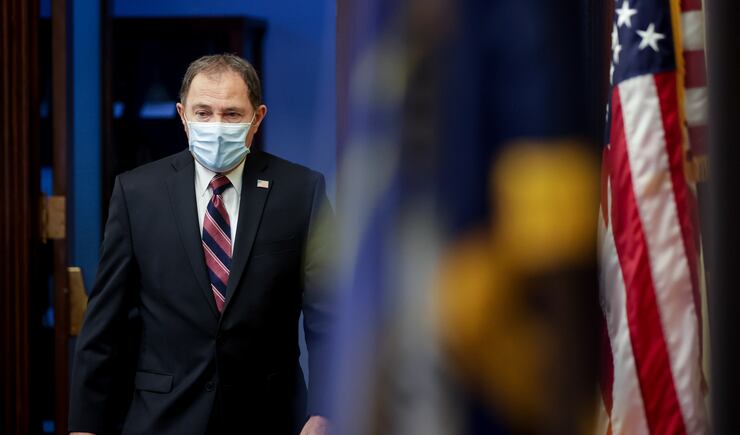
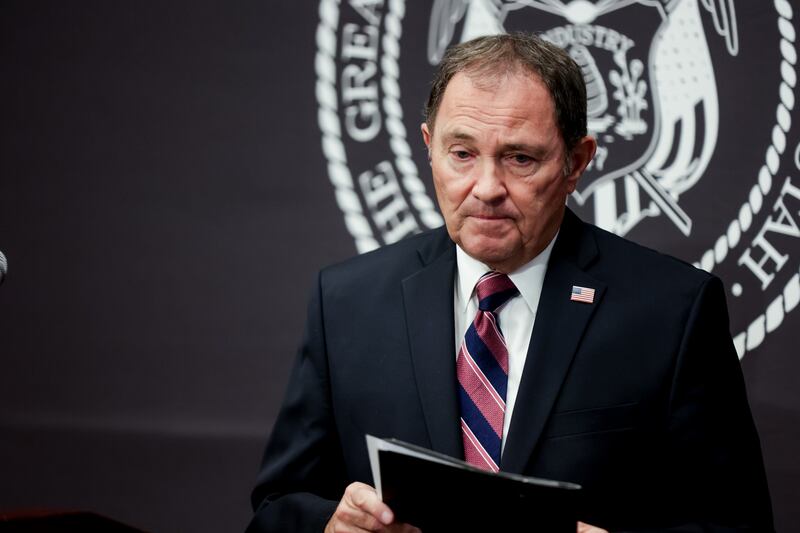
“It’s no longer just a pleasant request ... it is now a public health order,” Utah Gov. Gary Herbert said during his weekly COVID-19 update. The governor has not issued a statewide mask mandate, but has left the decision up to local jurisdictions and data specific to those regions of the state.
He said masks can and do help to mitigate the risk of spreading the virus.
Transmission levels are high in 23 counties, moderate in one, and low in five, Herbert said.
“We’re far too close” to having to enact crisis standards of care in Utah hospitals, he added.
The Utah Department of Health on Thursday announced an increase of 1,837 new cases and an additional 11,232 people tested in Utah.
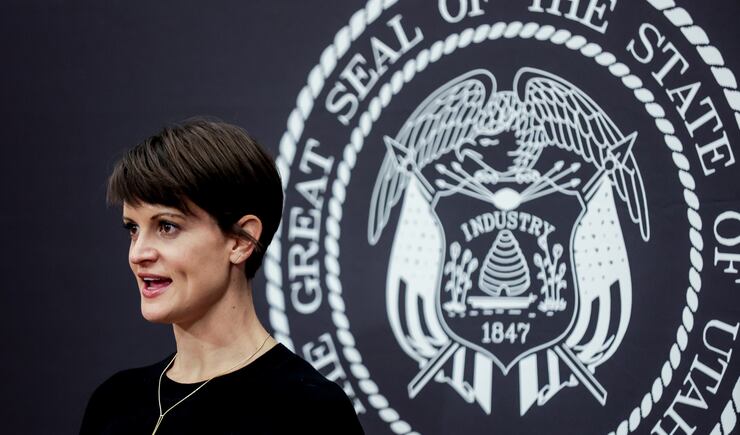
The rolling seven-day average number of positive tests is now 1,578 per day, up from 1,289 a week ago, said Utah epidemiologist Dr. Angela Dunn. She said the rolling seven-day average for percent of positive laboratory tests is 18.1%, which is also up from 15.5% last Thursday.
Among 15- to 24-year-olds in Utah, she said, the percent positivity is higher, over 20%.
And 317 people are hospitalized with COVID-19 throughout Utah.
Some hospitals are already referring patients elsewhere.
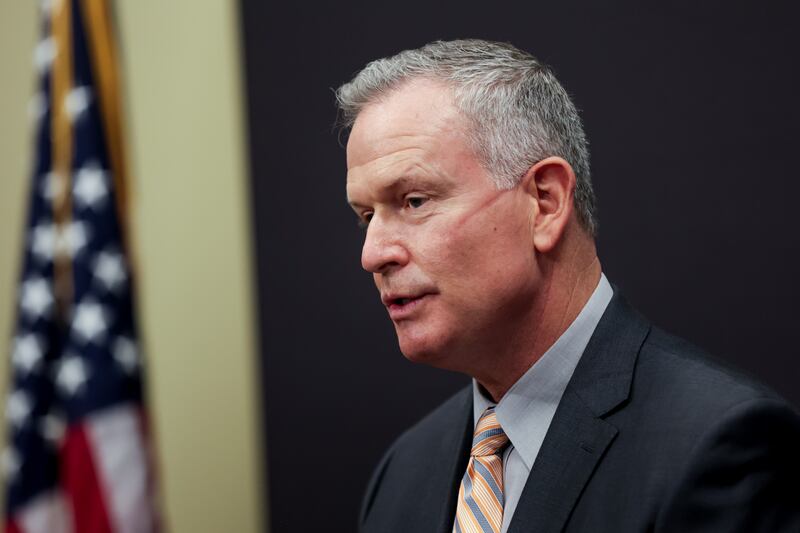
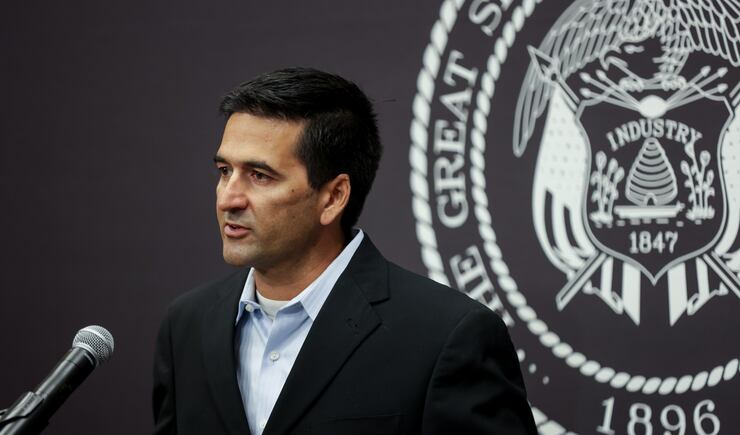
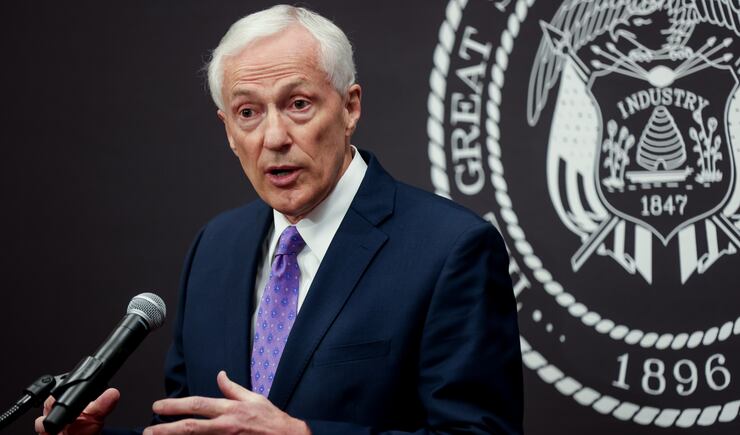
“It’s not just about COVID. It’s about anyone who has an issue that takes them to the hospital,” said Rich Saunders, interim executive director at the Utah Department of Health. “It’s about patients waiting for hours and hours for emergency surgery or emergency care.”
“We are in the midst of a pandemic and it is now virulent among us,” said Greg Bell, president and CEO at the Utah Hospital Association. He said he expects hospitals will be forced to ration care within the next two weeks if the surge in cases continues as it is.
“The work is hard and it is endless and we embrace it,” said Dr. Mark Shah, an emergency physician and chairman of the Utah Hospital Association’s Crisis Standards of Care Committee. “Despite those best efforts, health care is still finite.”
“In times of scarcity, we want to do the greatest good for the greatest number,” he said, adding that should the state’s hospitals be forced into crisis standards, patients will be treated based on the severity of their illness.
Shah said the state’s mission, since the beginning of the pandemic, has been to “empower and enable Utahns to help Utahns get through this.”
“We can continue to argue and disagree about lots of things, politics and sports, upcoming elections,” he said. “We cannot continue to argue about masking. We cannot continue to argue about whether this pandemic is real or made up. And we cannot continue to argue that health care will do just fine regardless of the demand. That is not true.”
Dunn said current testing protocols aren’t even catching every case.
“There’s a lot of spread in the community,” she said, adding that a more realistic count is “likely much higher and spread is out of control.”
Herbert said he is working with the Utah Legislature to find ways to test everyone who wants to be tested, with or without symptoms, as “more testing will help to isolate and with contact tracing ... to slow the spread.”
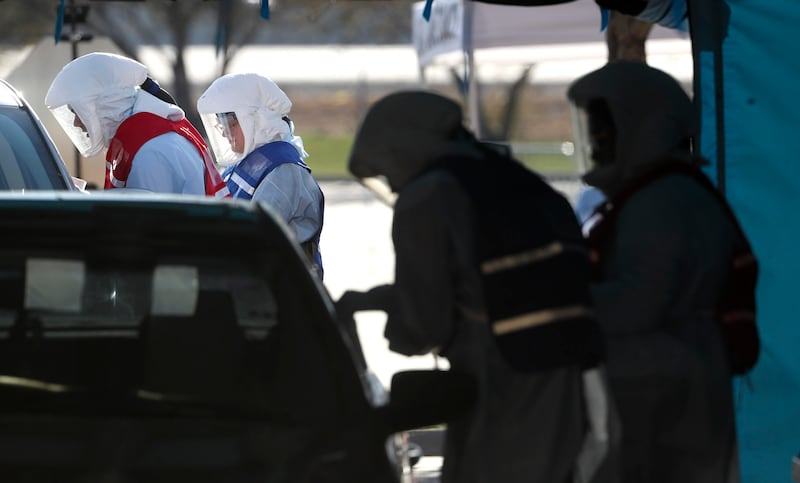
“This is a time for Utahns to really lengthen our stride,” he said, practically begging people statewide to follow proper social distancing rules and wear a mask when that isn’t possible.
In addition to rising numbers of COVID-19 cases in Utah, the health department announced another 10 deaths at hospitals and long-term health care facilities throughout the state, bringing the total number of lives lost to COVID-19 in Utah to 598.
Those deaths include four Salt Lake County men, one between the ages of 25 and 44, and two between the ages of 45 and 64, who were hospitalized at the time of their deaths, as well as one between the ages of 65 and 84 who was a resident at a long-term health care facility. The latest deaths also include a Utah County woman older than age 85, who was a long-term health care facility resident; a Piute County woman between the ages of 65 and 84 who was hospitalized; a Juab County man between the ages of 65 and 84 who was hospitalized; and, an Emery County man, a Beaver County woman and a Piute County woman, each of whom was between the ages of 65 and 84 and not hospitalized at the time of their deaths.
“We are clearly in a battle of this pandemic,” Herbert said. “We’re in this together.”
The biggest challenge, he said, “is our casual associations with one another.”
“We need to be more careful and still have a good Halloween,” the governor said.