

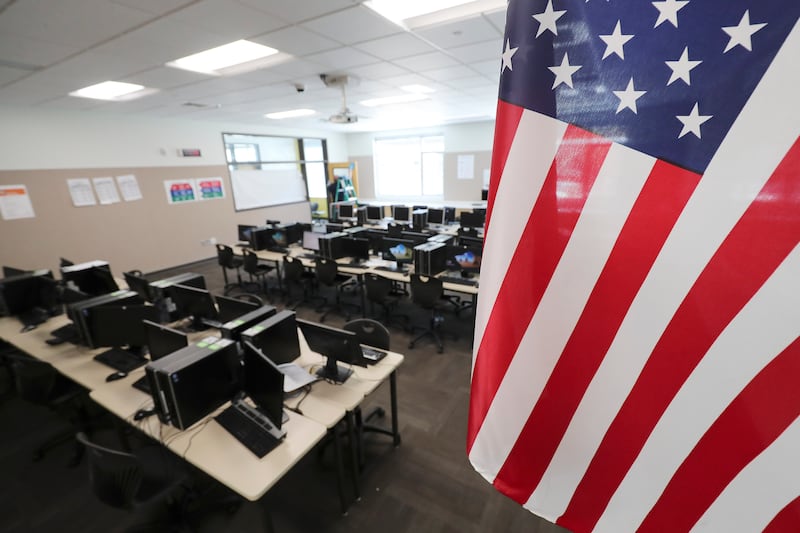

SALT LAKE CITY — “Small groups” of Salt Lake City School District students could be returning to school under a plan proposed by Interim Superintendent Larry Madden.
The proposal would slowly expand numbers of student groups returning to in-person learning in the school district, which is the only district statewide to start the school year exclusively through online learning. However, some students who receive special education services are already being served in schools.
Madden proposed that the school district extend in-person learning opportunities to its youngest learners, students in pre-kindergarten through second grade, as well as small groups of other students who need extra support such as seniors in danger of not graduating.
Under the proposal, the resumption of in-school learning on a limited basis would likely be accompanied by regular COVID-19 testing. Madden said he has been meeting with representatives of the University of Utah’s HERO project — Health and Economic Recovery Outreach — to develop a testing plan.
“It is a project to help monitor what’s going on so that we can more effectively bring kids back into school in a safe way,” Madden told the Salt Lake City Board of Education Tuesday night.
Madden said expanding the numbers of students served in schools needs to be a deliberate process, giving teachers ample time to plan how to resume in-school learning for small groups of students while the majority of students would continue to be served online.
Resuming some degree of in-person learning among the district’s youngest learners appears to be supported by health data, Madden said.
There are lower numbers of cases among students ages 0-9, comprising just 4% of total cases in Salt Lake County between Sept. 22 and Oct. 5.
Moreover, that cohort has a lower probability of contracting COVID-19, he said.
Just one elementary school in Salt Lake County, a public charter school, temporarily closed and shifted to online learning due to an outbreak, he said.
The board asked Madden to report more details at an upcoming meeting,
The board also heard a report on a recent parent survey that indicates 70% say online learning is working at least moderately well for their families, but some board members said they are concerned about students who are not well served.
Board member Kristi Swett said that since the district elected to solely use distance learning to start the school year, “the remote needs to be stellar.” Right now, it is not and it needs to be before implementing more changes, she said.
One of the challenges for the board is that parents are divided regarding their preferences with respect to remaining on distance learning or returning to classrooms in the midst of the pandemic.
“I have a very divided house, and I need to listen to both sides. My personal biases and my personal choices are not what belongs at this board table,” Swett said.
Board President Melissa Ford said the plan proposed by Madden would offer more flexibility.
“I love moving toward options for families. I think that choice piece is really important. I’m hearing that loudly,” she said.
The survey indicated that 54% of parents would prefer to stick with remote learning if by Nov. 10 numbers of positive COVID-19 cases and transmission rates are close to current levels, while 46% opted for hybrid learning.
The survey, answered by 11,000 parents, indicated 16% said online learning was going extremely well, 25% said it was going very well and 29% reported moderately well.
When examined at each school level, 76% of parents said online learning was manageable at the elementary school level, and 82% and 74% said it was manageable for middle and high schools, respectively.
Tiffany Hall, the district’s executive director of teaching and learning, said the survey also looked at how many hours a day students are working online. Last spring, there were reports as varied as 10-12 hours a day to 20 minutes.
“We wanted that to be a realistic amount of time. We wanted it to be an amount of time that would look like, and appear that we were attending to those educational means, but also not making it so laborious and long that students were really discouraged,” Hall said.
The survey showed it’s now an average of five to five and a half hours a day, “so that’s a good compromise in terms of what we’re doing,” she said.
Madden the district has received its back-ordered laptops and Wi-Fi hotspots. “We do have the technology that we need, now we just need to make sure that is in the hands of the students.”
Board members said some parents shared anecdotal experiences that suggest not all households have connected with schools or had technology, although the parent survey indicated 99% of respondents have internet access and 97% have devices at home.
Madden said schools continue to reach out to families that haven’t connected to their teachers. “I think we’re well aware that we have to be proactive. I mean, we just can’t wait,” he said.
According to Sam Quantz, the district’s chief information officer, 94.3% of Salt Lake students are actively participating in online school. By comparison, school attendance in fall 2019 was 94.7%
Swett said she worries about student engagement. Some teachers tell her that half of students engage in Zoom meetings while it is unclear if the rest are participating.
Board member Mike Nemelka questioned the accuracy of the IT numbers, saying he was aware of one school where one third of students hadn’t logged in.
Online learning is not good for kids, he said.
“I just think that right now in that school district we are destroying a generation of children. And I don’t think we’re doing the job. We should be teaching these kids. And I’m not saying everybody should come back but I think some should have the option to come back,” he said.
Earlier in Tuesday’s meeting, a dozen parents, educators and community members addressed the board, some urging the board to allow the option of students returning to classrooms while others asked to leave remote learning in place to ensure the safety of staff, students and their families.
Nathan Flores, a junior at the Salt Lake Center for Science Education, said his father contracted COVID-19 earlier this year and it continues to take a toll on his health.
“I agree with the Salt Lake City School Board’s decision to maintain all students in a remote learning. COVID-19 has not decreased in severity and is even increasing cases. I know a lot of people think they’re sort of immune to the virus because of their age. However, we don’t know the effects that it can have on every individual and because of that COVID can be fatal,” he said.
Raina Wilson, a working mother of five children, said it is not the school district’s job to keep people alive.
“We have doctors, hospitals, medical professionals to do that. Our kids are not getting educated, so that is my main concern. I would love to have an option, I don’t want anyone to go back to school that doesn’t feel safe. But I would like an option so those families that have to be in person can get the same education as everyone else,” she said.
Dina Freedman, a meteorologist and an earth scientist who teaches at Hillside Middle School, said she strongly believes in data and “the spike in the virus in our city is really alarming.”
She pushed back against some parents’ perception that online learning is a waste of time.
“I just don’t believe that. My students are doing great work. ... Our teachers are doing incredible work. Today we really made a huge mess in our bathroom and in our kitchen areas and sinks and we had a blast. So the students are definitely learning,” she said.
Freedman said attendance in her online classes has been greater than 95%, which is “higher than my traditional school, and the return rate on assignments is also higher.”
But others, like Ryan Bell, said the district’s choice of online learning while other children in other districts with similar community transmission rates have access to in-person learning violates students’ constitutional rights.
“There are other important stakeholders here. Teachers deserve to be heard. But their rights are not constitutionally guaranteed. Parents not interested in in-person learning deserve to be heard, but their rights to cancel school for others are not constitutionally guaranteed,” Bell said.
Amy Lynn Fehlberg urged the school board to consider safety.
“I’m asking you to look at all of the schools that have opened only to quarantine classes, entire grade levels, or in some cases closed completely. Inconsistency is not good for anyone and it will not be good for our students. We need to stay with remote learning until we can open and stay open. And yes, this might be fall 2021,” Fehlberg said.
Lucy Hawes, a mother of four children, said her son attends a charter school that had to shift to online learning. On Tuesday, he “happily returned to in-person learning. Despite the interruption in his education, he has remained enthusiastic about school.”
Her daughters, who attend district schools, “are less interested in school, even though they are fairly high achievers.”
“That is one of the reasons that I feel that trying to find an option for families to return to school is really important,” Hawes said.