

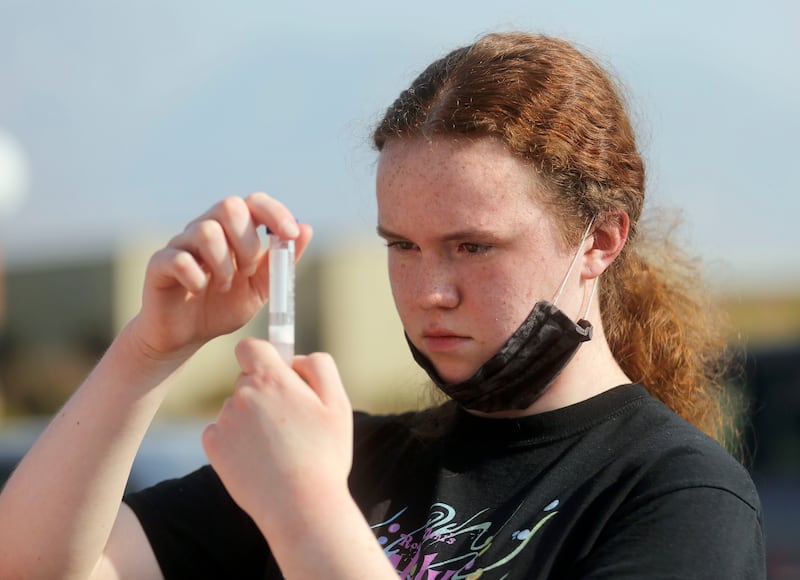

SALT LAKE CITY — As Salt Lake County continues to see record daily new COVID-19 case counts, Salt Lake City is still waiting for Gov. Gary Herbert to either approve or deny Mayor Erin Mendenhall’s request to move back to the orange restriction phase in the pandemic.
The change to the stricter moderate risk level the mayor requested on Tuesday would reimpose a limit on gatherings to 20 people or fewer. Mendenhall has said it likely wouldn’t affect businesses, which are already operating with precautions, but the move could impact team sports.
“Governor Herbert and Mayor Mendenhall had a productive meeting this afternoon to discuss the mayor’s request to move Salt Lake City back to orange. We appreciate the mayor’s sincere efforts on behalf of our capital city, and will share more as conversations continue,” the governor’s office said in a statement Thursday evening.
When asked Friday when a decision might be made, Herbert’s spokeswoman reiterated the statement from the previous evening and said more information should be available next week.
While Salt Lake City remains in the low restriction phase in the pandemic, some neighborhoods are the state’s current COVID-19 hot spots with among the highest two-week case rates. Downtown Salt Lake City has confirmed 708.93 cases per 100,000 people within the last two weeks; Rose Park has confirmed 516.36; Glendale has confirmed 496.85; and the Avenues has confirmed 468.96.
Similarly high case rates are happening in areas of Utah County, where tighter restrictions including a mask mandate were imposed a few weeks ago.
By comparison, other areas in the state with high case rates — including Washington, Box Elder, Tooele, and Cache counties — are seeing cases ranging from 200 to 400 per 100,000 people on average within the last two weeks.
On Thursday in his weekly news conference, Herbert reiterated his weekly plea for people to choose to do the right thing on their own — to help neighbors, including people they don’t know — by wearing a mask. He again declined to implement a statewide mask mandate.
While mask-wearing compliance across the state remained relatively stable through August with about 80% of residents wearing masks in indoor locations, it fell to about 70% during the week ending Sept. 27 despite the record-breaking surge in cases, according to the latest available observational and survey data from the Utah Department of Health. Those 65 and older are most likely to wear masks throughout the state, the data shows.
New cases
Utah’s COVID-19 surge does not appear to be abating as health officials reported another 1,343 cases on Friday.
The new cases were confirmed out of 9,026 tests, with a 14.9% positive rate, according to the Utah Department of Health. The rolling seven-day average for new cases is now 1,148 per day, and the average positive test rate is 13.8%.
The state’s record in daily new cases occurred on Thursday as 1,501 were confirmed. Only three out of the last 10 days have brought Utah fewer than 1,000 new cases.
Currently, 243 patients are hospitalized with COVID-19 in Utah, six more than were hospitalized on Thursday. Although just under 70% of the state’s COVID-19 hospitalizations were in Salt Lake County as recently as Tuesday, now only about half of those hospitalized are being treated in the county — 121.
Eighty-six patients with COVID-19 are in intensive care units across the state. Utah’s nearly 600 intensive care unit beds are 71.8% full — mostly by patients without the coronavirus. Nonintensive care units, meanwhile, are 64.8% full with COVID-19 patients and others.
Four more deaths were also reported Friday — a Salt Lake County man and woman, both of whom were older than 85 and residents in long-term care facilities; and a Davis County man and Salt Lake County man, both between 65 and 84, who were hospitalized when they died.
They bring the state’s death toll due to COVID-19 to 505.
Now 83,290 cases have been confirmed out of 901,048 people tested in Utah since the pandemic began — a 9.2% positive rate. About 4,220 cases have required hospitalization in the state.
About 61,300 of Utah’s cases are considered recovered after surviving the three-week point since their diagnoses, meaning about 21,500 cases remain active.