

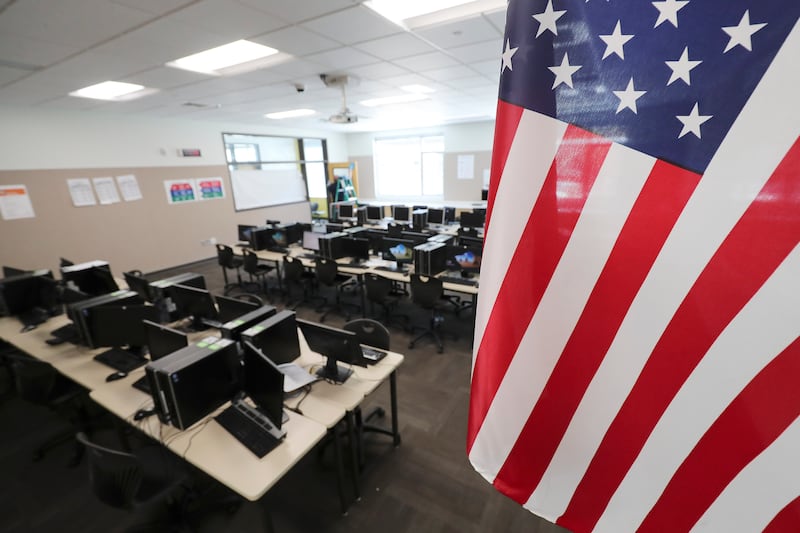

SALT LAKE CITY — Growing numbers of Utah high schools are moving to online remote learning until Nov. 30 as cases of COVID-19 climb and numbers of quarantined students and staff increase.
Seven of nine high schools in Davis School District are on remote learning as a result of the spread of COVID-19, the latest additions being Bountiful and Viewmont high schools. There will be no instruction at either school Friday and virtual classes will begin Monday. It is anticipated the schools will resume in-person classes on Nov. 30.
Similar shifts were also announced in the Canyons School District due to “sustained increase in COVID-19 cases” associated with schools and rising positivity rates in surrounding neighborhoods.
Alta students will transition to online learning until after the Thanksgiving recess. According to the district’s dashboard, there are 39 active cases at the school.
Jordan High School, which commenced online learning Thursday, has 18 active cases and 326 students and staff quarantined in the past two weeks, which necessitated a shift to online learning. Indian Hills Middle School is also on remote learning.
It was also announced Thursday that Granite School District’s Cottonwood High School was shifting to remote learning Thursday, joining Cyprus and Skyline high schools, which were earlier shifted to virtual learning and slated to return to in-person learning next week.
Meanwhile, Nebo School District high schools Salem Hills, Springville and Maple Mountain were moved to an “alternating day schedule” after each reaching the 15-case threshold that triggers discussions with local health authorities and action.
A note to parents noted that all Nebo schools remained open the first term of school, which is “truly remarkable.”
Under the split schedule, the student body will be split in half by last name and each group will attend in person two days a week and all will observe remote learning on Wednesdays.
On Wednesday night, the Jordan School District Board of Education voted to move 14 middle schools and high schools to remote learning with a projected return to in-school learning on Nov. 30 due to rising numbers of both COVID-19 cases and staff and student quarantines as well as increasing difficulty finding a sufficient numbers of substitute teachers.
On Thursday, the district had 526 active cases and 3,341 students and staff quarantined and according to the district’s dashboard, up from 441 cases on Tuesday.
Late last week, the Utah Education Association urged Gov. Gary Herbert to require all public secondary schools in communities with high rates of COVID-19 transmission to pivot to remote instruction “at a minimum, from the Thanksgiving holiday through winter break.” UEA also called on Herbert to suspend extracurricular activities that cannot be conducted under social distancing guidelines.
Herbert, in an executive order announced Sunday, put a temporary hold on extracurricular activities but allowed high school football championships to proceed.
Decisions on how school is conducted — in person, online or on hybrid schedules — is up to local officials, Herbert has said, a position he reiterated during a press conference Thursday.
“Those are local decisions. They know best what’s taking place in their jurisdictions. The local school boards, we have 41 of them, they know the issue better than anyone else so they’re making those decisions as to whether they should go online or hybrid or what the situation should be,” Herbert said.
Local and state officials are accumulating data and decisions should be informed by that data, he said.
“There’s still some discussions for us to have now that we have an accumulation of data and we’ll take a look at that and work with them and talk to them and maybe have more on that in a future press conference,” he said.
Asked what can be done to stem the spread of COVID-19 among high school-age students, state epidemiologist Dr. Angela Dunn said public health measures are effective.
“What we’ve learned from testing high school athletes is that high school students can prevent spread within their own social circles. If they wear masks, if they limit the number of people that they’re around socially, there won’t be spread among that population. So that’s what we need to keep focusing on, what can we do to ensure that that population continues to adhere to masking and physical distancing,” she said.