

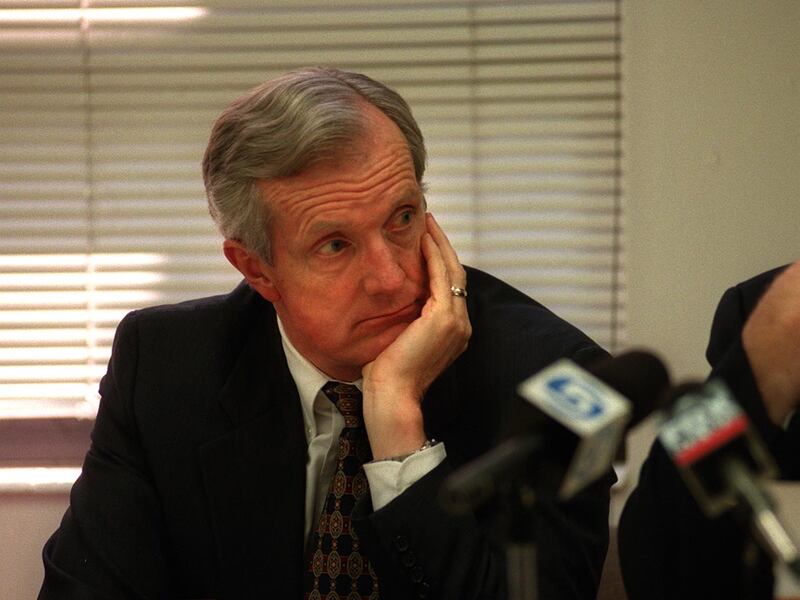

SALT LAKE CITY — For some in the Salt Lake community, John Pingree was a source of angst and frustration. But he will be remembered as the man responsible for creating one of the best midsize public transportation systems in the country.
Pingree, who served as general manager of the Utah Transit Authority for two decades, died this week of cancer. He was 80 years old.
During his time as head of the state’s largest transit agency, Pingree was instrumental in leading the organization into what would become its greatest growth.
“UTA was a tiny, 50-bus operation. Their offices were on Fourth South and they would literally maintain buses under the Fourth South viaduct,” explained Bill Barnes, who served in government and media relations for UTA for nine years of Pingree’s tenure.
“They just had nothing. It was just a new fledgling organization. I think the buses spent as much time broken down as they did operating (on the road).”
“He truly professionalized UTA and brought it up to be a modern transit agency,” Barnes said.
For his work, Pingree was recognized with multiple awards from the American Public Transit Association as the outstanding midsized transit system in North America, he noted.
Barnes said the idea for a light rail train system in Salt Lake City was born out of a corridor study that was commissioned jointly by UTA and the Utah Department of Transportation on how to mitigate the transit demands along the central I-15 corridor.
“It was pretty fortunate that there was a railroad alignment that paralleled the freeway right there … that UP — Union Pacific (Railroad) — was willing to sell,” he said.
The conclusions of the joint study included expanding I-15, which was done by adding two lanes in each direction; and to build the light rail system in the corridor to begin meeting future demand. After passage of a ballot initiative to raise the local sales tax, the funding was used to significantly expand bus service and begin development of the north-south light rail line.
From the very beginning, the proposal to build light rail transit stoked controversy among some local civic leaders and a subsequent ballot measure failed to garner voter support, prompting Pingree to look for another way to get the project built and operational, which eventually happened, Barnes said. Though the project drew lots of criticism throughout the community and from many on the UTA board of directors, since completion TRAX has gained much greater support.
“I think most people in the community now would say, ‘Yeah, TRAX is a good thing,’ even if they don’t ride it,” Barnes said.
“He was the general manager to lead the charge. Clearly, he didn’t do it alone. He had a team working, but he was the general manager,” Barnes said. “He was the CEO of the company that initiated the study, that managed the study, that came up with the conclusions that put it on the ballot and then faced the controversy of making the decision to proceed.”
So controversial were Pingree’s ideas to build light rail that one Utah lawmaker staged a fiery protest to express his opposition.
“He was actually burned in effigy on the grounds of the state Capitol building by a state legislator,” Barnes recalled. Pingree also frequently found himself at odds with members of the Utah board as well as with members of the then-Salt Lake County Commission.
In 1996, Pingree survived a 7-7 no-confidence vote, but lawmakers later added a 15th member to the board — who was appointed by the commission. His fate was eventually sealed when eight board members requested a special meeting where they voted to oust Pingree.
At the time, James E. Clark, the board’s chairman, called the movement to fire Pingree “payback time” based “strictly (on) petty power politics.” Clark also expressed frustration that he was unable to do anything to intervene on Pingree’s behalf.
“This is very troubling to me,” Clark told the Deseret News. “He’s Mr. UTA. He took a third-rate bus company and built it to national prominence — this is the reward he gets.”
Despite all the political wrangling that would lead to his eventual demise at the agency, Barnes said Pingree held true to his principles no matter how ugly things got for him.
“A direct quote from him to me one day was, ‘You know, I may go down, but I’m going to go down with my conscience intact,’” Barnes recalled.
“John had a profound impact on UTA in spite of all the controversy since and whether you think they’re a good group or bad group … it’s all based on a successful transit system that John developed from virtually nothing.”