


SALT LAKE CITY — Tens of thousands of Utah businesses made it over the fence and are set to receive some $3.7 billion of federal emergency funding made available in response to the coronavirus pandemic, but tens of thousands more are stuck in a queue that, at the moment, is showing no signs of moving forward.
The U.S. Small Businesses Administration announced Thursday that the original $350 billion in funding for the Paycheck Protection Program, part of the $2.2 trillion COVID-19 federal stimulus package, was completely drained just shy of two weeks into the effort. And, while congressional wrangling holds up an additional $250 billion funding installment for the program, some 18,000 Utah small businesses have applications in process and are collectively eligible for about $2 billion in federal help.
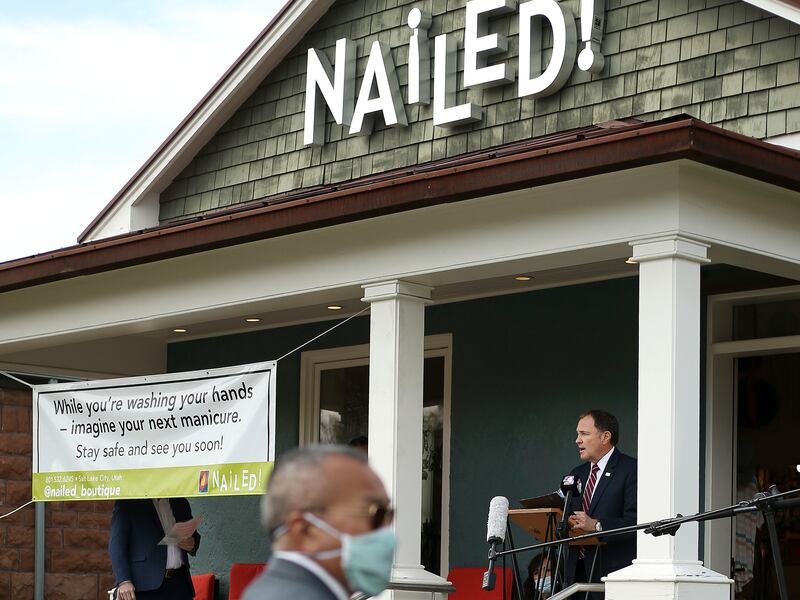
On Friday, one of those small business owners joined Gov. Gary Herbert and leaders from the state’s banking and business sectors in a call to congress to drop the partisan tug-of-war, find common ground and get the desperately needed additional assistance moving to those who need it most.
“I think I speak for every business owner who’s applied for these loans but haven’t been approved,” Utah small business owner Tricia Bennion said. “Congress needs to come to an agreement ... and extend more funding so these loans can be approved.”
Bennion and the 52 people she employs at her two Nailed Salon locations have been out of work since March 18, when the Salt Lake County Health Department advised a shut down of those businesses.
Bennion said she complied immediately and has since sought assistance through various state and federal efforts, including the Paycheck Protection Program, but has yet to receive any funding. She said about half of her employees are single mothers, and she knows that at least 10 of her furloughed workers have not been able to secure unemployment benefits. Bennion said it’s a situation that is causing her, and other Utah small business owners who are also waiting for federal help, increased worry about the well-being of out-of-work staff members.
Herbert said he was on a call earlier Friday with members of Utah’s congressional delegation discussing the status of a proposal to push another $250 billion to the Paycheck Protection Program and, while he’s worn out with the partisan squabbles among federal lawmakers, he believes a deal is in the works.
“Let’s find ways to resolve the bickering,” Herbert said. “This pandemic ... is something that should bring us together. It’s a matter of Republicans and Democrats coming together, finding common ground and getting it done.
“I hope that they can work it out and expect they will.”
In a webcast press conference Friday, Rep. Ben McAdams, Utah’s only Democrat in Congress, urged his party to reach a deal that provides at least $250 billion for small businesses.
“I’m calling on Democrats in Washington to make this deal and get the funding passed already,” McAdams said. “Let’s move this forward because hard-working Utah families have no time to waste. This delay is causing so much fear and stress and hardship on Utah families.
“It’s time to pass a bill.”
Democrats have blocked legislation that doesn’t include more money for hospitals and state and local governments to deal with the virus.
McAdams said he favors a compromise House Minority Leader Kevin McCarthy, R-Calif., floated Friday that would include funding for hospitals. Anything outside of providing COVID-19 relief shouldn’t be on the table, he said.
“There’s no space in this negotiation for anything that is not related to the epidemic,” McAdams said. “We saw early on members of Congress trying to push forward their agenda on unrelated issues, and I have no patience for that.”
As the congressional impasse continues for now, the first wave of Paycheck Protection Program money is starting to find its way to the 21,000 Utah businesses that were approved in the first round.
Utah Credit Union Association President and CEO Scott Simpson said the Small Business Administration released some information showing how the federal funding distributed among Utah’s different industry sectors. According to that data, of the $3.7 billion approved for Utah businesses, 13% went to the construction industry; just under 13% to science and technology companies; 12% to manufacturers; 11.7% to health care and social assistance businesses; 8.9% to Utah hospitality and food industry companies; and 8.6% to the state’s retail sector businesses.
The Paycheck Protection Program provides federally guaranteed loans to eligible small businesses in amounts up to $10 million and may be partially forgivable. The available financing can provide businesses that employ 500 or fewer with funds equal to 2.5 times the company’s average monthly payroll expenses.
Utah businesses garnered just over 1% of the total funding for the Paycheck Program and, should the current $250 billion re-funding effort find success, and that state distribution percentage holds up, the current backlog of Utah applicants should get funding.
Herbert noted that small businesses, those with 500 or fewer employees, make up about 90% of all businesses in Utah and, of those companies, about half have less than 50 employees.
“Small businesses are the backbone of the Utah economy,” Herbert said. “We look forward to additional funding from Congress.”
Contributing: Dennis Romboy