A look back at local, national and world events through Deseret News archives.
On Feb. 6, 1899, a peace treaty between the United States and Spain was ratified by the U.S. Senate; the treaty ended the Spanish-American War and ceded the Philippines, Puerto Rico and Guam to the United States.
The Treaty of Paris, signed Dec. 10, 1898, also granted Cuba its freedom. Its ratification was front page news in the Deseret Evening News.
For Utahns, the end of the war meant a great deal. The state had been admitted to the Union in 1896, but Salt Lake Valley’s Fort Douglas served as a training ground for U.S. troops that would fight in the Spanish-American War, a role it continued to play in World Wars I and II.
The war
Per the history books, the war began in April 1898 with the sinking of the USS Maine in Cuba, and lasted just about eight months.
The Spanish–American War brought an end to almost four centuries of Spanish presence in the Americas, Asia and the Pacific; the United States, meanwhile, became a major world power.
With the treaty signed, the United States acquired sovereignty over Puerto Rico, Guam and the Philippines, and established a protectorate over Cuba.
Utahns were there
The 24th Infantry Regiment of the Rough Riders — an all-Black unit — left Fort Douglas to make history as it charged up Cuba’s San Juan Hill with Col. Teddy Roosevelt in the Spanish-American War.
The 24th, one of the regiments of so-called “Buffalo Soldiers,” as they were called by Native Americans during battles on the frontier, compiled an outstanding record of service from after the Civil War to its inactivation in 1951.
The 24th Infantry came to Fort Douglas Oct. 22, 1896, bringing approximately 600 men, women and children to the city. The 24th’s posting to Fort Douglas was a reward for its many years of service on the frontier.
And, some 21 members of the regiment plus nine family members are buried in the fort’s cemetery. Although most of the regiment’s members were from other states, mostly in the East, several of them asked to be buried with their comrades at the fort, including Edward Lee of Ohio, who, in 1922, was the last soldier buried there.
Also, according to Deseret News archives, “no soldier should go off to war with out the well-wishes and support of his community, thought Emmeline B. Wells.
“And so in 1898, when two cavalry companies and three batteries of artillery were being sent from Utah to participate in the Spanish-American War, Wells headed a group of 100 women who responded to the call for volunteers. Utah’s Red Cross unit was born.”
Another group of Utahns, many members of the Utah National Guard, served in the short war.
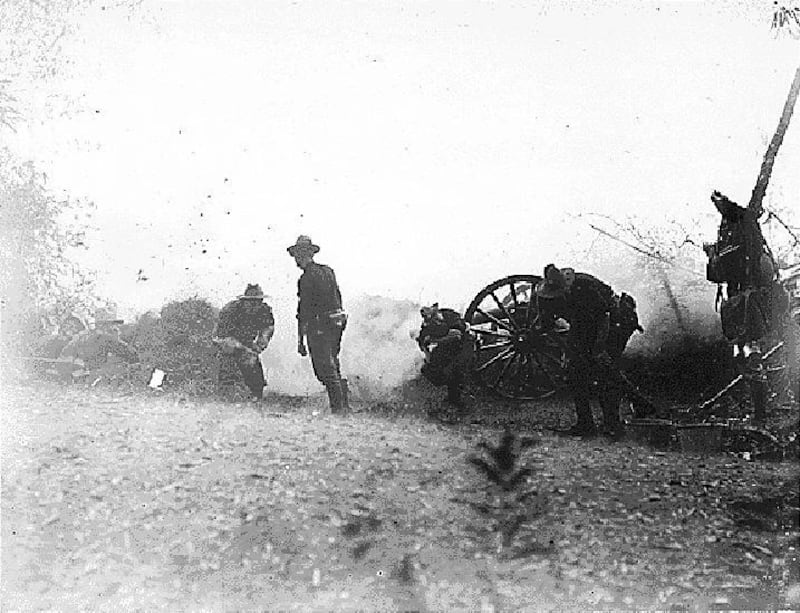
Per a Deseret News story, almost 800 Utahns, most of them Guard members, volunteered for service in the Philippines during the Spanish-American War. Batteries A and B of the Utah Volunteers saw extensive combat in campaigns around Manila.
Elmer Thomas, a Salt Lake man, was only 17 in 1898 when he joined Battery A of the Utah Light Artillery. The two batteries took a train to San Francisco, then went aboard the Colon for a rough sea trip to the Philippines.
He recalled Aug. 13, 1898, when the Americans captured Manila. “There wasn’t much resistance. The infantry went in and attacked the town, and we followed them in.
“There was only token resistance. We had been shelling the town.”
After the Spanish surrendered, Thomas and others in the Utah batteries fought against Filipino rebels, then returned to a great victory parade in 1899.
Roosevelt visited Utah in 1903 while serving as president. According to Deseret News accounts, “there were the Rough Riders, veterans of the Spanish American War, who came to see their old commander, Theodore Roosevelt, as he spoke at the City-County Building in Salt Lake City on May 29, 1903.”
The men, “many of them riding horses galloped toward the stand where Roosevelt was seated. The president rose and halted them saying, ‘Don’t try to gallop boys, go slowly, you might hurt some of the children.’ When he was told some had come 300 miles to see him, he said, ‘By George, that’s fine. The last time I was here, I was out riding with them.’”
Here are some stories from Deseret News archives about the Spanish-American War and Utah’s involvement in the conflict:
“Guard has long history of service”
“Dream still alive for Puerto Rico becoming a state”
“Fort Douglas has been a survivor throughout its history”
“Historic flag in need of mending”
“Rough Riders’ flag a piece of Arizona history”
“Utah Red Cross: 100 years of helping”
“Remembering the Maine 100 years later”
“Remembering back 176 years: How Utah stopped being part of Mexico”