


Editor’s note: This story was originally published on March 9, 2025.
A look back at local, national and world events through Deseret News archives.
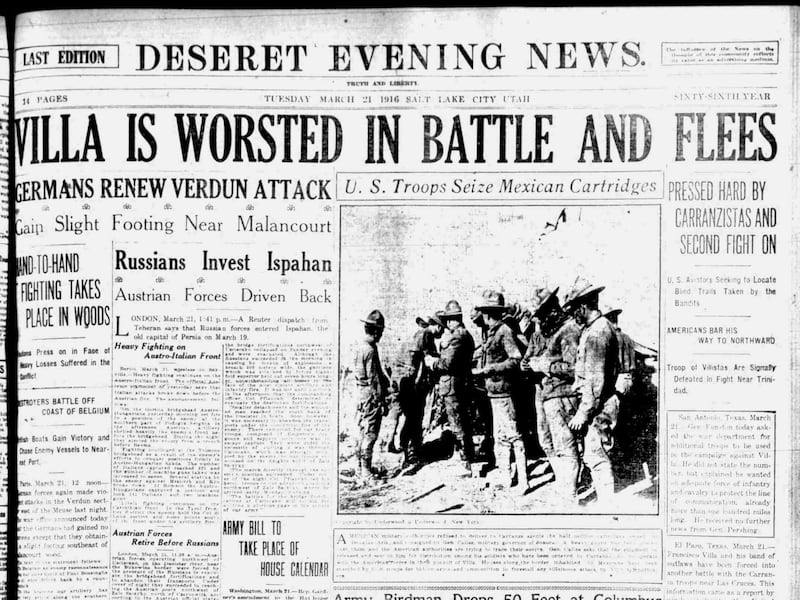
On March 9, 1916, more than 400 Mexican raiders led by Pancho Villa attacked Columbus, New Mexico, killing 18 Americans. It is one of the few times the United States suffered an attack on its home soil.
Ah Pancho Villa. Did you think he was a real historical figure?
In the early 1900s, he most definitely was.
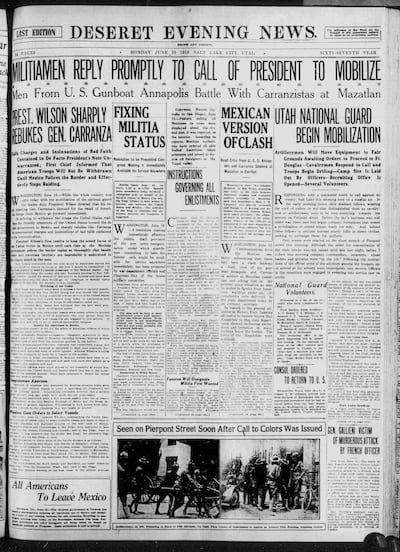
The Deseret Evening News carried daily updates on the battle to catch Villa, and how the Utah National Guard was called to support the battles along the U.S.-Mexico border.
U.S.-Mexico relations in the early 1900s
Following two years of war, the two countries sign the Treaty of Guadelupe-Hildalgo in early 1848. In exchange for $15 million, Mexico surrendered half its territory, or 890,000 square miles, including California, Arizona and New Mexico as well as Texas, to the United States.
Fifty years later, uprisings grew along the border. In 1914, President Woodrow Wilson ordered Marines to seize the Mexican port of Veracruz in retaliation for the arrest of some American sailors. In November of that year, revolutionary peasant leader Francisco “Pancho” Villa took over.
His government collapsed the following year.
The Battle of Columbus
According to historical accounts, by late 1915, Villa had lost much of the widespread support he had enjoyed at the start of the Mexican Revolution. Having lost a series of battles, Villa and the remaining 500 soldiers of his Army of the North were desperate for food, horses and weapons.
In March 1916, Villa planned a raid on the military garrison in the Columbus, New Mexico. The small town lay only a couple of miles across the border. According to historians, Villa sent spies to gather information, and they returned to report that the garrison consisted of only 50 men. On the night of March 8, Villa led the Army of the North into Columbus and attacked the garrison in the early hours of March 9. Villa’s men also began looting and setting fire to houses in the town.
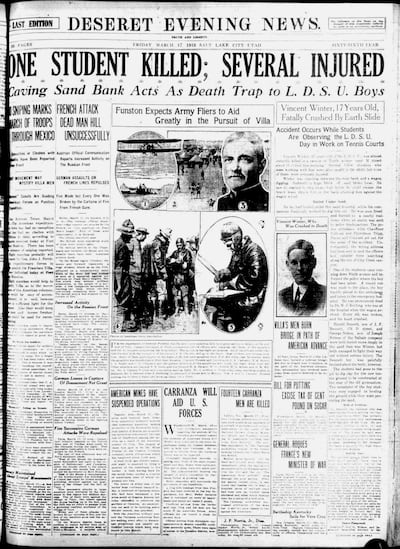
But, instead of the 50 U.S. soldiers that Villa had expected, there were actually 350 soldiers, including the 13th U.S. Cavalry, stationed at the garrison.
The raid quickly became a fierce battle when U.S. troops fought back from the garrison with machine guns. A second detachment of U.S. soldier launched a counterattack, which forced Villa and his men to retreat. They were pursued by U.S. cavalrymen back across the border into Mexico.
A few weeks later Villa’s forces attacked two small towns in the Big Bend region of Texas, Glenn Springs and Boquillas, fighting another garrison of American soldiers.
In response to the attacks, U.S. forces under the command of Gen. John J. Pershing invaded Mexico in an attempt to capture Villa. The raid also touched off anti-Villista reprisals throughout the Southwest, with six captured raiders hanged by vigilantes at Columbus.
The National Defense Act was signed on June 3, 1916, and became one of the hallmark moments in National Guard history. On June 18, 1916, the Utah National Guard mustered two squadrons of cavalry, one field artillery battery and a field hospital. In total, the Utah Guard would assign more than 800 Soldiers to duty along the Mexican border. The Utah National Guard units began to arrive at the border on June 29, 1916 and established its camp in Nogales, Arizona, along the Santa Cruz River.
Utahns also had interest in the border because many followers of The Church of Jesus Christ of Latter-day Saints settled in northern Mexico from 1890-1910. Here are some stories from Deseret News archives about Villa, the battles along the U.S.-Mexico border and why Utahns care deeply about the colonies in northern Mexico:
Pancho Villa relative is Mexico’s newest tough cop
Mexican towns full of poverty — and faith
Twila Van Leer: The genealogist who started helping with family history at 8 years old
“Foreign attacks on U.S. soil rare in nation’s history”
“Chronology: U.S.-Mexico relations since 1835″
“Remembering back 176 years: How Utah stopped being part of Mexico”