

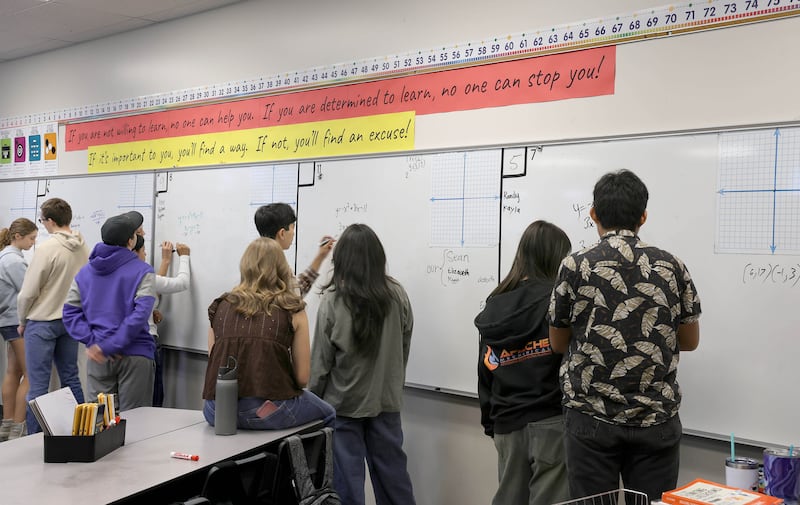

- Math teachers at Utah's Hurricane High School are utilizing a nontraditional teaching approach to help their students succeed.
- The "Building Thinking Classrooms" strategy promotes collaboration.
- Hurricane High math students report feeling better prepared for tests, future studies.
Americans have a complicated relationship with math.
Studies reveal that a vast majority of adults living in the United States believe math skills are essential — but more than a third report having negative feelings about the wide-ranging academic discipline encompassing numbers, shapes, patterns and logic.
But a growing number of students at Utah’s Hurricane High School are discovering that math doesn’t have to be scary. Algebra, trigonometry, calculus and other math subjects are even helping them better connect with their peers — while simultaneously learning problem-solving skills valued far beyond the classroom.
Over the past few years, the math faculty at the Washington County high school have watched students of all backgrounds benefit from the so-called “Building Thinking Classrooms” teaching approach that emphasizes collaboration, real-world problem-solving, perseverance and risk taking.
The teaching method — which involves students working in small groups using whiteboards — has bumped-up student engagement and math growth scores, Hurricane High Principal Daniel McKeehan told the Deseret News.
“This is a very active engagement-type strategy where kids are learning to problem solve,” he said. “They’re up. They’re moving. They’re thinking— and they’re working with other students."
“It’s fascinating to watch.”
Teaching ancient math subjects — in a new way
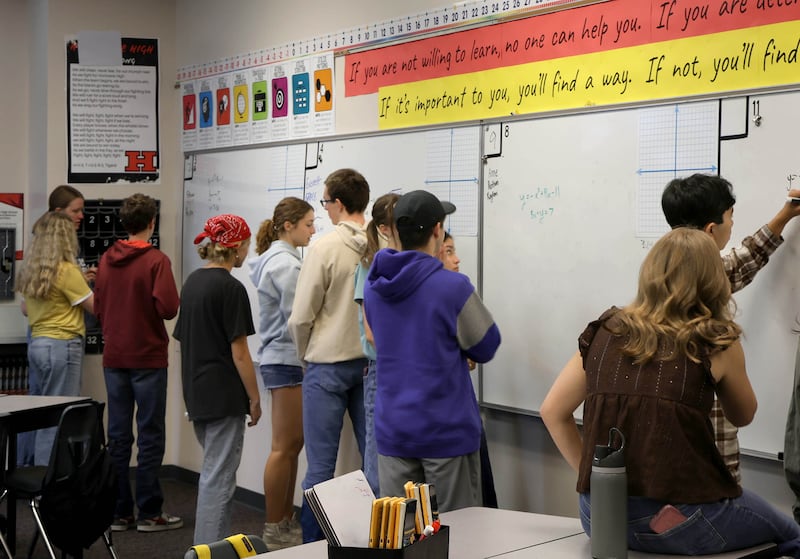
Scrapping traditional teaching methods might seem daunting — particularly for math educators who have already spent decades in the classroom
McKeehan noted that several of the teachers in Hurricane’s math department have more than 30 years of experience in the profession.
“And sometimes it’s hard to change when you’ve been doing something for a long time — but this math team at Hurricane is not like that. They felt that they needed more real world application (in the classroom)."
The Hurricane math teachers, he added, told him: ‘We need kids to understand why this is important. We need kids to really understand the bigger picture in life and learn how to problem solve — whether it be in math or something else’.”
One math teacher shared with McKeehan a few ideas she gleaned from the book “Building Thinking Classrooms in Mathematics” which challenges institutional teaching norms by implementing a series of “optimal practices for thinking” to facilitate deep mathematical thinking and learning.
Intrigued, several of the Hurricane High math teachers attended a “Building Thinking Classrooms” national conference to learn more.
“It totally changed their way of teaching math,” said McKeehan. “They have adopted this ‘Building Thinking Classrooms’ style and strategy.”
“It’s all about problem-solving — as opposed to solving math equations.”
Once students are trained to problem-solve, he added, “Then solving math equations becomes second-nature because their mind is in the problem-solving phase.”
Collaboration is a key element of the “Building Thinking Classrooms” teaching approach. That can be challenging for students often attached to their cellphones and ear pods.
“Sometimes kids kind of stick to themselves, but this math system requires students to work in small groups,” said McKeehan. “They’re not sitting at desks, they’re up on whiteboards. The whole room has whiteboards wrapped around it, and the kids work in random small groups.
“And you’re never with the same people twice. It’s completely randomized.”
Teachers still offer instruction and guidance during the class period — but the students are working together instead of sitting alone at their desks, heads buried in textbooks.
Of course education is a results-driven culture — and some Hurricane High teachers understandably wondered how the novel approach would affect math test scores. “But we were less concerned about test scores — and more concerned about if the students are engaged and growing,” said McKeehan.
The principal is certain that the test scores will take care of themselves. “We’re going to do everything we can for that 80 minutes in class to help students problem-solve and develop as learners. … It’s totally revolutionized what we do.”
And the results, added McKeehan, “have been fantastic.”
Several Utah school districts have reached out to Hurricane High to learn more.
Meanwhile, while proficiency scores at the school have remained about the same since implementing the new strategy, math growth scores at the school have significantly increased, according to McKeehan.
“Obviously, I feel like we have good teachers,” he added, “and the kids have clearly shown that this is working for them.”
The principal noted that the “Building Thinking Classrooms” strategy is being utilized to varying degrees across a variety of math courses at Hurricane — ranging from Advanced Placement classes and algebra and concurrent enrollment.
McKeehan also believes the school’s teaching approach in math would work across other subjects. “When students are engaged in their learning, they’re learning better. … It’s a game changer.”
No more ‘zombie copying’
A veteran math educator at Hurricane High, Franci Homer admits she was initially hesitant to modify her teaching approach. That changed after reading “Building Thinking Classrooms.”
“It completely changed my ideas and thoughts about how kids learn,” she told the Deseret News.
The book challenged Homer and her colleagues to get away from standing at the board in front of seated students — with the students “zombie copying” their work.
“Now, instead, we give a launch by teaching about something for about five to 10 minutes — and then we split kids up into groups of three and throw them at the whiteboards.
“We have them work through a series of problems, learning how to solve them without us giving direct instruction.”
Homer said she can now never go back to the traditional form of teaching. “It’s been awesome to see kids work together and really struggle through math problems, knowing that the three of them together are eventually going to get there.”
An additional benefit of the “Building Thinking Classrooms” strategy: Hurricane High students are connecting with fellow students/collaborators that they might not otherwise ever speak with.
“We try to promote a little bit of socialness before we work so that the students can start to learn who their classmates really are.”
Building skills — and friendships — beyond math class
Shyanne Standing and Tanner Matua are both juniors at Hurricane High School. And they both have generally enjoyed math during their school years.
But their high school’s “Building Thinking Classrooms” approach is now helping them build skills that go beyond that day’s math assignment.
“Honestly, I’ve really liked the changes,” said Shyanne. “We now problem-solve on our own. We are provided with a little bit of material, and then you have to go try to persevere through finishing the problem without too much help.”
But the teacher is always available to assist, she added. “And you also have your group members to help you if you get stuck.”
Tanner admits that the updated math approach is different from his past classroom experiences — but in a good way.
“And especially just for tests and things, we feel a lot more prepared — and you get to know the people around you a lot better by working together in groups.”
Neither student expects to focus their future college studies on math, but both say the skills they are learning now will serve them well in the future.
A “math anxiety-free” future.