
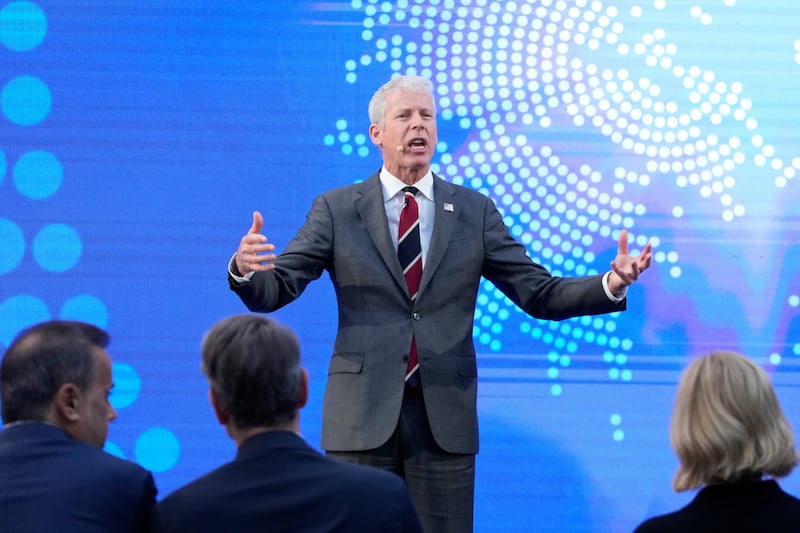

Secretary of Energy Chris Wright toured the Idaho National Laboratory north of Salt Lake City on Monday to get eyes on the innovation playing out on the advanced nuclear energy stage.
INL is the nation’s premier Department of Energy laboratory for nuclear energy research and was the first place to power a light bulb using that form of energy.
The DOE lab even created large nuclear reactors to power an airplane, but when you look at their size it is easy to understand why it did not work out.
If you use a cellphone, operate a computer or rely on an energy grid (hint, we all do), the U.S. Department of Energy-sponsored research unfolding just 215 miles north of Salt Lake City is quietly designed to make your life better.
The Idaho National Laboratory is intertwined with multiple Utah projects, from helping keep cellphones functional for first responders in a catastrophic emergency to testing the functionality of batteries in electric vehicles.
It is North America’s only producer of radioactive, medical grade cobalt-60 used in Gamma Knife radiosurgery, a type of radiation treatment for brain tumors used at facilities like the Intermountain Medical Center in Murray.
Most recently, INL became the first facility to receive a specialty fuel to power microreactors specifically designed to bolster military readiness.
“This milestone reflects years of dedicated effort by the Office of Nuclear Energy’s Advanced Gas Reactor TRISO Fuel Qualification Program to fabricate and qualify TRISO fuel using world-class capabilities at INL’s Advanced Test Reactor and Materials and Fuels Complex, and Oak Ridge National Laboratory — capabilities that exist nowhere else in the world,” said John Wagner, INL director.
The lab is also a leader in the case of water systems, INL and Idaho are leading in demonstrating how to protect public health in a growing area of national concern.
INL is the birthplace of Cyber-Informed Engineering, a strategic initiative to prioritize cybersecurity in infrastructure design and operation. CIE’s premise is that no matter how many safeguards a system has, determined adversaries will find a way in. Therefore, it is crucial to engineer systems so they suffer minimal damage or fail safely when compromised by cyber-enabled threats.
Since 2023, the Idaho Department of Environmental Quality has factored CIE into its considerations of drinking and wastewater systems. This year, they have expanded CIE into scoring grant applications from communities seeking funds to help replace or update their water systems. This means any grant proposal that contains CIE has a greater chance of being funded.
Earlier this month, Wright took a two-day tour of the Pacific Northwest, where he boasted about the low cost of energy in the Northwest, noting prices are largely helped by the region’s hydropower system.
At a press conference, Wright stood on a bluff overlooking Ice Harbor Dam, one of the controversial Lower Snake River dams. Fish advocates have pushed to remove the four dams as part of an effort to save endangered salmon and steelhead.