



- Education Department launches "earning indicator" to help student make informed college decisions.
- The "earning indicator" flags colleges where graduates are, on average, earning less than high school graduates.
- Utah's Bridgerland Technical College was flagged as a "lower earning" institution.
College-bound students applying for federal aid: Your possible school choices may come with a warning.
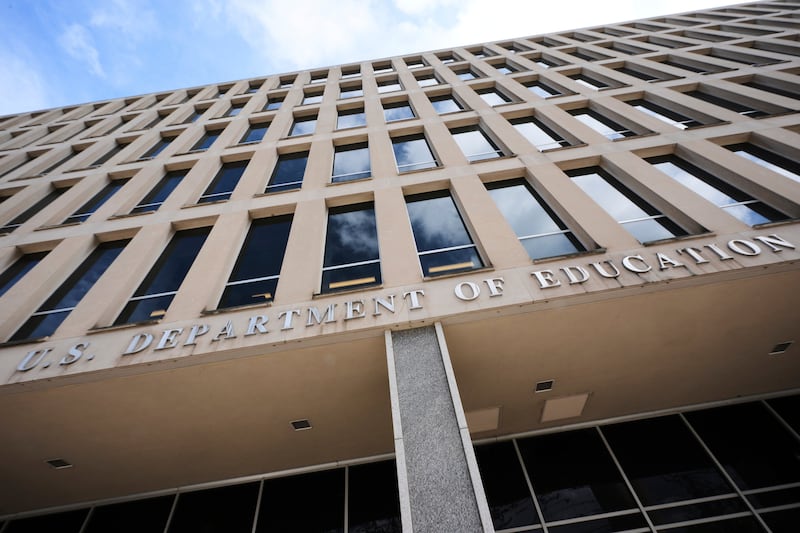
The Department of Education has launched a new “earnings indicator” that works in conjunction with the Free Application for Federal Student Aid — or FAFSA.
The earnings indicator, according to the DOE, is designed to provide students and their families with “clear, easy-to-understand information about a school’s post-graduation earnings.”
The DOE-sponsored earnings indicator comes at a moment of growing debate about the value of pursuing higher education.
Recent polls suggest most Americans don’t think a four-year college degree is worth the cost — even as research in Utah and beyond points to the lifelong financial and personal benefits of finishing college.
As part of the FAFSA application, prospective students send their personal information to colleges and universities that they are interested in possibly attending. Once the form is complete, FAFSA will now provide the applicant with “key financial data” for each selected institution, according to DOE.

If the average earnings of graduates from a specific institution are below that of average high school graduates, the form will generate a “lower earnings” disclosure.
Such disclosures, according to DOE, “will help prospective students and families better navigate” their postsecondary application journey.
“More than half of all Americans now say a college degree is not worth the price, and total outstanding student loan debt is approaching $1.7 trillion. Families deserve a clearer picture of how postsecondary education connects to real-world earnings, and this new indicator will provide that transparency,” said Secretary of Education Linda McMahon in a DOE release.

“Not only will this new FAFSA feature make public earnings data more accessible, but it will empower prospective students to make data-driven decisions before they are saddled with debt.”
A “lower earnings” disclosure would appear after a student’s FAFSA form is processed.
DOE is assuring applicants that any “lower earnings” flag will have no impact on FAFSA completion, submission or eligibility for aid.
The average total student debt in the U.S. hovers near $30,000, with 2024 college graduates owing $494 more in loans on average compared with the prior year, according to U.S. News & World Report.
Data reported to U.S. News & World Report by 992 colleges in an annual survey showed that graduates from the class of 2024 who took out student loans en route to a bachelor’s degree borrowed $29,890 on average.
That’s $560 more than borrowers from the class of 2015 shouldered, representing a roughly 2% increase in the amount students borrowed over that decade, according to U.S. News & World Report.
How many colleges are being flagged as ‘lower earning’?
Statistically speaking, not many.
“More than 2% of undergraduate students nationwide,” according to the DOE report, “attend an institution where graduates earn less than a high school completer on average.”
But, the report added, those same “low earning” institutions receive approximately $2 billion in federal student aid annually.
The DOE emphasizes that its new earnings indicator is intended to inform — not limit — college student choices.
“Students and families should have the full picture before making postsecondary education choices — and earnings outcomes are one of many factors students and families should consider alongside cost, mission, location, and personal interests,” according to the DOE.
The earnings indicator, added the DOE, broadens the agency’s “strategy to enhance transparency in higher education” while ensuring loan applicants have access to institutional data on postsecondary value.
The DOE news release announcing its earning indicator highlighted three key features:
- Greater transparency: Students and families can identify which schools’ graduates have lower typical earnings compared with high school graduates, helping them understand the financial implications of their college choice.
- Publicly available data: The indicator uses publicly available data to highlight earnings outcomes at a critical moment in the college decision-making process. Students can further explore program-level results using the College Scorecard at CollegeScorecard.ed.gov.
- Providing more support to students: High school counselors, college access professionals, and other student-support entities can use the information as a tool to guide students in making informed, long-term decisions about their education and career.
DOE report: How are Utah schools designated?
In Utah, 21 institutions were flagged by the DOE data set as “lower earning.” Almost all are small, for-profit cosmetology schools.
None of Utah’s 16 public institutions of higher learning were flagged as “lower earning” — with the exception of Bridgerland Technical College.
According to the DOE’s earnings data report, Bridgerland’s 2025 reported inflation-adjusted earnings, for graduates after four years, was about $2,400 below Utah’s 2025 inflation-adjusted median high school earnings.
The Deseret News has reached out to Bridgerland Technical College for a response to the DOE report, but hasn’t received one.
None of the institutions of higher learning sponsored by The Church of Jesus Christ of Latter-day Saints — including Utah’s Brigham Young University and Ensign College — were flagged as “lower earning.”