

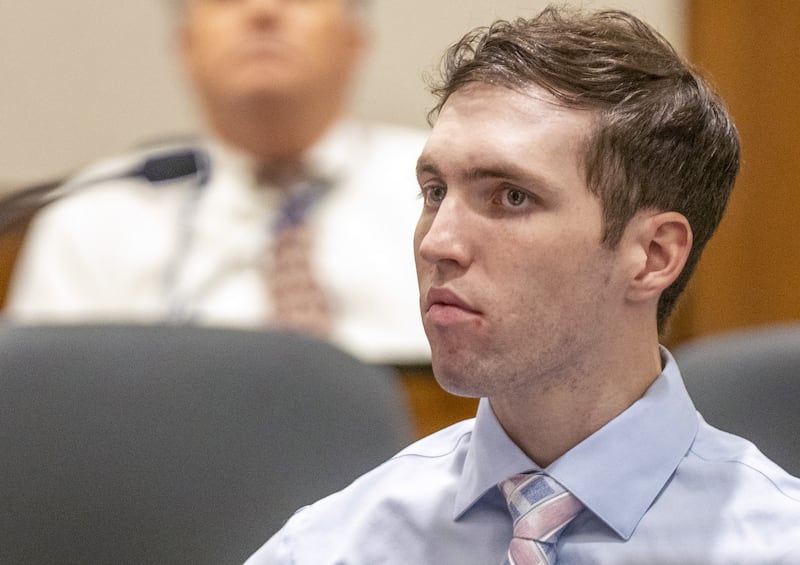
The Utah County Attorney’s Office says just because the son of one of their attorneys was present when Charlie Kirk was shot and killed at Utah Valley University, the entire office should not be disqualified from prosecuting the case.
Furthermore, the decisions being made by the office in relation to the prosecution of Tyler Robinson — including the decision to announce on the day charges were filed that they intend to seek the death penalty if Robinson is convicted — are not being driven by an emotional reaction.
“(The attorney) has no personal conflict of interest because his (son) is neither a material witness nor a victim in the case. In fact, nearly everything (the son) knows about the actual homicide is hearsay. And because Mr. (redacted) has no conflict of interest, the county attorney’s office also has no conflict of interest requiring disqualification,” the state said in their reply.
In December, Robinson, 22, and his defense team filed a motion under seal to have the Utah County Attorney’s Office disqualified from the high-profile murder case due to an alleged conflict of interest. A redacted public version of the motion was released a week later. The defense argues that because the son of one of the attorneys currently prosecuting the case attended the Turning Point USA event on Sept. 10 at UVU and was in the audience when Kirk, 31, was shot, and because he immediately sent texts to his father, the entire Utah County Attorney’s Office should be disqualified.
“As described by witnesses on campus at the time of the shooting, the event and the aftermath were harrowing, even for those that did not see the shooting as it happened. (The son) and his (father) are not immune to this trauma,” the defense argues in its motion.
Robinson argues that the state could be making decisions based on emotions due to the trauma the attorney’s son incurred that day.
The Utah County Attorney’s Office filed its sealed response a week ago. Their redacted public version has now been released. Neither the defense nor the state identifies the prosecuting attorney or his son, only stating that the son is 18 and a student at UVU.
According to the Utah County Attorney’s Office, the son was standing near the back of the outdoor amphitheater, about 85 feet away from where Kirk was seated.
“While the second person in line was speaking with Charlie, I was looking around the crowd when I heard a loud sound, like a ‘pop.’ Someone yelled, ‘He’s been shot,’” the son stated in a sworn affidavit submitted as part of the state’s reply.
The son says he and others around him crouched down before running for cover in a nearby building. He then sent text messages to his family group chat, which included several relatives and his father.
“Someone got shot,” he texted to the group. “I’m OK, everyone is going inside.” It was only after speaking with others inside the building that the son learned it was Kirk who was struck.
“I did not see Charlie get shot. The last time I saw him was before I looked away, before I heard the gunshot. I did not see him get carried away or see his wound. Aside from being scared at the time, I have not had any lasting trauma from the event. I have not needed to get counseling or therapy. I did not have to miss classes or work or any other normal activities after the shooting. I have been able to continue with all my normal activities without any emotional problems,” the son stated in his affidavit. “The only time I have seen the actual shooting of Charlie Kirk was when I saw a post on social media that recorded it.”
A copy of the son’s text messages was also included in the state’s reply.
Prosecutors argue that because the son did not witness the actual shooting — and wasn’t even aware, initially, that Kirk had been shot — “any testimony (he) could give would be merely cumulative of testimony available from literally thousands of other witnesses and would relate solely to uncontested issues because (the son) has no personal knowledge of the actual murder. Moreover, (his) comparatively minor emotional reaction could not have had a greater (impact) on (his father) and the prosecution team than the significantly more harrowing experiences of many others at the event.
“Any potential testimony from (the son) and most others at the UVU event is only marginally relevant, providing context only.”
Furthermore, the son’s experience “did not elicit any unusually intense negative reaction about the case or (Robinson),” by the prosecuting attorney, the state’s reply continued. “Under these circumstances, there is virtually no risk, let alone a significant risk, that it would arouse such emotions in any father-prosecutor as to render him unable to fairly prosecute the case.”
Robinson and his defense team also contend that Utah County Attorney Jeff Gray’s decision to announce that his office intends to seek the death penalty on the same day he announced the filing of charges was influenced by the emotions of the prosecuting attorney and his son. Under Utah law, if a judge finds during a preliminary hearing that there is enough evidence for a defendant charged with capital murder to stand trial, the defendant will then enter a plea at an arraignment. After the arraignment, prosecutors have 60 days to file a notice of intent seeking the death penalty.
In Robinson’s case, the Utah County Attorney’s Office says it learned a lesson in 2024 when a capital murder charge was filed against Michael Aaron Jayne, who is accused of killing Santaquin Police Sgt. Bill Hooser. In that case, prosecutors waited several months after filing charges to announce their intention to seek the death penalty.
“Gray’s decision to file a death-penalty notice on the same day he filed the Information had nothing to do with (the son’s) presence at the Turning Point USA event,” according to the state’s reply.
In addition to the evidence of aggravated murder against Robinson being “substantial,” prosecutors say that they learned from the Jayne case “that waiting to file notice when the evidence is substantial only fuels speculation and misinformation; and Gray wanted to minimize the speculation and misinformation in this case,” according to their reply.
Prosecutors also point to the case involving Ryan Michael Bate, 30, of Tremonton, who was charged in August with two counts of aggravated murder, a capital offense, for the ambush shooting deaths of Tremonton-Garland Police Sgt. Lee Sorensen, 56, and officer Eric Estrada, 31. The Box Elder County Attorney’s Office announced its intention to seek the death penalty on the same day charges were filed. Gray argues that his office’s decision to do the same was not out of the ordinary.
“Speculation and misinformation in aggravated murder cases are extremely unsettling and hurtful to the families and loved ones of murder victims. The county attorney makes every effort to minimize that hardship in whatever way he can. The national and worldwide interest in this case has generated a tremendous amount of speculation and misinformation, and that has been apparent from the moment Charlie Kirk was assassinated. Having reviewed the evidence and concluded that the evidence and circumstances of the case justify the death penalty, the county attorney determined that there was no reason to delay making that election,” prosecutors argued in their reply.
“Filing delay would only result in further misinformation, speculation, and conspiracy theories, which were already mounting before charges were even filed. The county attorney has concluded that under the circumstances of this case, delaying the filing of a death-penalty notice is unnecessarily unsettling and painful to Charlie Kirk’s loved ones and does not promote justice for anyone.”
Robinson’s next in-person court hearing is scheduled for Friday. At that time, 4th District Judge Tony Graf is expected to consider the motion by the defense to disqualify the Utah County Attorney’s Office.