

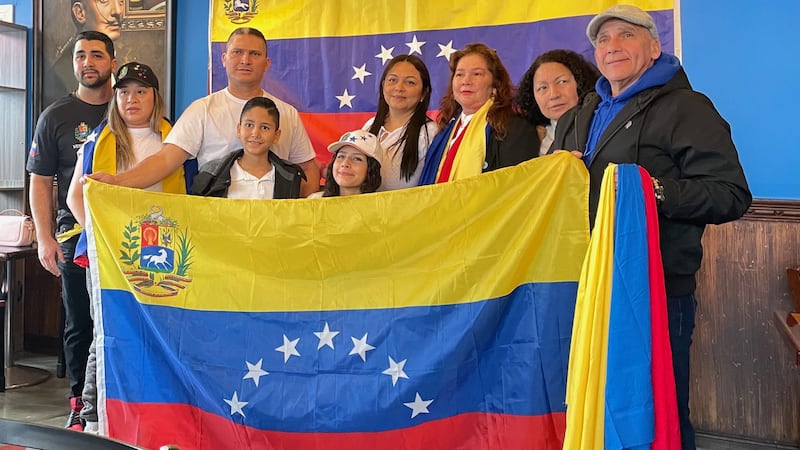
The population with roots in Venezuela now ranks as the second-largest subgroup of Latinos in Utah behind Mexicans and Mexican Americans, reflecting the sharp growth of the community across the United States.
Venezuela is the focus of intense U.S. attention stemming from the Jan. 3 invasion of the nation by U.S. forces, who removed President Nicolás Maduro so he can face drug-trafficking charges in the United States. Parallel to that, the Venezuelan population has surged across Utah and the United States in recent years, largely in response to the rule of Maduro and his predecessor, President Hugo Chávez, the focus of a new report by the Pew Research Center.
“In recent decades, Venezuela has experienced economic and political crises that have led to record numbers of Venezuelans migrating,” reads the Jan. 9 report. They’ve mainly fled to neighboring Latin American countries, most notably Colombia, but many have also come to the United States.
Nationally, 1.17 million Latinos of Venezuelan origin lived in the United States, according to 2024 U.S. Census Bureau estimates released last September, up by approximately 113% from around 550,000 in 2019.
In Utah, the American Community Survey one-year estimates indicate the state was home to 23,134 Latinos with Venezuelan ancestry in 2024, up 186% from 8,095 in 2019. The figure represents U.S. citizens of Venezuelan descent and Venezuelan immigrants here, both legally and illegally. Moreover, those of Venezuelan descent were the second-largest subgroup of Latinos in Utah, trailing the much larger Mexican subgroup, which totaled 375,571.
By 2010, there were more people in Utah of Mexican, Salvadoran, Peruvian, Argentine, Puerto Rican, Guatemalan, Honduran, Cuban, Colombian, Ecuadorian and Chilean descent, but Venezuela surged past all of them except Mexico as of 2024. Similarly, the numeric increase of the Venezuelan population between 2010 and 2024, 21,373, easily surpassed the increase of all other Latino subgroups except Mexico, up by 95,923. The next largest numeric increases between 2010 and 2024 were among Colombians (up 15,244) and Chileans (up 11,397).
Here’s a list of the 10 largest Latino or Hispanic subgroups in Utah as of the 2024 American Community Survey estimates:
- Mexican, 375,571
- Venezuelan, 23,134
- Salvadoran, 19,620
- Spaniard, 18,765
- Colombian 17,954
- Puerto Rican, 16,475
- Peruvian 16,158
- Chilean 13,622
- Spanish, 12,617
- Guatemalan 11,706
Half in the country ‘without authorization’
As in Utah, the Venezuelan population across the United States has grown faster than other Hispanic subgroups, according to Pew. But nationally, Venezuelans were just the ninth-largest U.S. Hispanic group as of 2024.
The growth of the Venezuelan population in Utah and the rest of the United States stems from the strong outmigration of Venezuelans fleeing the South American nation for political and economic reasons. Anecdotally, many Venezuelans in Utah have said they have left the nation due to political persecution under the socialist governments of Chavéz and Maduro and the weak Venezuelan economy.
Pew says some 80% of Venezuelans in the United States weren’t born here, higher than the rates for those in other Latino subgroups. At the same time, most with Venezuelan roots have been in the United States “for a relatively short period,” likely reflecting the toll of the recent political and economic upheaval in the country. “In almost all South and Central American origin groups, 50%-65% of people were born outside the U.S. Among Mexicans, the country’s largest Hispanic population, 29% are immigrants,” Pew said.
Parallel to that, more than half of those in the Venezuelan subgroup in the United States are here “without authorization,” according to Pew. Many of them had temporary protected status or protection under a program geared to Cubans, Haitians, Nicaraguans and Venezuelans before the administration of President Donald Trump ended the initiatives.
Some in the Venezuelan community in Utah have said many would return to the nation if the government shed its socialist leanings. The removal of Maduro by itself, though, may not be enough of a spur as remnants of his socialist government remain in power.