
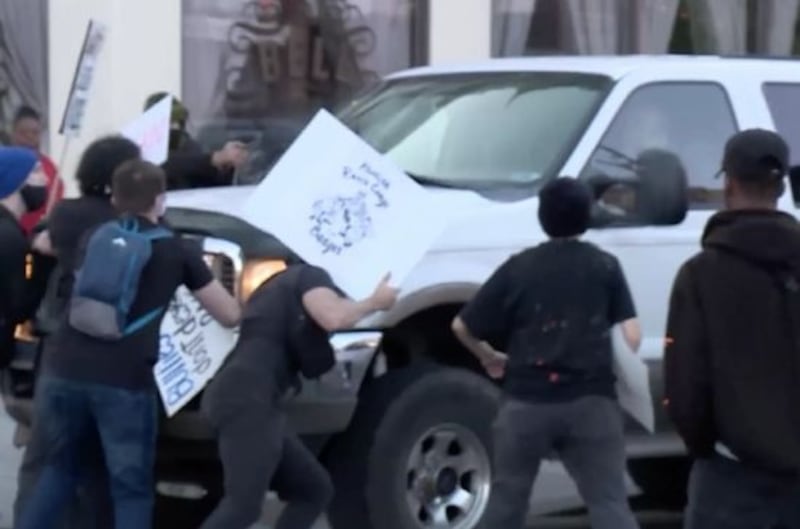
PROVO — A man who fired shots at a Provo Black Lives Matter protest, hitting and injuring a man driving a car, was found guilty of attempted aggravated murder on Friday.
Jesse Taggart was charged with attempted aggravated murder, a first-degree felony; felony discharge of a firearm, a second-degree felony; plus aggravated assault and riot, third-degree felonies.
On Friday, a jury found him guilty of attempted aggravated murder, aggravated assault, discharge of a firearm and riot.
The decision came after four days of testimony and several discussions between the attorneys and judge on the charges that stemmed from a shooting at a Provo protest in June 2020.
Part of the trial included lengthy discussions on how state law defines “dangerous weapon” in regards to the charges. Fourth District Judge Kraig Powell said the state was arguing Taggart used deadly force while the defense argued he used deadly force but it was justified.
Powell said those are both “very serious statements” with “very serious allegations.”
During closing arguments, prosecutor Spencer Wyatt reviewed several videos from the day of the protest, trying to prove that Taggart was acting intentionally with lethal force and recklessness against multiple protestors. Wyatt then showed text messages from Taggart later that day to try to prove that Taggart did not feel remorse for the shooting but instead bragged about killing a “nazi.”
“In his mind, he is the hero. ‘One nazi down,’” Wyatt said, quoting one of Taggart’s texts. “He was shooting to kill, both times.”
Wyatt concluded by sharing parts of Taggart’s testimony — in which he claimed he was trying to defend others from dangerous drivers — and said Taggart’s story was a “direct contradiction” to the evidence. He said Taggart’s claim that he saw a driver he fired toward had a gun was added later and not part of his initial story.
Nathaniel Johnson, Taggart’s attorney, argued Taggart was justified because “he thought people were going to die.” He encouraged the jury to pay attention to a video from near Taggart’s point of view and said from that perspective, it seemed the car was going to hit pedestrians.
A sentencing date was set for Monday, March 16.
Taggart’s previous testimony
In the audio played for the jurors on Wednesday and Thursday, Taggart testified about firing the gun at the car and claimed he was defending people around him from someone he thought had a gun as well.
Taggart talked about how his role at Black Lives Matter protests gradually changed as he went to “maybe 27,” spending nine to 12 hours a day there. He said after the first week, he began taking on a “support and safety role” encouraging demonstrators to be safe and not approach vehicles.
He said he witnessed multiple vehicle attacks.
At the Provo protest on June 29, 2020, he said one woman drove past multiple times yelling “racially charged things” and later drove into people’s shins multiple times.
At the University Avenue and Center Street intersection the day of the shooting, Taggart said there were “a lot of screams” as the Ford Excursion driven by Ken Dudley approached the intersection. He said the man did not have a blinker, and it looked like he was communicating it was “his way or the highway.” When he said he saw through the windshield from behind the car that the car was making contact with people, he knew it was a problem.
As he was in the sidewalk or crosswalk, Taggart said he almost got hit by the truck’s mirror and then saw into the vehicle that the man was “waving a black object around” that he believed was a gun.
“I felt that because of the given circumstances … if I didn’t shoot that he was going to shoot us within the next millisecond,” Taggart said.
When he fired the gun, he said his intention was to stop him. He said he was aiming for his elbow on the first shot and was confident in his aim and planned to fire only one shot — testifying he was not there to kill anyone. He said the man accelerated, and he followed him. When he saw “hair fly up over the hood and then a body go flying,” Taggart testified that he aimed a second time and fired, this time aiming for the knee the man was using to turn the steering wheel.
He denied seeing people swarm the car as Dudley testified on the first day of the trial. Taggart also said he did not see anyone knocked to the ground or bleeding because of the driver’s actions.
Taggart also testified about police eventually arriving at the scene and telling protestors to leave over 15 minutes after the shooting. He said he was “acting as a barrier” between the police and other protestors until eventually he left the protest.
Although over an hour of his previous testimony was played, Taggart chose not to testify directly at his jury trial. His attorneys did call two expert witnesses, who added critiques to the police investigation in the case.
New legal question for Utah
On Wednesday, a legal question came up regarding a law passed by the state Legislature in 2021. The question hinged on whether Taggart’s testimony during a previous hearing could be played in his jury trial.
The 2021 law allows defendants who wished to claim self-defense to ask for a justification hearing, during which the judge is able to dismiss the case if the defendant is able to prove they acted in self-defense. The judge said it was surprising the Legislature did not anticipate an issue “would always happen” when the law passed.
In this case, prosecutors said they wanted to use Taggart’s testimony from his justification hearing during his jury trial, but his attorneys claimed that would infringe on his constitutional right to not testify.
Johnson said justification hearings are unique because they require a defendant to admit they did what they are charged with doing but that they were justified in those actions. He said if the only way to take advantage of the right to a justification hearing is to testify and risk having that testimony played at trial, no defendant would seek a justification hearing — “the risk so seriously outweighs the benefit,” he said.
Powell ultimately decided the audio could be played for the jurors, “over his objection.” He noted that the prosecutors had given notice they planned to play it and agreed with Deputy Utah County attorney Meghann Mills that Taggart’s statement was voluntary.
“At some point this issue will probably be decided in Utah ... but I am unable to wait for that day,” Powell said, saying appellate courts or the Legislature could address it.
Contributing: Curtis Booker