
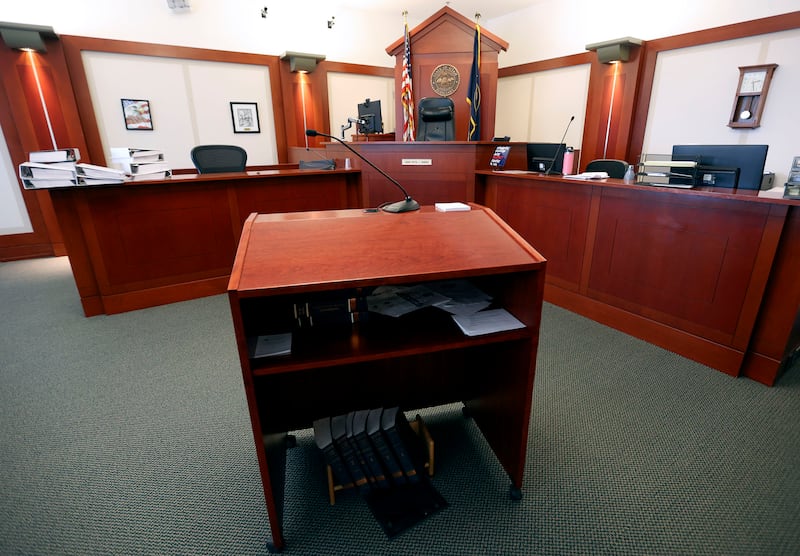

- HB540 would require a centralized online access point for public court records, and audio recordings.
- Judges would have to disclose conflicts of interest like elected candidates for transparency.
- Concerns have been raised about victim privacy and potential misuse of court information.
Lawmakers expressed concerns with a bill that would make major changes to judicial transparency in Utah, but ultimately passed it through a House committee on Friday.
Before the bill was passed, a number of legislators expressed concerns about how it would impact victims who testify, and members of the public shared concerns about how the information might be misused.
The House Judiciary Committee originally voted to hold the bill, HB540, and wait for some changes to be made. Then, 20 minutes later, Rep. Jason Thompson, R-River Heights, made a motion for the committee to reconsider its actions and pass the bill forward with a favorable recommendation.
“I am confident in the sponsor’s ability to work with stakeholders to get this bill to where it needs to be, and if not, well, we’ll be able to determine that on the floor,” Thompson said.
The bill passed through the committee by a vote of 6 to 5.
After the vote, the bill’s sponsor, Rep. Logan Monson, R-Blanding, said, “I hear and understand the concerns there. I am committed to making sure that we find a good place on this, working with each of you that have expressed concerns specifically as well, to make sure that those things are incorporated and part of what we’re working on.”
What would this judicial transparency bill do?
“The people of Utah deserve transparency and accountability from all branches of government,” Monson said as he presented his bill to the committee.
HB540 is part of a broader judicial reform effort by Republicans during this year’s legislative session.
Some provisions of the bill would put requirements for transparency and public access on the judiciary that are similar to the requirements for the state’s legislative branch.
First, HB540 would require the judiciary to create and maintain a single online access point for all public records that is free for up to 50 searches and easy to navigate. It would also make court audio recordings accessible and free to the public.
The bill would require judges and justices to disclose potential conflicts of interest related to employment, ownership and other finances. It would follow the same requirements as candidates for elected office.
In response to high-profile legal battles, HB540 would prevent former Utah Supreme Court justices from immediately joining law firms that are suing the state.
The bill would ban firms from hiring a judge for two years after the judge leaves office if the firm represents an individual suing the state government. A similar “cooling off” period exists to prevent lawmakers from lobbying on behalf of others for one year after leaving office.
As previously reported by the Deseret News, Fix the Court, a court reform advocacy group, published a report last year that found that Utah tied for last in its ranking of all 50 states on metrics of disclosure for state judges and justices.
“An independent judiciary and the rule of law are essential, and this matters deeply to the people of Utah,” Monson said. “I also think it’s our shared responsibility to improve transparency, accountability and public confidence to the people that we serve.”
What concerns were expressed over this judicial transparency bill?
One of the major concerns expressed about the bill was about the public access to court records and audio recordings.
“My concern would be the victim and witness privacy, particularly for child victims and victims of sex crimes, I think there could be a significant privacy concern with hearing those very hard details,” said Rep. Tyler Clancy, R-Provo.
Monson said that he understands those concerns and he is working with stakeholders to see what can be done to provide those protections.
A similar concern was expressed during public comment by Kim Cordoba, president of the Utah State Bar Association. She said that when people come to court, it is often one of the biggest days of their lives whether that’s dealing with divorce, employment issues, child custody, evictions, being accused of a crime, being a witness to a crime or being a victim of a crime.
“These are vulnerable people,” she said. “This is a vulnerable time in their lives, and for it to be livestreamed, especially when we’re dealing with very serious and private issues, then that is a concern for lawyers in the state.”
Steve Burton of the Utah Defense Attorney Association expressed concerns about how court information and details could be misinterpreted or misused by members of the public.
He added that often cases are spread out over a long period of time and so there will only be pieces of information available at different times and those could be misinterpreted as the whole story.
“When those things become accessible, there may be lots of cases for everyone, that people can look up just on a whim and then misunderstand it and publish it as truth, or as meaning something that it doesn’t mean,” Burton said. “So I’m very concerned that there may be a use of that information in inappropriate and incorrect ways.”
There were also concerns over the restrictions of where judges can work after they leave the bench, what the motivation behind that provision is and how it can be enforced.
These concerns, especially over the privacy of victims and other vulnerable individuals, are expected to be addressed by the sponsor as the bill moves forward.