


Federal immigration enforcement is running into resistance in Utah. Recent polling shows that more than half of Utahns (53%) disapprove of deportation methods being carried out across the nation.
The respondents also drew a hard line on the idea of having a federal immigration detention facility in their backyard.
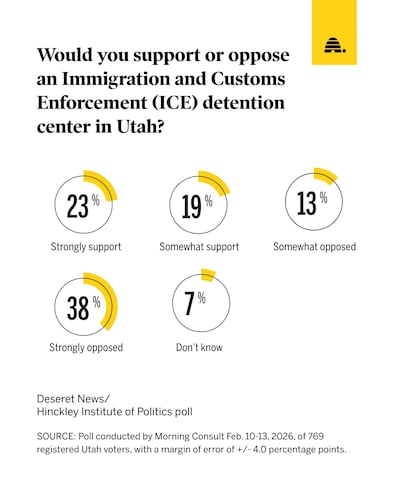
A Deseret News/Hinckley Institute of Politics poll conducted by Morning Consult asked 769 registered voters in Utah if they would support or oppose a detention center in the state:
- Strongly support — 29%
- Somewhat support — 19%
- Somewhat oppose — 13%
- Strongly oppose — 38%
- I don’t know — 7%
Separate polling by The Washington Post revealed similar findings about ICE tactics. Yet, the Post polling revealed that half of Americans support deporting all undocumented immigrants, and the majority would still choose President Donald Trump to head immigration policy as opposed to congressional Democrats or neither.
Are politics feeding the mistrust?
Utah law enforcement officials told the Deseret News that politics has become the central fault line behind a growing disconnect: Voters want safer communities, yet remain wary of the federal institutions tasked with providing that safety.
“I think the challenge here is people are not looking at this as a public safety matter. The public expects law enforcement to apprehend those individuals who have committed crimes that have warrants for their arrest, and go through due process and handle them accordingly,” Weber County Sheriff Ryan Arbon said. “There’s nothing different with what we’re doing with ICE. ... I think (poll respondents) just don’t understand, in my opinion.”
Speaking of the recent fatalities of two people in Minnesota during altercations with federal law enforcement, Arbon argued that when “sanctuary cities” like Minneapolis refuse to work with the federal government, public safety is compromised. In Utah, Arbon said there’s clear coordination and accountability between the two entities.
“But if ICE is in there and there’s a problem being created, law enforcement should respond and do their job,” he added. “And if they’re refusing to, that’s on them. That’s a reckless and complete mistake, and any elected official who supports that should resign.”
Some point to a lack of leadership at the federal level, specifically with Secretary of the U.S. Department of Homeland Security Kristi Noem.
Noem’s responses to the deaths of Renee Good and Alex Pretti caused her to lose “a lot of trust from the American people,” Utah Sen. John Curtis said in a press conference at the state Capitol on Thursday. “Immediately following the second fatal federal immigration law enforcement-involved shooting in Minnesota last month, and before any conclusions of an investigation were made, Noem labeled Pretti’s actions as “domestic terrorism.” Since then, some lawmakers have called for Noem’s resignation.
“I think it’s up to the president to see if that’s salvageable, but I do think a lot of trust was lost, and, you know, trust is very hard to rebuild,” Curtis added.
When asked in an interview with NBC News what he learned from the situation in Minnesota last month, Trump responded, “Maybe we can use a little bit of a softer touch, but you still have to be tough.” Tom Holman, Trump’s border czar, was dispatched to Minnesota days after the death of Pretti, and withdrew 700 immigration officers from the state following discussions with local leadership.
Multiple local law enforcement agencies in Utah, including Weber, are actively participating in ICE’s 287(g) program that allows ICE to deputize trained local officers to perform specific immigration-related functions under federal supervision. But Utah Sheriffs Association President Tracy Glover told the Deseret News that collaboration with ICE has always been done.
“Sheriffs in Utah have always turned illegal immigrants that are in our jails over to ICE,” Glover, who is also sheriff of Kane County, said. “And I’ve talked to every sheriff, I believe, that has a jail, and I believe we all do it the same, and so that’s gone on forever. That’s always been the case.”
Salt Lake City’s relationship with federal law enforcement is somewhat complex. Even as the city’s law enforcement and ICE maintain distinct — if sometimes intersecting — responsibilities, the city’s stance on immigration enforcement, especially concerning a detention facility, has been unambiguous. During her State of the City address last month, Mayor Erin Mendenhall told her constituents that recent tactics by immigration enforcement have been “completely and utterly deplorable.”
She also confirmed that a federal immigration detention facility would not be welcome in Utah’s capital city under her leadership.
“I want to make it clear that I am prepared to use every tool within my control to protect the values of Salt Lake City and the dignity of every one of our residents,” she said. “Every one of us is here because of courage, sacrifice, migration, and belief in a future that did not yet exist, but was possible here.”