


- Polls reveal voters have mixed feelings about cellphone bans at school.
- The proposed bill would make a "bell-to-bell" school cellphone ban the state's default policy.
- Local districts and schools would still be allowed to craft their own cellphone policies.
While a bill calling for a default “bell-to-bell” cellphone prohibition in Utah’s K-12 schools seems destined for passage by lawmakers, the public’s opinions on banning cellphones in schools are mixed.
A pair of recent Deseret News polls — one local and the other national — indicates that a sizable majority support student cellphone prohibitions during the school day.
But opposition levels are notable, particularly among Utah voters.
Senate Bill 69 enhances Utah’s current default K-12 cellphone policy by prohibiting cellphones in school from the opening bell to the closing bell. Last year, lawmakers passed a bill restricting cellphones during class time — while allowing schools or districts to opt for a different standard.
The broader default policy now being debated by lawmakers once again allows local districts to implement their own cellphone policy.
A recent Deseret News/Hinckley Institute of Politics survey asked 769 registered Utah voters if they “support or oppose banning cellphone use in school during the school day.”
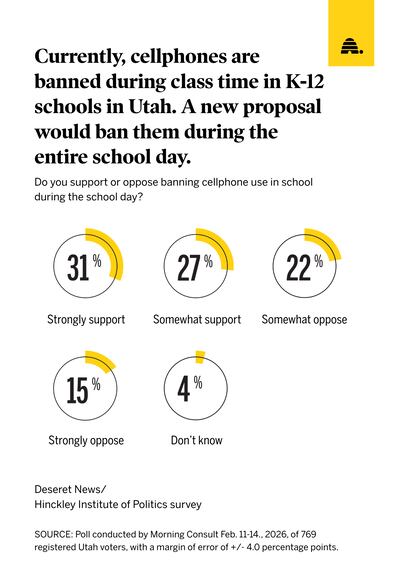
More than half — 58% — expressed support, with 31% saying they “strongly support” a bell-to-bell cellphone prohibition.
But 37% said they oppose such actions — with 15% noting they are “strongly opposed.”
Four percent answered, “Don’t know.”
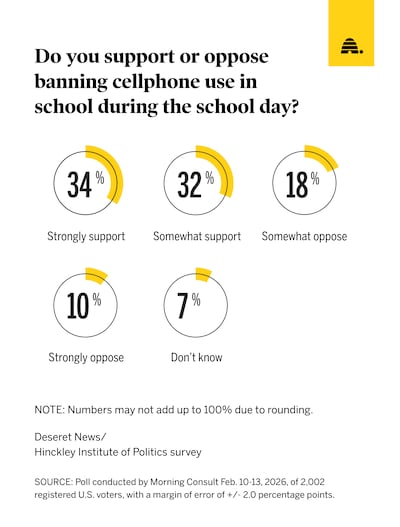
Answering the same question in a nationwide survey that included 2,002 registered voters, respondents expressed wider support for keeping cellphones out of students’ hands during the entire school day.
Sixty-six percent expressed support, with 34% answering: “strongly support.”
Just over a quarter of respondents in the nationwide survey expressed opposition — with 10% saying they “strongly opposed” bell-to-bell cellphone prohibitions.
Bill sponsor: Cellphones are casinos, TVs and adult movie screens
Co-sponsored by Sen. Lincoln Fillmore, R-South Jordan, (a former school principal) and Rep. Doug Welton, R-Payson, (a high school teacher), SB69 easily passed a recent Senate floor vote.
There was a bit more pushback this week when Fillmore presented the bill to the House Education Committee. But the measure still received favorable recommendation with an 8-3 vote.
Fillmore again emphasized that the proposed cellphone prohibition provides for local control. The “bell-to-bell” prohibition — which articulates a few “add backs” — would simply function as a state default.
“Districts ought to be free to set their own policy or to outsource that to schools. But the state policy really should be zero,” he said.
The devices typically used by today’s teens, noted Fillmore, are not aptly called “cellphones.”
“They are so many other things — including casinos and televisions … and in addition to being a movie screen, it’s also an adult movie screen (and) a chat device that replaces the notes that you might have used to pass back and forth in school.”
Cellphones, he added, are addictive and have the potential to harm a child’s mental and social development.
Recognizing such dangers, SB69 “sets the baseline for cellphones in schools at zero — and then fully empowers school districts to add back, so that they can take advantage of the potential that these devices have to improve education; to improve student safety,” said Fillmore.
What about parent involvement in crafting school cellphone policies?
During this week’s committee hearing, Rep. Matt MacPherson, R-West Valley City, who voted against moving the bill forward, expressed concerns that parents were not adequately involved in the policy process.
A parent may want his or her child to have cellphone access during the school day — even if a local district or school opts not to relax the state’s default prohibition, said MacPherson.
Fillmore responded that parents can work with their local school board members who are authorized to adopt their own local cellphone policy.
Mothers and fathers can be involved in crafting any policy, he added, “because those school boards that make that policy are, in fact, directly accountable to the parents whose children attend their schools.”
Rep. Tiara Auxier, R-Morgan, who also voted “nay,” asked Fillmore why a bill enhancing the state’s cellphone school policy default was necessary when current law already allows schools and districts the freedom to implement their own cellphone policy.
“I just have a hesitancy coming back and addressing this again when everyone has already talked about that,” she said.
Fillmore said he would have preferred to run a “bell-to-bell” prohibition bill last year, instead of simply a default policy restricting cellphone use during class instruction.
“But since that bill passed, dozens of other states have passed a bill that is more similar to what we’re doing now — and the evidence from those schools is that they are working better than our current policy,” he said.
“That has been obvious to enough senators and representatives that there’s enough momentum to try to pass this (enhanced) bill because it’s been shown across the country to be the better policy.”
Public support for beefier school cellphone policy
During the hearing’s public comment period, Lindsay Butrum of The Policy Project, said her organization has spent the past year working with schools and districts navigating student device policies.
Schools are making the shift to “bell-to-bell” prohibitions, she said, because “classroom only” restrictions are difficult to enforce — while often creating conflict for teachers and their students.
“While the research base is still emerging, the pattern is consistent: meaningful improvements in student engagement, school climate and educator satisfaction occur when expectations are clear and applied consistently throughout the day,” said Butrum.
Utah Office of Families Director Aimee Winder Newton called SB69 “a great bill for families — this is good for our kids.”
Kids are not in school to text, surf social media or play games on their phones, she added.
“We have heard multiple stories of schools who are so grateful that they did this — especially ‘bell-to-bell’ — where kids get a chance now to walk down the halls, look each other in the eye and have that social connection that they so badly need.”