



Sales taxes expected to bring in a total of $88 million to state and local governments in Utah won’t be charged on tickets for the 2034 Winter Games under a bill passed during this year’s just-concluded state legislative session.
But state and local governments should count on recouping the lost revenue, according to the sponsor of HB537, Rep. Jon Hawkins, R-Pleasant Grove, the House chairman of the Legislature’s Olympic oversight committee.
Just how that will work has yet to be decided, since the bill still awaiting action by Gov. Spencer Cox only deals with the exemption for the privately funded, nonprofit Olympic organizing committee.
“I can’t answer that with a full, ‘Here’s what it’s going to be’ right now. But I can say that because of the relations we have with the organizing committee, I think we’ll be OK,” Hawkins told the Deseret News.

The original version of the bill authorized what’s formally known as the Organizing Committee for the 2034 Olympic and Paralympic Winter Games to “charge a government Olympic services recovery fee” to cover state and local public safety costs.
That fee, the original bill stated, could not exceed the combined state and local sales tax rate collected where the organizing committee is headquartered, Salt Lake City, and could be collected on tickets, hospitality packages or merchandise sold by organizers or their affiliates.
“We took it out because we wanted to be able to work that out in finer detail,” Hawkins said, noting organizers were in Italy for the 2026 Milan Cortina Winter Games during much of the legislative session.
Instead, language was added to exempt the organizing committee from sales tax.
“This was something that, it’s kind of not a heavy lift to do, and especially while the team was in Milan focusing on other things, we could do it pretty quickly and simply,” said Hawkins, who also spent time in Italy observing Games preparations.
Will there be fees added to Utah’s Olympic tickets in 2034?
Former Utah House Speaker Brad Wilson, now the CEO of the organizing committee, said no decision has been made yet about charging a separate fee on the sale of tickets and hospitality packages.
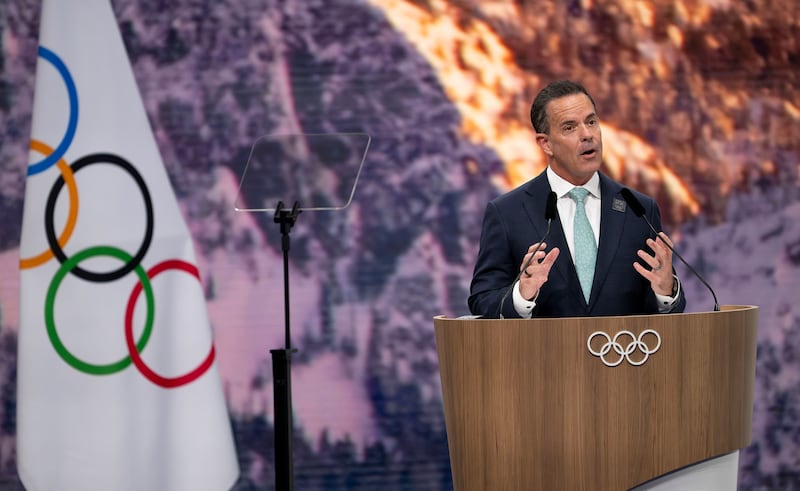
Wilson said the amount that Olympic organizers anticipate needing to reimburse state and local governments for public safety services in 2034 as part of their $4 billion budget will be close to what would have been raised by collecting sales taxes.
“We may charge a fee on top of our tickets to offset those costs,” he said. “We’ll make that decision probably in about four years if we’re going to do that and what that would look like. What we don’t want is to collect and remit sales taxes.”
Without the exemption, Wilson said tickets sold through a third-party vendor would be subject to sales taxes. He said a sales tax exemption may also be sought for Olympic merchandise, such as T-shirts and plush mascot toys.
Organizers have long committed to relying on private sources of funding rather than state or local revenues. Money will come largely from the sale of broadcast rights, sponsorships and tickets, with tickets accounting for 30% of projected revenues.
“We have to pay for the services, regardless of how much we generate,” Wilson said.
What lawmakers said about exempting Olympic tickets from sales tax
Hawkins’ bill easily passed in both the House and the Senate.

Still, a few lawmakers had questions about giving up what fiscal analysts estimated would be $58 million that would have been collected by the state, plus another $30 million by local entities.
During debate on the House floor, Rep. Nicholeen Peck, R-Tooele, said she wanted “to make sure I’m understanding that the people rolling out the red carpet for the Olympics are not going to be thrown under the financial bus.”
Sen. Brady Brammer, R-Pleasant Grove, expressed a similar sentiment when the bill was heard in a Senate committee. He suggested in the future, legislation may be needed to require Olympic organizers to come up with at least what the sales tax would have generated.
“I just want to make sure that we’re not coming out behind despite spending billions of dollars getting ready,” Brammer said. “But I don’t necessarily want us to come out ahead, either, in that sense. I just want to make sure we’re protecting the state.”
Hawkins told the Senate Revenue and Taxation Committee members he believes organizers are well aware of that concern.
“Obviously, they have to make their plans,” he said. “But the idea is to increase the price of a ticket with that fee commensurate to the sales tax rate.”
Were tickets to Utah’s 2002 Olympics taxed?
Taxing Olympic ticket sales was a much more contentious issue ahead of Utah’s last Winter Games, in 2002.

In 1998, the Utah Legislature approved imposing sales taxes on tickets, despite opposition by what was then known as the Salt Lake Organizing Committee, or SLOC, which claimed the added costs could affect attendance and reduce revenues.
Lawmakers at the time said they needed to close a “loophole” they warned was already being exploited because sales taxes weren’t being collected on merchandise sales at SLOC’s downtown headquarters.
The larger issue was the growing awareness that state and local governments would need to provide public safety and other services at the Winter Games and somebody would have to foot the bill.
By 2000, though, lawmakers had removed the sales tax on tickets after a deal had been worked out with what was also a privately funded organizing committee to use the $13 million that would have been paid in sales taxes to offset public safety costs.
Although the federal government will be in charge of security at the Olympics and pick up much of the tab, organizers plan to pay state and local governments for everything from using police officers to direct traffic at venues to snow removal.
Wilson said contracts for state and local services won’t be negotiated until a year or two before the start of the Winter Games because organizers “want to be making these decisions with the leaders that will be implementing them.”
It’s Utah taxpayers who are on the hook for any budget shortfalls, as the guarantor in the International Olympic Committee’s contract for hosting a second Winter Games that was signed by the governor in 2024.
Wilson said that means organizers must work toward meeting their budget objectives, even though the Games are years away.
“I’ve got a list that we’re trying to check off. This was one that was simple to do, and we had legislative enthusiasm and support to work on it, so we moved forward,” he said, adding, “We’re just chipping away at the things we can.”