



Anyone who sat in on public discussion on the slate of judicial-focused bills this past legislative session heard no shortage of concerns, as speakers lined up to warn that lawmakers were seeking “unilateral and arbitrary power.”
Though recent polling shows the opposition may not be the majority opinion of Utahns.
The GOP-heavy legislature ended its session earlier this month, satisfied with its efforts to overhaul the state’s court system by passing several judicial bills, including a newly established three-judge court.
The second court structure bill signed by Gov. Spencer Cox established a three-judge court that will focus solely on lawsuits challenging state laws as unconstitutional. Initially, only the state had the power to transfer a civil action from a single district judge to a three-judge district panel, prompting plaintiffs in multiple cases against the state to seek temporary restraining orders.
As a solution, lawmakers passed a separate bill allowing any litigant — not just the state — to file a notice requiring that a constitutional challenge be heard by a three-judge panel rather than a single district judge.
A recent Deseret News/Hinckley Institute of Politics poll, conducted by Morning Consult, surveyed 800 registered voters at the beginning of March to provide a statewide perspective on the newly established 3-judge constitutional court.
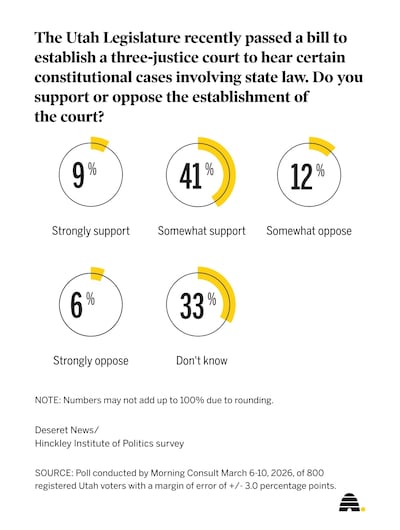
Democratic men were most strongly opposed to the new court (16%), while Republican men were the political demographic most in favor of it (12%), though the findings didn’t show any demographic as a major outlier.
Are Utahns confident in the state Supreme Court?
The March 6-10 survey also looked into how much faith Utahns have in the state’s Supreme Court as well as the nation’s highest court.
The first judicial-focused bill signed into law by the governor this last session reformed the state Supreme Court. Adding two more judges to the state Supreme Court’s five-person bench, some lawmakers said, was the “biggest commitment” the legislature could make to the judiciary.
“The Legislature believes in checks and balances and in respecting the distinct and independent roles and responsibilities of each branch of government. That respect, however, does not eliminate the need for accountability,” Senate President Stuart Adams and House Speaker Mike Shultz previously told the Deseret News in a joint statement.
But last month, four former Utah Supreme Court justices, with more than 40 years of combined experience, said Utah Republican leadership in the Legislature’s efforts to reform the judicial branch were a political overreach. The justices said they believe lawmakers are bringing these bills forward because they are unhappy with some of the recent decisions made by the courts
Confidence in the Utah Supreme Court is as follows:
- A great deal: 13%
- A fair amount: 42%
- Not much: 27%
- Not at all: 8%
- Don’t know: 10%
Men were more likely to have confidence in the state’s legal bench than women. Where the findings were a little surprising was how much more Democrats lacked trust in the state Supreme Court compared to Republicans:
Democratic men and women (combined):
- A great deal: 14%
- A fair amount: 73%
- Not much: 68%
- Not at all: 32%
- Don’t know: 12%
Republican men and women (combined):
- A great deal: 30%
- A fair amount: 97%
- Not much: 42%
- Not at all: 9%
- Don’t know: 21%
Results from the survey have a margin of error of plus or minus 3 percentage points.