



- The University of Utah hosted its annual campus safety summit on Thursday.
- This year's theme: Preventing and preparing for active threats on campus.
- One school shooting survivor offered guidance on supporting those impacted by mass shootings.
Helplessness is one of the common, wrenching emotions people experience when news breaks of another mass shooting.
“I just wish,” many say, “that there’s something I could do.”
But such feelings of helplessness — while understandable — are not accurate. Regular folks can help prevent shootings by “deciding to decide.”
- Decide to be an “upstander” rather than a “bystander.”
- Decide to trust your instincts — your gut feelings — and speak up when someone’s behavior seems off.
- And then decide to act, despite uncertainty.
Those were just a few of many tips shared Thursday at the Utah Campus Safety Summit sponsored by the University of Utah Department of Public Safety.
This year’s theme at the annual gathering of law enforcement, first responders, educators, mental health professionals and security workers: “Preventing and preparing for active threats on campus.”
The sold-out summit featured a variety of training sessions, ranging from how “everyday guardians” can stop targeted violence before it happens — to exploring connections between online radicalized communities and violent behavior.
Kristina Anderson Froling, a survivor of the 2007 Virginia Tech University shooting and now an advocate for bystander intervention and school violence prevention, offered the event’s keynote address.
“We all must take the time to prepare for the event we hope never happens — but have our plan of action if it does,” noted University of Utah Chief Safety Officer Keith Squires in his welcome message.
How to become an everyday guardian

Most acts of targeted violence, including campus shootings, follow behavioral warning signs the everyday people — so-called bystanders — can pick up on.
But what should a relative or a friend or a co-worker do when someone starts “leaking” troubling behavior?
First, trust your gut — and then act, taught University of Utah Associate Director of Threat Assessment and Management Keith Livingston during his Thursday morning presentation.
Everyone in the community, said Livingston, can decide to be more than simply a helpless bystander. Choose instead to become an everyday guardian.
“What I’m looking for is to turn our community into a force multiplier of people that understand what concerning behaviors look like and that need to be reported — and will then get involved and share that information with people who can actually do something,” he said.
Almost every case of targeted violence included indicators — or behaviors — that occurred prior to an attack. About half of those cases also include ‘leakage” where shooters leak their intentions to another person.
“So we as guardians — as a community — if we’re recognizing what those behaviors look like, if we’re hearing that leakage, and then we’re taking the time to report, gives us a greater opportunity to do something about it,” said Livingston.
The veteran law enforcement officer said he’s still alarmed to learn that 8 out of 10 school shooters had told someone about their plans prior to a target attack. But that’s of no value if those plans are not reported before tragedies occur.
Take note and trust your instincts when a friend, relative or neighbor changes his or her baseline behavior — especially if those deviations are coupled with other unsettling behaviors, said Livingston.
A mass shooting is rarely spontaneous. It’s typically premeditated.
“Which means that an individual is going to leave bread crumbs,” said Livingston. “They’re going to leave evidence that their intention is to commit this act of targeted violence.”
Perpetrators of, say, school shootings, have typically followed a pathway that ends in actually carrying out mass violence.
Such paths to targeted violence, taught Livingston, usually begin with some sort of grievance that is then followed by violent ideation, research and, finally, planning an attack and pre-attack preparation.
Relatives and acquaintances, added Livingston, should remain alert to several common warning behaviors that could lead to a targeted shooting, including:
- Grievance fixation
- Escalating agitation
- Identification with previous attacks
- Acquiring weapons in connection to a grievance
- Planning and research
- “Leaking” intent to commit violence
Everyday guardians are not expected to predict violence. Instead, it’s their duty to prevent violence.
“So if I start to see clusters of these (warning behaviors), I need to share that information with somebody that can take that information and do something with it,” said Livingston.
Reporting warning behaviors to, say, law enforcement or mental health professionals, requires a mental paradigm shift, he added. “‘Reporting’ is not ‘accusing’ somebody.” It’s about initiating management strategies to help an individual in crisis find resources and support.
Livingston also offered a “speak up” strategy that everyday guardians can utilize when they spot warning behaviors in another.
- Trust your instincts — if something feels off, it’s worth sharing.
- You don’t need proof or certainty. Just report what you’ve observed.
- Remember, reported information is just one piece of a large picture that trained professionals evaluate.
- Reporting is about help, not punishment. Most cases lead to support, not discipline.
- And finally, silence allows dangerous behavior to grow. Speaking up can stop it.
A survivor’s call for preparation, support and empathy
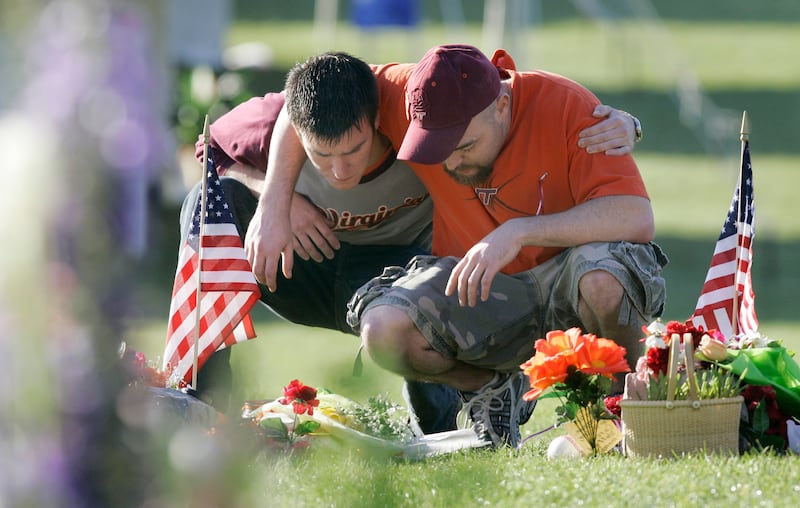
Almost two decades have passed since the Virginia Tech campus shooting that resulted in 33 deaths (including the shooter) and 17 wounded by gunfire on April 16, 2007.
But for Kristina Anderson Froling, April still brings renewed anxiety and unwanted reminders that she was shot three times in her French class and almost died.
And, also, that she lived and many others did not.
Now the mother of three is the founder of the Koshka Foundation for Safe Schools, an organization focused on preventing, responding to and healing in the aftermath of mass shootings.
Anderson Froling walked her keynote audience Thursday through each moment of that deadly shooting spree.
It was a sunny Monday in Blacksburg, Virginia, that forever changed her life — and became another haunting entry in the nation’s ongoing story of mass shootings.
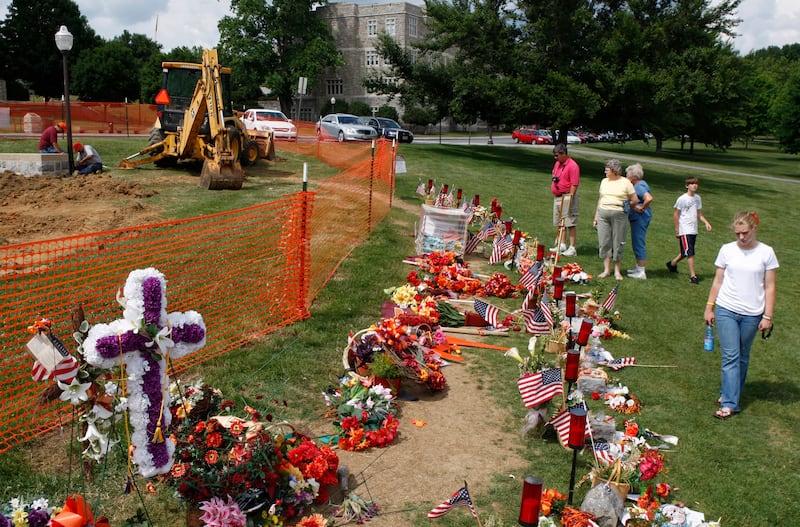
Anderson Froling displayed the names and photos of each person who died in her French class — and shared a clip from a televised interview she gave shortly after the 2017 Las Vegas music festival shooting.
She was asked in the news clip if she feels any obligation as a targeted shooting survivor:
“The obligation is to live a better life,” she said. “The obligation is that you’ve lived and you’ve felt and you’ve seen the fact that everyone gets to go home to their children and to their spouses.
“And that life is short. And that the best way you can honor what happened is to be authentic to yourself.”
Besides emphasizing the importance of campus safety and preparedness, Anderson Froling also stressed community support, offering empathy to survivors, first responders and their families — and also for mental health services.
Concluding, she invited her audience to find frequent opportunities to stop and reflect.
“Think about who you will contact; who you love,” she said. “You never know when that last text or phone call or conversation will happen — so hold that dear.
“It is a small moment that we’ll appreciate, and we all deserve those in our relationships.”