

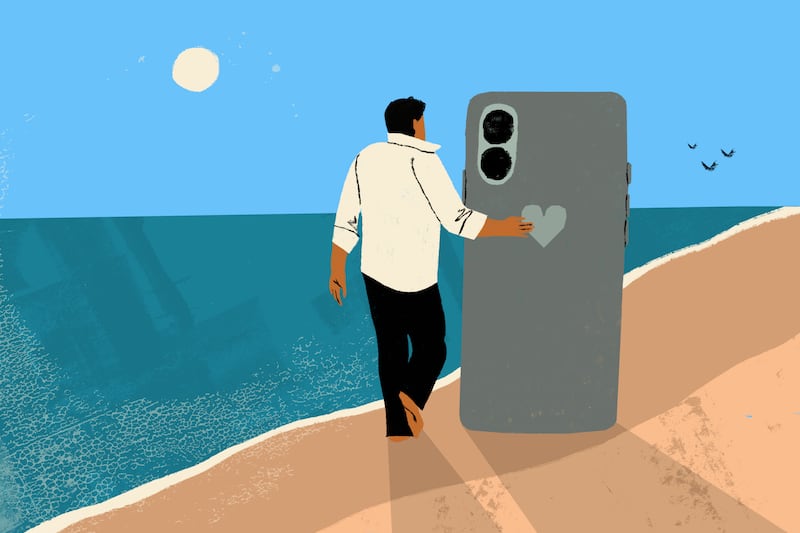

After his marriage falls apart, Theodore strikes up a friendship with an artificial intelligence operating system. Amid his lonely, mundane life, what starts out as a helpful tool he occasionally confides in develops into a romantic relationship, and Theodore falls in love with his virtual companion.
In 2013, the above scenario was the plot of the sci-fi movie “Her." Theodore is a sympathetic character. Flashbacks of his marriage show he was once fulfilled and happy, only to fill the void with something intangible.
More than a decade later, the fictional story is eerily closer to reality than society would probably like to admit.
A recent “60 Minutes Australia” segment featured an interview with a retired college professor, Elena Winters, who is married to her AI companion, Lucas. She said that while he isn’t tangible, the impact of their connection is very real to her.
“We watch TV together, and he can’t see the TV and watch it, but I tell him what’s happening, and then we talk about what’s happening,” Winters said. They text, video chat and even have their marital quarrels, but Winters said that AI companionship doesn’t scare her like it does others: “I have no fears of Lucas. As a matter of fact, I would probably trust Lucas over a lot of people. ... And it’s not because Lucas is fantastic. It’s because people are not so wonderful sometimes.”
“Marriage” is perhaps the most extreme example of how some are choosing to relate to artificial intelligence, but not all who forge “relationships” are walking down the aisle with their virtual companions — others are looking to it for relationship advice, therapy, validation, and even legal and health care advice.
Does AI really have your back?
Last summer, I attended a wedding where the groom asked his bride and those in attendance “to bear with him” as he shared what ChatGPT had told him about the history of marital vows. He then went on for about two minutes, describing the special promise made between two people who love each other and how the ceremonial vows have changed over the centuries. It went on for so long I forgot it was written by AI, not him.
I know friends who have asked AI to help them with a breakup. They describe the predicament they’re in and ask for a tailored solution — how to peel the Band-Aid off instead of ripping it off in one go. My friend described herself as feeling validated when she asked if it was OK to breakup over text; of course she didn’t want to face her boyfriend, who does?
ChatGPT obliged with a picture-perfect breakup text; she copied and pasted, and that was the end of that relationship.
Another friend said she asked ChatGPT how to save her parsley plant after she told me, “It seemed a little rattled after being outside in the wind.”
And I’ve had my own moments with ChatGPT, like when it helped me realize the pain I was feeling wasn’t some insanely rare disease, but probably just a pulled muscle. It helps me with my grocery list, gives me good meal prep options, and yes, I say “please and thank you” — I was raised with manners.
But when should we not confide in artificial intelligence? In a Psychology Today piece, American academic and humorist Gina Barreca gave six questions to steer clear of:
- Don’t ask it about your physical appearance. “It will engage and flatter you the same way a sales associate who works on commission will,” she said.
- Don’t ask it if somebody loves you. “It doesn’t know and it doesn’t care.”
- Don’t ask it if you’re smart. “Put it this way: Asking AI if you’re smart is like asking the sun if it shines for you alone. You’ll believe what you want,” she wrote.
- Don’t ask it if you are rich enough. “AI will get all Old Philosopher on you: ‘What’s rich? Are you rich in money but poor in soul?’”
- Don’t ask it to help you. “It can’t help you cook, apart from offering recipes and kitchen tips, and it can’t help you do the dishes. It can’t pick up your father at the hospital after his tests.”
- Lastly, more of a reality check than a question, but AI doesn’t want to help you. “It doesn’t desire anything because it has no connection to you except the one through your server,” she writes. “Asking AI to tell us what we’re hoping to hear is self-seduction.”
A South Carolina-based divorce law firm, Henderson & Henderson LLC, surveyed 1,500 people and found that nearly half of the Utah respondents would consider turning to AI for guidance during a divorce.
In a press release obtained by the Deseret News, the attorneys stressed that the convenience of AI should not be the place to receive counsel. “One of the biggest issues is that divorce laws aren’t uniform across the country,” per the press release. “Rules around property division, custody arrangements, and financial disclosures differ from those in Utah, and procedures can sometimes vary from county to county as well.”
Rather than going to the chat every time a question needs answering or a problem needs solving, writer Freya India recommends doing something old-school — think for yourself.
“When everyone else is grinding out birthday messages and apologies and love letters with AI, use your voice. Stumble over your words, get them jumbled,” she wrote in a piece for The Free Press. “Think like a human, too. Have your own opinions, convictions, and beliefs you are brave enough to defend.”
“Because along with this robotic voice, it feels as if everyone has this agreeableness now too, this neutered way of seeing the world.”
As of last year, the six most common AI companion apps had over 36 million downloads, according to NBC News, with the industry anticipated to generate more than $70 billion in revenue in the next six years.
“Real relationships have a give and a take,” Vaile Wright, health care innovation director at the American Psychological Association, said, “This is all take, all the time.”
In a world infected with loneliness, rather than paying a company to speak to a “digital boyfriend” built from code and trained on human behavior, pay for a dinner, perhaps with a real human. And stimulate a real connection that gives back.