

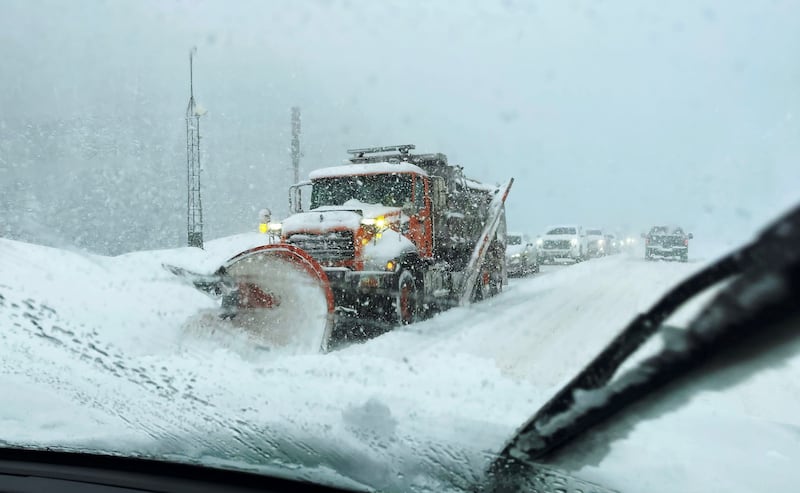
Utah’s early summer preview is coming to an end, as a mix of rain and snow returns to the Beehive State this week.
The shift in weather comes as a high-pressure system that’s dominated the state’s weather over the past few weeks — breaking a slew of records along the way — moves out toward Texas and decays, opening the door for low pressure to return to Utah, said KSL meteorologist Matt Johnson.
Two large systems off the Pacific Coast are forecast to push storms into Utah starting on Tuesday.
“It has quite a bit of moisture with it,” he said. “It’s going to drift in and amplify rain totals.”
Storm timing
Some scattered showers are possible in northern Utah on Tuesday morning, especially in higher elevations. Showers may expand to mountaintops in other parts of the state by the afternoon, before more widespread showers develop until later in the day.
Valley rain and mountain snow will become more prevalent Tuesday night and more so early Wednesday as a “slug of moisture” enters the state, Johnson said. Snow levels will likely start at 8,500 feet, dropping to 7,000 feet by Wednesday morning. Some thunderstorm activity is also possible as the system arrives.
Showers are forecast to linger into Wednesday afternoon, becoming more scattered by the afternoon and evening.
Another wave of moisture from a different low-pressure system is expected to reach Utah’s northern half on Thursday, driving up totals. Snow showers are possible on the valley floors on Friday morning, before the system clears out. Any snow accumulation will likely be low, Johnson said.
Big numbers projected
Mountain areas are projected to receive their biggest boost in weeks, even from the first wave of moisture. Alta and Brighton in the Cottonwood canyons could receive 1½ to 2 feet of snow or more by early Friday, according to a National Weather Service model updated on Tuesday.
Areas like Brian Head could still receive 6 to 12 inches of snow, even if models suggest it will miss out on the second storm.
Big precipitation numbers are also projected across valley communities. Over an inch of rain is possible across the Wasatch Front, with the highest amounts near the Great Salt Lake, according to KSL Weather models.
Most other areas could get at least a half-inch of rain by the end of Thursday. St. George and Moab may end up with some of the lowest totals in the state this week, but they may still collect a quarter of an inch or more.
UTAH STORMS: After 25 days of no precipitation, record heat and 9 ski resort closures… the spigot turns back on! Models have trended wetter with 2 storms this week. #utwx
— Matthew Johnson (@KSL_Matt) March 30, 2026
STORM 1: Tuesday PM - Wednesday
STORM 2: Thursday - Friday AM pic.twitter.com/QdqAJULEc6
It would be a welcome sight for Utah’s resorts and water managers. Almost 70% of the state is now in severe drought following a recent wave of warm and dry weather, which also caused the statewide snowpack to tumble.
Utah’s statewide snowpack entered this week at 3 inches of snow water equivalent, about one-fifth of the median average for the end of March, which is the normal peak of the snow collection season. It appears to have peaked at 8.3 inches this season, which would be the lowest level in at least 45 years.
Many resorts have had to close as a result. Seven of Utah’s 15 were still open this week, according to Ski Utah.
Cooling down
This week will also be demonstrably cooler than the record-setting warmth from the past few weeks.
High temperatures will drop from the mid-60s on Tuesday to potentially below 50 degrees in some parts of the region by the end of the workweek. Overnight lows may fall below the freezing point in parts of the region this week, as well.
This comes after places like Salt Lake City have surpassed 70 degrees on 11 of the previous 14 days before Tuesday, while setting a new monthly high-temperature record of 84 degrees on March 21.
Freezing temperatures are expected Friday morning and Saturday morning along the Wasatch Front and in the San Rafael Swell and Western Canyonlands which will affect early season agriculture. pic.twitter.com/97PMA1RKcF
— NWS Salt Lake City (@NWSSaltLakeCity) March 30, 2026
The cooldown won’t last long, though. High temperatures are projected to return to the mid-60s by Easter Sunday.
It won’t be as drastic in southern Utah. Temperatures near St. George will fall from the mid-80s on Monday to the mid-60s on Friday, then warm up again.
Full seven-day forecasts for areas across Utah can be found online at the KSL Weather Center.