

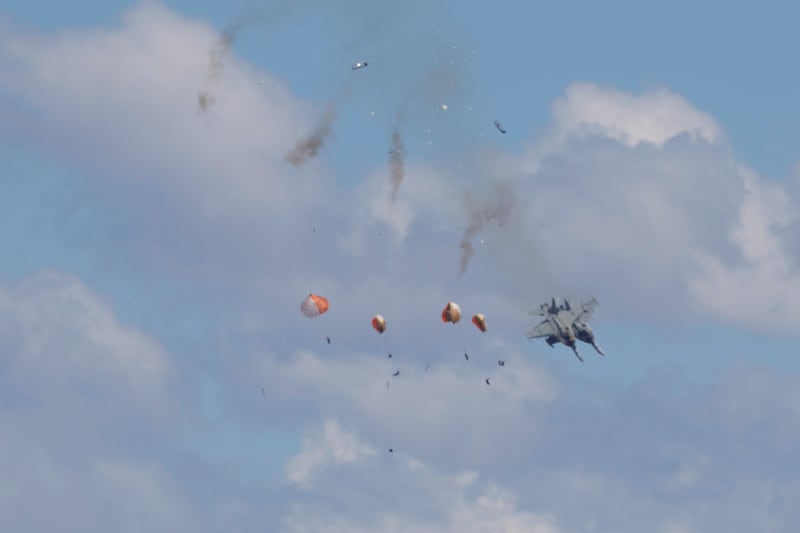

- A pair of Navy fighter jets collided Sunday during public air show in western Idaho.
- All four Navy aviators involved in the crash survived and were not seriously injured.
- A similar military air show was postponed last month at Utah's Hill Air Force Base.
Four Navy aviators survived a midair collision between two fighter jets during Sunday’s air show witnessed by thousands at Idaho’s Mountain Home Air Force Base.
The crash involved two U.S. Navy EA18-G Growlers from the Electronic Attack Squadron 129 in Whidbey Island, Washington, said Naval Air Forces spokesperson Cmdr. Amelia Umayam in an Associated Press report.
The aircraft were reportedly performing an aerial demonstration when the crash occurred.
The four crewmembers from both Navy jets ejected safely and parachuted to the ground. All were in stable condition.
There were no injuries on the ground to airshow spectators or military personnel.
“Everyone is safe and I think that’s the most important thing,” said Kim Sykes, marketing director with Silver Wings of Idaho, which helped plan the weekend air show.
The base was locked down immediately following the crash and the remainder of Sunday’s air show was canceled.
Videos posted online by spectators showed four parachutes opening in the sky as the fighter jet fell to the ground near the base about 50 miles south of Boise, according to The Associated Press.
Shane Ogden said he was filming the two jets as they came close together. A video he captured shows the two aircraft appear to make contact and then spin in tandem as the crewmembers eject and their parachutes open. The planes then fall together, exploding into a fireball upon impact as the crewmembers drift to the ground nearby.
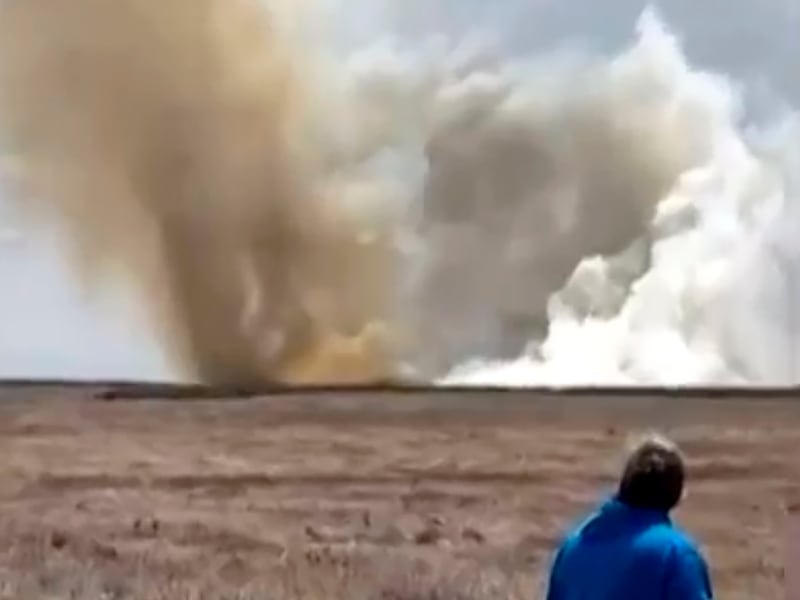
“I was just filming thinking they were going to split apart and that happened and I filmed the rest,” Ogden said in a text message to The Associated Press.
The EA-18G Growler is a variant of the F/A-18 aircraft family that combines the F/A-18F Super Hornet platform with sophisticated electronics to perform a wide range of enemy defense suppression tasks.
Each jet costs $67 million, according to the Navy.
Challenges of highly technical fighter jet maneuvers
It was remarkable both crews were able to eject from their planes.
Aviation safety expert Jeff Guzzetti told The Associated Press that may have been possible because of the way the planes collided and appeared to remain stuck together in midair before falling to Earth.
Crews usually don’t have a chance to eject in a midair collision, he said.
“It’s really striking to see,” Guzzetti said. “It looks like they struck each other in a very unique fashion to cause them to remain intact and kind of stick to each other and that very well could have saved them.”
“It appears to be a pilot issue to me. It doesn’t look like it was a mechanical malfunction,” he added. “Rendezvousing with another airplane in formation flight is challenging, and it has to be done just right to prevent exactly this kind of thing.”
Aviation safety expert John Cox, who is CEO of Safety Operating Systems, told The Associated Press that the pilots who perform at air shows are among the best, but there is little room for error.
“Air show flying is demanding. It has very little tolerance,” Cox said. “The people who do it are very good and it’s a small margin for error. I’m glad everybody was able to get out.”
The air show industry has been working to improve safety for years at the roughly 200 events held each year in the U.S.
The last fatal crashes at an air show reportedly came in 2024 when two people were killed in separate crashes at different events.
A spectator hasn’t been killed at an air show in the U.S. since 1952.
Investigators may be able to quickly get an idea of what happened in Sunday’s crash because the crews of both planes survived and will be able to tell investigators what they saw and experienced before the collision. The Navy will lead the investigation, so there won’t be as much information shared publicly as in civilian crashes.
Military air shows nixed at Hill Air Force Base, elsewhere
Military air shows have made Utah news in recent weeks.
In April, Utah’s Hill Air Force Base announced it was postponing its biennial Warriors Over the Wasatch Air Show. The change “is a direct result of the need to prioritize resources for critical ongoing operations.”
Initially planned for the end of June, the 2026 Warriors Over the Wasatch Air Show has been rescheduled for June 19-20, 2027.
“This was not the outcome any of us hoped for. We know this news is a great disappointment to the community partners, performers, and thousands of supporters who make this event a success,” Col. Dan Cornelius, 75th Air Base Wing commander, said in a statement.
“We are committed to delivering an exceptional experience — and it became evident that with current constraints, we could not guarantee the quality and scale that defines the Warriors Over the Wasatch show and that our community deserves.”
Similar military air shows have halted since the war with Iran began.
March air shows featuring the Navy’s Blue Angels aviation demonstration team were canceled at California’s Naval Air Facility El Centro and California’s Naval Air Station Lemoore due to “increased security measures and evolving force protection requirements,” the Pensacola News Journal reported.
Meanwhile, the Niagara Falls Air Reserve Station announced the 2026 Thunder of Niagara Air Show was canceled. The show was to be staged in late June.
“After reviewing the situation and the resources available to us it became clear that we would not be able to produce an air show that meets the standard our community expects and deserves,” according to a station spokesperson.