

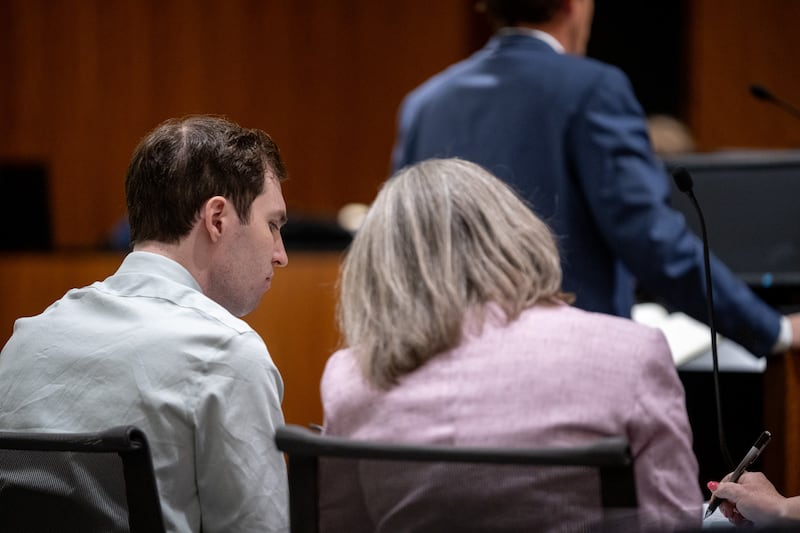
Did prosecutors break the judge’s pre-trial order by speaking to the media or were they trying to prevent a potential jury pool from being prejudiced by statements made by Tyler Robinson that the state contends were misleading?
On Tuesday, 4th District Judge Tony Graf heard arguments about whether the Utah County Attorney’s Office should be held in contempt of court because prosecutor Chris Ballard, the office’s spokesman, went on national TV and sent emails to the media discussing evidence in the capital murder case.
Robinson, 23, is accused of shooting and killing political activist Charlie Kirk at Utah Valley University on Sept. 10, 2025. He faces a potential death sentence if convicted.
In March, Robinson’s defense team filed a motion to postpone his preliminary hearing. In that motion, they noted that an initial report from the Bureau of Alcohol, Tobacco, Firearms and Explosives “indicates that the ATF was unable to identify the bullet recovered at autopsy to the rifle allegedly tied to Mr. Robinson.” And the defense said it might offer the testimony of the ATF firearm analyst as “exculpatory evidence.”
“Our motion to continue did not mischaracterize the ATF report,” defense attorney Richard Novak argued Tuesday. “We accurately characterized what is in that ATF report.”
But that bit of information created a “tidal wave” of media coverage, some of it questioning whether the state’s case had just imploded, deputy Utah County attorney Ryan McBride responded.
“(Robinson’s team) reported the most prejudicial statement they could find,” McBride said, while adding the statement was "absolutely misleading."
Because of that, McBride contends prosecutors had an obligation to their client, the state of Utah, to correct the misinformation that was being spread. The state says Robinson specifically left out a key part of the ATF report that said it could not identify “or exclude” that the bullet fragments recovered at autopsy matched the rifle found near the shooting that investigators believe Robinson used.
And McBride said the type of bullet fragment recovered automatically eliminated many weapons that it could have been shot from, but did not exclude the one recovered by the police.
“By no stretch of the imagination is the testimony of this (ATF) witness ‘exculpatory,’” McBride said.
Prosecutors say that to correct the mischaracterization of evidence and prevent the potential jury pool in Utah County from being prejudiced by the misleading information from the defense, Ballard appeared on several national news programs and sent a statement from the Utah County Attorney’s Office to several outlets. McBride emphasized that the Utah County Attorney’s Office was only correcting misleading statements made by the defense.
But Robinson contends Ballard went on a “media tour,” which was against the rules, and that the Utah County Attorney’s Office could have relayed its side in a different way. Furthermore, Novak argued that Ballard inappropriately made statements about Robinson’s alleged culpability in the crime.
McBride countered that Ballard did not make statements of guilt. “This is nothing more than saying we believe we have adequate evidence. ... There’s nothing wrong with that.”
Robinson wants Graf to hold a full evidentiary hearing to determine whether Ballard and his office violated the rules of pretrial publicity.
During the second part of Tuesday’s hearing, attorneys argued whether portions of Robinson’s July preliminary hearing should be closed to the public and some evidentiary items kept out of the public eye. Robinson and his defense team are again arguing that Robinson’s right to a fair trial could be compromised if evidence later determined to be inadmissible at trial is introduced to the public during the preliminary hearing.
On Monday, Robinson listed in court documents some of the items of evidence he believes should be sealed at the preliminary hearing, including DNA and ballistics reports from the ATF and FBI, text messages between Robinson and his roommate Lance Twiggs, the recorded statement of Twiggs, a burnt note found in Robinson’s apartment, Discord chats between Robinson and his friends, videos recorded from behind where Kirk was sitting at UVU — and even the autopsy report from the state medical examiner.
The defense argues in its latest court filing that although some of this evidence has already been made public, such as the messages between Robinson and Twiggs, “the republication of evidence only serves to recirculate purported evidence that was improvidently released.”
On Tuesday, however, prosecutors and Robinson’s defense team agreed that certain items of evidence, such as video of Kirk being shot, should not be shown to the courtroom gallery and would not be available for members of the media to inspect after the hearing.
That left the issue of witness testimony to argue. Robinson is concerned that hearsay will be offered by some of the law enforcers whom the state plans to call to the witness stand, which would not be allowed at trial. Whether hearsay will be allowed at the preliminary hearing is part of a third motion that Graf is expected to hear arguments on in June.
Defense attorney Staci Visser contended Tuesday that Robinson could raise objections to these issues as the preliminary hearing moves along, but that would severely interrupt the flow of the hearing and potentially make it much longer. She suggested closing the preliminary hearing and providing a transcript afterward of the portions that were allowed as evidence, arguing it is the only way to prevent the spread of misinformation and protect Robinson’s right to a fair trial.
Prosecutor Chad Grunander countered that while this is primarily the media’s fight, “We favor open hearings so the public can trust what happens in this courtroom.”
Attorney Michael Judd, representing the media, argued Tuesday that simply saying “it’s possible” that some evidence will be inadmissible during trial is no reason to close a preliminary hearing.
As for hearsay evidence, prosecutors say it “is a staple of preliminary hearings.” The state says the evidence prosecutors plan to introduce at the preliminary hearing “includes witnesses’ personal observations, photographs of seized physical evidence, witness recordings of the alleged crimes, surveillance video, foundational statements for evidence, statements from law enforcement officers to other officers, autopsy findings, forensic laboratory findings, and (Robinson’s) own admissions. None of this evidence is speculative in nature, inaccurate, or inflammatory, and (Robinson) has not argued that the substance of this evidence would be inadmissible if introduced directly rather than as reliable hearsay.
“Here, none of the state’s proposed evidence is speculative, inflammatory, or inaccurate, although the videos of (Kirk) being shot are sensitive. And again, there is nothing to suggest that the substance of the evidence is inadmissible.”
Prosecutors further emphasize that a preliminary hearing is a public proceeding.
“Consequently, the media has a right to be present and to report on the hearing,” the state argues. “(Robinson) has not shown that the media’s presence and reporting on this case will jeopardize his right to a fair trial. As the court has repeatedly recognized, the public and news media enjoy a presumptive constitutional right of access to criminal proceedings.”
Graf says he will issue his decisions on whether to hold an evidentiary hearing on the issue of contempt and whether to close the preliminary hearing to the public on June 1.
He then scheduled a hearing for June 12 to argue the issue of hearsay evidence and, if needed, for both sides to present evidence on the contempt issue, depending on how he rules on June 1.