

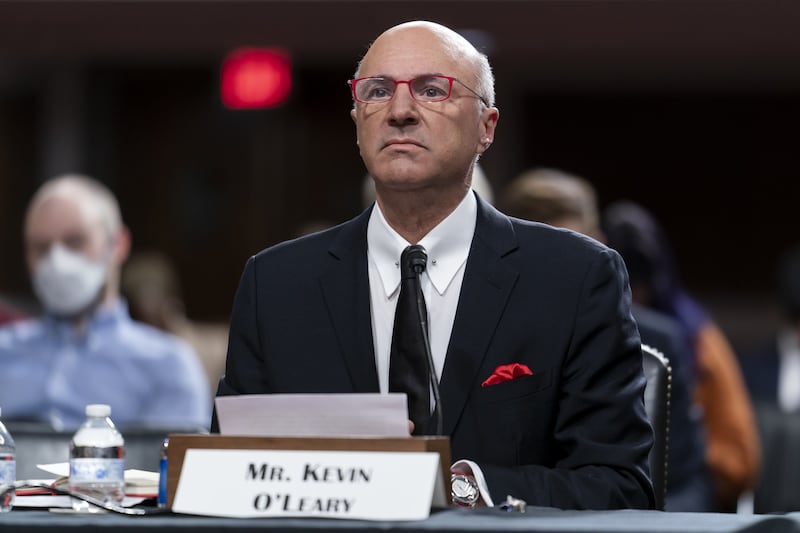
Kevin O’Leary, the force behind the Box Elder County data center proposal, is calling for dismissal of the federal defamation suit he faces stemming from his critical comments targeting foes of the controversial project.
The celebrity businessman on Monday filed his response to the lawsuit filed in July against him by Alliance for a Better Utah, Elevate Strategies, and leaders from the two organizations: Joshua Kanter and Gabrielle Finlayson. Like O’Leary, Fox News Network, the other defendant in the case, also filed a motion to dismiss the matter.
Kanter, the founder of the Alliance, and Finlayson, a senior partner with Elevate, contend in their lawsuit that O’Leary defamed them during the contentious public debate when the proposal first publicly emerged by saying they had links to China. They filed the suit on July 15 in U.S. District Court in Salt Lake City.
In his answer, though, O’Leary rejects the charge, noting the language he used in publicly criticizing the project foes on television, his invitation for Kanter and Finlayson to respond to him and more.
“Read in the full context of each appearance, on opinion programming, in the middle of an eight-week political fight in which both sides accused the other of wrongdoing, no reasonable viewer would take them as factual reports. They are argument and rhetorical hyperbole qualified as O’Leary spoke them,” O’Leary’s response reads.
O’Leary made his critical comments suggesting Kanter and Finlayson had links to the Chinese government in a May 11 interview with Fox News host Maria Bartiromo. In its response, the television network argued, in part, that the suit doesn’t demonstrate malice on the part of Fox in interviewing O’Leary, an element of defamation.
Moreover, the comments by O’Leary that are at issue “are nonactionable assertions of opinion,” Fox said.
O’Leary, pushing the Box Elder County proposal through O’Leary Digital, had suggested that foes of his data center initiative were “proxies for the Chinese government” in his May interview with Fox. “This is the CCP at work here,” he told Fox, referring to the Chinese Communist Party. He singled out Finlayson and Kanter by name.
Later, O’Leary posted a social media message on June 25 saying he had no evidence that the two groups or Finlayson or Kanter were funded by China or the Chinese Communist Party. Bartiromo read a similar statement on her program the next day and said Fox “apologizes for the error.”
O’Leary Digital’s plans for Box Elder County, which have sparked widespread debate and fierce opposition from some, call for development of data centers and up to 9.5 gigawatts of power-generating capacity to support them. The proposal is seemingly on hold as another lawsuit in Utah by foes of the plans winds its way through state court.
‘Weekslong smear campaign’
Debate in Utah and beyond about the Box Elder County proposal reached a pitch last spring. Critics worried in particular about the potential environmental impacts of the operations and their water use. Proponents like O’Leary touted the importance of data centers and their computing power to national security and in countering the potential threat posed by China if its data center capabilities exceed U.S. capabilities.
In that context, O’Leary hinted at what he believed to be the potential links between the data center foes and China.
In response, the Alliance and Elevate charged in their lawsuit that they had faced a “weekslong smear campaign” at the hands of O’Leary and that Fox was “instrumental” in the effort. The Alliance “advocates for progressive policies” while Elevate aims through its efforts with political candidates and causes “to boost progressive power,” according to the respective organizations’ websites.
“Across at least 10 separate media appearances broadcast to millions of viewers and shared with millions more online, O’Leary repeated his malicious, false claims that plaintiffs were agents of China and engaging in criminal conduct,” the lawsuit reads.
In their responses this week, though, O’Leary and Fox counter the charges on an array of grounds.
O’Leary’s filing states, among other things, that the lawsuit isn’t specific enough in singling out the “actionable” statements by O’Leary. The lawsuit “sweeps together ten separate media appearances, numerous social-media posts, four different plaintiffs and different statements made over several weeks, and then declares the entire collection actionable,” the filing reads.
Moreover, Oleary’s filing argues that the plaintiffs don’t adequately demonstrate that he engaged in malice — similar to the Fox response.
In making his initial assertions, O’Leary “moved from an observed similarity between plaintiffs’ content and content he attributed to a (Chinese Communist Party)-linked source to the inference that the two are connected,” his response reads. O’Leary says he “presented that step as his ‘argument,’ thereby drawing a conclusion, not publishing a known falsehood.”
Beyond that, O’Leary’s filing maintains that he never accused the plaintiffs of committing any crimes, thus his statements don’t amount to defamation.
In its filing, Fox noted its on-air corrections on the matter on five Fox programs that hosted O’Leary on the data center issue last May.
“Far from publishing O’Leary’s statements with actual malice, Fox corrected them once the alliance plaintiffs belatedly sent a correction demand,” the filing reads. The plaintiffs sent that demand on June 5.
Fox also argued that interviewing O’Leary on the data center topic was about presenting varied views on the subject, not attacking the plaintiffs.
“Inviting a central player in an ongoing controversy for interviews, while also hosting other speakers with different viewpoints, is good journalism, not actual malice,” its response reads.